My newest Substack essay continues a public dialogue with Matt Zwolinski that began with his thought-provoking piece, “The Myth of Libertarianism.” My initial reply to Zwolinski (“Are We all Libertarian-Adjacent Now?”) led to Zwolinski’s reply in a recent essay, “Family Resemblance: Is Peter Thiel a Real Libertarian?”
Today’s follow-up reply discusses the proliferation of libertarian-hyphenate positions within a Big Tent that seems to include everyone from contemporary classical liberals to neo-Nazis. Explaining these libertarian-hyphenates through the lens of sociology may be helpful in some respects, but it doesn’t help us to establish definitional boundaries, which cannot be infinitely elastic.
Libertarians are not unique in their diversity or their internal squabbles. Indeed, as a friend of mine once quipped, wherever there’s an ‘ism’, there’s a schism—whether in religion, philosophy, or political thought. My essay discusses the cultural context of these schisms within libertarianism and the relationship between certain forms of libertarianism and such figures as Peter Thiel and Hans-Hermann Hoppe.
I agree with Zwolinski that contested issues must ultimately be resolved by reference to substantive values—a far more important focus than gatekeeping who is and isn’t a libertarian.
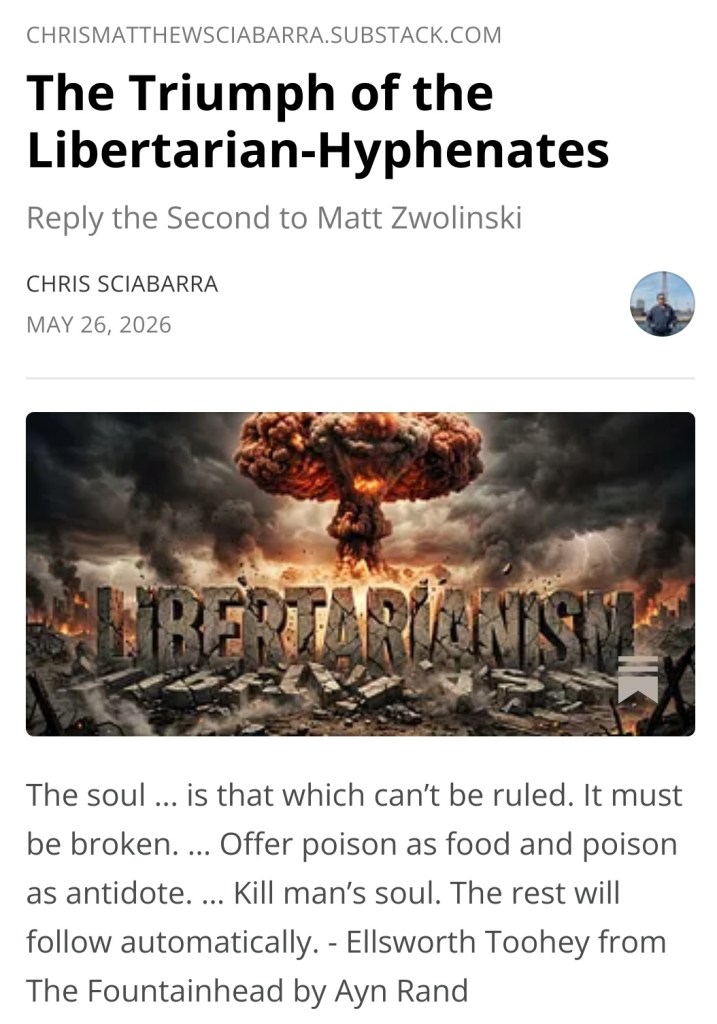
Still, if the soul of libertarianism in all its remarkable, anarchic diversity, can’t be ruled, it can be broken. The struggles within libertarianism are extensions of larger battles taking place across cultural and structural institutions. Elites in positions of power who have subscribed to a libertarian-hyphenate ideology are seeking to legitimize a toxic combination of political and economic means to achieve self-aggrandizing goals. Cloaking these goals in the rhetoric of liberty cultivates profound institutional and existential dangers.
These themes are central to my newest Substack essay, “The Triumph of the Libertarian-Hyphenates: Reply the Second to Matt Zwolinski”.


