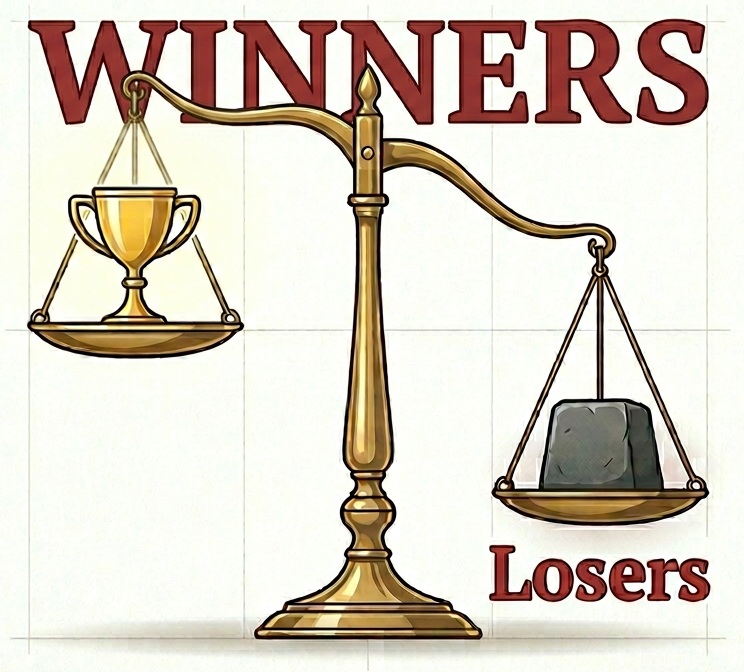
On March 27, 2026, during a Q&A at the Future Investment Initiative (FII) Priority Summit in Miami, Trump was asked: “What is the one leadership trait the world is missing right now? What is missing in leadership?” Trump replied:
Well, it’s Winning! You’ve got to win. You know I’ve watched a lot of people, leaders, great leaders. And you know, the one thing about sports is you break it down into, you know, two-hour period, something nice. You don’t have to wait a lifetime to find out if somebody is a winner or a loser. You got a lot of losers, mostly losers, fortunately. It’s a good thing to have a lot of losers. I always like to hang around with losers actually because it makes me feel better.
That comment elicited a chuckle from some folks in the audience. Trump went further:
I hate guys that are very, very successful and you have to listen to their success stories. I like people that like to listen to my success.
More laughter.
But I find and I found this, and I’m only kidding, I want to say that. Eh, sort of. But, but I find that people that win, it’s much easier to lead when you’re successful and you win.
We’ve gotten so used to Trump’s uncensored, off-the-cuff comments that we tend to dismiss them as unserious. It’s just Trump being Trump.
Those who have tried to penetrate Trump’s psychology have viewed him variously as a narcissist, a solipsist, a comedian, and a huckster. I’ve long maintained that trying to understand this man’s soul is a fool’s errand.
Still, you must ask yourself, what kind of man celebrates “winning” by wishing to surround himself with “losers”? What kind of man believes that every “win” must come at the expense of someone’s loss? What kind of man can’t stand listening to the success stories of others, while preferring that others listen to his stories of success?
A person of genuine self-esteem doesn’t boast about their successes at the expense of others’ losses. Truly confident people who achieve their goals don’t feel the need to diminish others for their alleged failures or the need to corral an audience to “listen” to tall tales of their achievements.
Success depends on a lot of factors, not the least of which is a bit of luck or being at the right place at the right time. But it also demands skill, mental toughness, tenacity, hard work, emotional intelligence, and talent. Indeed, talented people often seek to nourish and draw wisdom from other talented people in building their varied enterprises.
But this way of thinking is anathema to Trump, who has always embraced a binary, dualistic view of the world, where there are winners and losers, where the “art of the deal” takes place in the context of a zero-sum game, whether in trade or in war. In a cutthroat struggle to the top, rules need not be obeyed. The only rule is to win at all costs.
Trump and Machiavelli
This does take talent, no doubt. Trump is correct that successful leaders can be quite effective. But this drops the context of how we measure success. Success is a consequence, not an end goal. And it can pertain to the achievement of a wide variety of disparate values (or disvalues as the case may be). For example, the successful exercise of power, as Niccolò Machiavelli observed, is not inherently tied to virtue or justice; it is to be evaluated by its effectiveness. But effectiveness in an institutional context often demands leaders who are shrewd, adaptable to changing circumstances, and ruthless. Successful leaders need not be constrained by social mores. They must be realistic, willing to lie and deceive in achieving and exercising power.
But deception entails a social relation. For Machiavelli, the leader must “know well how to disguise this characteristic, and to be a great pretender and dissembler; and men are so simple, and so subject to present necessities, that he who seeks to deceive will always find someone who will allow himself to be deceived.” After all, what is a leader without those who wish to be led?
Though it might seem that Trump learned something from Machiavelli, the truth is he has never been a reader. If he had read Machiavelli, however, he might have learned that leaders require competent advisors. In “observing the men he has around him,” Machiavelli argued, the leader will “be considered wise” if he surrounds himself with “capable and faithful” consultants. It is impossible to “form a good opinion” of the leader, if he makes “the prime error … in choosing” poor counsellors. Alas, a cursory look at many of Trump’s cabinet appointments gives credence to his personal desire to surround himself with “losers” — most of them unqualified sycophants who hang on his every word as if they were being handed down from Sinai itself. This makes for poor guidance and, in many cases, incompetent execution of policy. Given the destructiveness of the policies in question, however, some incompetence is to be welcomed.
Machiavelli emphasized that the effective exercise of power requires a leader who is both feared and loved. But “because it is difficult to unite [fear and love] in one person,” Machiavelli wrote, “it is much safer to be feared than loved.”
Though he is loved by millions in the MAGA movement, Trump has developed an array of insidious talents that inspire fear. He’s mastered the arts of deception, manipulation, fearmongering, and scapegoating, even if it means throwing long-time allies under the bus or crushing his perceived enemies. And for Trump, the enemies are legion: immigrants, Democrats, “Republicans-In-Name-Only” (RINOs), the “fake news” media, educational institutions, law firms, unruly corporations, transgender people, and now, apparently, the inhabitants of foreign countries.
In a world where the Supreme Court has granted the executive broad immunity for official acts committed while president, Trump has applied this principle globally. He sees no use for international law. For Trump, the only limit on his exercise of global power is: “My own morality. My own mind. It’s the only thing that can stop me.” Given what we know about his mind and his morality, this is not a very reassuring constraint on which to depend.
Trump and Rand
There is a touch of irony in all this because there was a time when some folks claimed that Trump’s success in business and politics was emblematic of Ayn Rand’s credo of the “alpha male capitalist entrepreneur.” But Rand famously declared that self-esteem could not be built on “one’s power to deceive. The self-confidence of a scientist and the self-confidence of a con man are not interchangeable states, and do not come from the same psychological universe. The success of a man who deals with reality augments his self-confidence. The success of a con man augments his panic.”
And make no mistake about it. Trump has been a conman his whole life. He began his career not as an authentic, uncompromising, creative architect like Howard Roark or an enterprising inventor and industrialist like Hank Rearden. He was a crony capitalist real estate mogul, who benefited from “tax breaks” and government subsidies, the weaponized use of eminent domain, serial bankruptcies, and the stiffing of workers and contractors. It is no surprise that in the 1980s, the U.S. Attorney for the Southern District of New York, Rudy Giuliani, implicated Trump at the center of a “cesspool of corruption” entailing “the buying and selling of public office” in which extravagant real estate deals clobbered New York taxpayers.
Trump’s years in government have been no different. He has used the executive office for personal profit, enriching himself and his brand to the tune of an unprecedented $3.4 billion since his first term. He has extended this branding even to government buildings. Never in American history has a sitting US President’s image appeared on large banners affixed to the exterior facades of government office buildings, but Trump’s pennants have adorned the Department of Agriculture on the National Mall and the Department of Labor. Even as he pines to have his face carved into Mount Rushmore (geological difficulties be damned), Trumpian iconography grows with each passing month. After being elected Chair by a board he appointed to the Kennedy Center, Trump was “honored” and “surprised” that the board unanimously decided to rename the institution: “The Donald J. Trump and The John F. Kennedy Memorial Center for the Performing Arts.” Soon, his signature will be found on all US paper currency, next to the signatures of the Treasurer of the United States and the United States Secretary of the Treasury.
Nevertheless, though he demolished the East Wing of the White House to build a grand ballroom, he insists that he has no plans to name it The President Donald J. Trump Ballroom. How magnanimous of him.
This is the stuff one sees among tin-horn dictators whose delusions of grandeur in authoritarian countries mask their self-doubt and insecurities.
Expanding the Trump Brand
If this is the kind of “winning” that is endemic to the Trump brand, I think we should expand and market that brand exponentially. Let us give title to The Trump War on Trade, The Trump War on Immigrants, The Trump War on Due Process, The Trump War on Birthright Citizenship, The Trump War on Trans People, The Trump War on Drugs. And, of course, The Trump War on Iran — one that has brought 50,000 US troops to the Middle East, crippled the Strait of Hormuz, and threatens to engulf an entire region in massive disruption, destruction, and death.
And let’s not forget the establishment of a Trump Vassal State in Venezuela. Or Trump’s Board of Peace, in which Board member nations can secure a permanent seat at the table by donating $1 billion to a fund controlled by Trump, who has been appointed board chair for life. The Board’s promise to reconstruct Gaza, once the debris and the bodies have been cleared away, might give us Trump’s “Riviera of the Middle East”, replete with a golden idol of himself on the strip and a plethora of Trump casinos that presumably will do better than the ones he bankrupted in Atlantic City.
There are so many other “winning” possibilities that have yet to materialize. Perhaps a Trump War on Cuba. Or the Panama Canal. Or Greenland.
For Trump, however, it’s not all about personal branding, winning, enrichment, and self-glorification. He has become a distinctly American embodiment of “L’État, c’est moi”. He has famously declared, “I am your Warrior. I am your Justice. And for those who have been wronged and betrayed, I am your Retribution.” He has gone so far as to proclaim: “I am the chosen one,” “saved by God to make America great again.” He projects himself as the exemplar of the state, the guardian of its values, its authority, and its white identity culture.
Despite this unholy attempt to unify the personal and the political, Trump has often wondered if he will ever get into Heaven. Perhaps this confession betrays a form of existential panic and dread. But panic and dread are what many of us are now feeling, in the wake of Trump’s reckless actions at home and abroad. He is creating a world of literal losers — as countless people are losing their liberties and lives with each passing day.
—
This essay also appears on Medium (that’s a ‘friend’ link).

 Notablog