This essay also appears on Medium. Scroll down for a rejoinder to various criticisms of this essay.
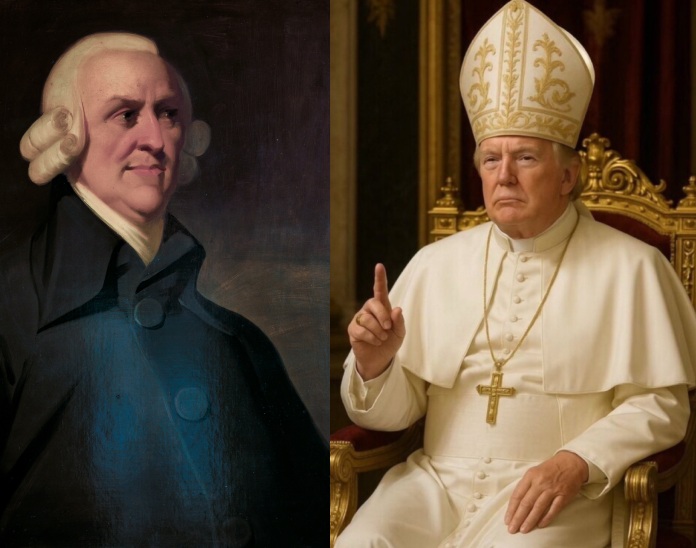
Adam Smith vs. Donald Trump (from Wikipedia Commons and Truth Social, respectively)
The first one hundred days of the Trump presidency have come and gone and nothing I’ve seen has altered my view of the destructiveness of this president, his administration, and the policies being enacted on virtually every issue imaginable — immigration, foreign affairs, education, a crony-led quest for “government efficiency,” and a reactionary turn on social issues. And that doesn’t even begin to address the administration’s war on due process and the rule of law, best exemplified by its pay-off to a foreign tyrant who has imprisoned deported undocumented immigrants in an El Salvadoran gulag.
“Liberation Day”: The Trump Tariffs
And then there’s the issue of Trump’s tariffs, announced officially on “Liberation Day” (for those not in the know, that’s Orwellian doublespeak). Trump’s reckless utterances on this subject have made him like the proverbial bull in a China shop. Economists and policymakers across the ideological spectrum have criticized the president’s policies. Even polls suggest that he’s losing support among those who thought his election would be good for the economy.
It should be noted that libertarians have been among the staunchest opponents of Trump’s tariffs. Even long-time Trump supporter, Senator Rand Paul — whose politics is a tense fusion of conservative and libertarian ideas — has taken the president to task on the issue of tariffs.
But there is still a sizable contingent of libertarians who continue to support Trump, for his promises to cut regulations and lower taxes. It should also be noted that many of these folks lean socially conservative. As part of the “anti-woke right,” as David French characterizes them, “[i]n the contest between a love for liberty and a hatred for the left, hatred won.” But even if this contingent jettisons such “anti-woke” views, how can any libertarian support a president whose tariff policy is a clear rejection of free trade, introducing massive uncertainties into global markets?
In my engagements on social media, I’ve seen such libertarians argue that Trump is playing some kind of 5D-chess game (or is that 7D?) that will ultimately lead to the lowering of tariff barriers across the world. To say that they give Trump the benefit of the doubt is an understatement.
Trump declares: “I know what I’m doing.” Whatever he’s doing, whatever game he is playing, Trump is talking out of both sides of his mouth. With one breath, he believes that the tariff is “the most beautiful word in the dictionary.” This leads us to Position A: that tariffs will increase domestic manufacturing by insulating domestic producers from foreign competition, while punishing other countries for their “unfair” trade practices. Some of these tariffs against perceived enemies such as China have touched off the equivalent of a mutual trade embargo — particularly problematic given the complex economic interrelationships between the two countries. Add to this Trump’s threat of secondary sanctions on China for purchasing Iranian oil and it’s starting to look a bit like the economic embargo of Japan in the lead-up to World War II.
But who cares! Trump argues that tariffs will raise revenue — perhaps $6 trillion over the next decade. Position A is tied to a nationalist conservative industrial policy, in which tariffs are just one aspect of a larger toolkit that allows Trump to protect domestic producers, while subsidizing those economic sectors hurt by his trade policies. That this weaponization of trade relations violates the most elementary principles of economics is beside the point.
But there’s always Position B to fall back on: For Trump, tariffs are not an end in themselves. They are negotiating tools. Toward what end? The Position B narrative goes like this: Trump is using tariffs as a retaliatory measure that will force foreign trade partners to lower their barriers, leading inexorably to free trade across the world. Of course, negotiating is a transactional business, and Trump is a master of “the art of the deal”! He’s already boasting that he’s negotiated 200 trade deals. We have yet to get the details on that astounding claim.
But there’s a problem with Position B. Trump has never advocated for free trade or free markets in his entire crony capitalist life. From his days as a New York and Atlantic City real estate mogul, Trump is famous for using every trick in the business playbook to swindle people. He renovated, built and/or acquired such properties as the Grand Hyatt Hotel (1980), Trump Tower (1980), the Plaza Hotel (1988, which subsequently filed for bankruptcy 2 years later), the Trump Building (1996, of which he’s still, apparently, the landlord), and the 76 acres that constituted the Lincoln Square neighborhood, which, due to his own struggles with debt, were sold off to investors based in Hong Kong in 1997 — the very year that Hong Kong was handed over to the People’s Republic of China. He benefited from the use of eminent domain, government subsidies, bankruptcy laws, and the buying and selling of politicians to such an extent that his political machinations led the U.S. attorney for the Southern district of New York to view him at the center of a “cesspool of corruption.” That attorney’s name was Rudy Giuliani. And as president, Trump has monetized his government position in astounding ways — “the likes of which we’ve never seen before,” as he might say — more than any other modern executive.
The history of his personal business profiteering aside, the more crucial point is that on policy, Trump has been a champion of tariffs going back to the late 1980s, one of the few consistent positions to which he’s adhered for decades. He despised those countries that were “ripping off” the United States. Back then, it was the Japanese whom he targeted for “dumping” their products on U.S. markets. For Trump, however, the only solution is to retaliate with prohibitive tariffs. In his binary, dualistic view of the world, there are winners and losers. Trade is a zero-sum game.
Clearly, then, there’s a problem with holding Position A and Position B simultaneously. Folks who understand Econ 101 know that Position A will not result in the renaissance of American manufacturing or in enormous revenue that will enrich the United States. Plain and simple: It is a tax on consumers that will insulate domestic manufacturers from global markets, while impoverishing vast sectors of the economy that depend on imports for their businesses. No amount of tax subsidies to these disadvantaged businesses will make up for the losses incurred. And as my friend and colleague Nathan Goodman points out, there are even internal tensions within Position A, for “the goal of raising revenue and the goal of protecting domestic industry are to some extent at odds. To the extent that domestic consumers respond to tariffs by substituting from foreign to domestic producers, tariff revenue will fall. To the extent that tariff revenue persists, that’s because Americans are continuing to purchase imported goods.”
But Position B makes no sense either. Even in global markets that are free of barriers, there will always be reasons for American consumers to purchase lower priced goods from abroad rather than higher priced goods produced by domestic manufacturers. Trump claims that tariffs will bolster U.S. domestic producers and enrich the country. So why on earth would he favor rolling back U.S. tariffs when that would put him at odds with his own industrial policy dreams of rebuilding U.S. manufacturing and raising U.S. tax revenue?
Would Adam Smith Have Defended Trump’s Tariffs?
The libertarian apologists for Trump’s tariffs believe that the president is a free trader at heart. They have been circulating a meme that cites Adam Smith’s approval of tariffs as a means of securing the abolition of foreign restraints. In other words, they buy into Position B, that Trump is neither an economic nationalist nor an economic protectionist, and that his ultimate goal is global free trade. They have clutched onto a passage in An Inquiry into the Nature and Causes of the Wealth of Nations, an anti-mercantilist 1776 work that was as significant as that document signed on July 4 in advancing the cause of a genuine Liberation Day — one that Donald Trump will never understand. The passage in question appears in Chapter II of Book IV of Smith’s opus. Smith writes:
The case in which it may sometimes be a matter of deliberation how far it is proper to continue the free importation of certain foreign goods is, when some foreign nation restrains by high duties or prohibitions the importation of some of our manufactures into their country. Revenge in this case naturally dictates retaliation, and that we should impose the like duties and prohibitions upon the importation of some or all of their manufactures into ours. Nations, accordingly, seldom fail to retaliate in this manner. … There may be good policy in retaliations of this kind, when there is a probability that they will procure the repeal of the high duties or prohibitions complained of. The recovery of a great foreign market will generally more than compensate the transitory inconveniency of paying dearer during a short time for some sorts of goods. To judge whether such retaliations are likely to produce such an effect does not, perhaps, belong so much to the science of a legislator, whose deliberations ought to be governed by general principles which are always the same, as to the skill of that insidious and crafty animal, vulgarly called a statesman or politician, whose councils are directed by the momentary fluctuations of affairs.
So, for the apologists, Trump is that “statesman or politician” who will rise above the legislature and retaliate with “skill” for a “short time” in a “transitory” fashion against nations that are imposing “high duties and prohibitions.” Such retaliation will set off a global rollback of tariffs. In the meantime, there’s nothing to fear, except perhaps a rise in the price of dolls. As Trump puts it: “Maybe the children will have 2 dolls instead of 30 dolls, you know, and maybe the 2 dolls will cost a couple of bucks more than they would normally.” That’s rich — coming from a guy who is wealthy enough to buy more than 30 dolls for each of his ten grandchildren.
I’m not the first person to reject the logic of those useful idiots who buy into this dubious narrative (see here, here, here, and here), and I won’t be the last. I’ll give the apologists this much: As a man who thinks he “run[s] the country and the world,” Trump is, indeed, an “insidious and crafty animal.” Confronting the world’s problems, the man once boasted: “Only I can fix it.” Upon the death of Pope Francis, he joked, “I’d like to be pope. That would be my No. 1 choice.” He’s now posted on Truth Social an AI-generated image of himself in papal regalia (see above). And with Gaza devastated by the Israel-Hamas war, he floated the proposal of a U.S. takeover, complete with gold statues of himself on the strip (see below) and a plethora of Trump casinos that presumably will do better than the ones he bankrupted in Atlantic City. As if rewarding the military-industrial complex with a trillion-dollar defense budget wasn’t enough, let’s not forget that Trump will also be hosting a Soviet-style military parade through the streets of Washington, D.C., to mark the army’s 250th anniversary, which just so happens to fall on June 14, the president’s 79th birthday. No plans have been announced on whether the parade will include any golden idols of Trump. Not yet, at least. But I wouldn’t put it past him. There are no limits to this man’s vile arrogance — an aspect of his character that Adam Smith would have found repugnant.
“The highest degree of arrogance,” wrote Smith, is for the statesman “to erect his own judgment into the supreme standard of right and wrong. It is to fancy himself the only wise and worthy man in the commonwealth, and that his fellow-citizens should accommodate themselves to him and not he to them. It is upon this account, that of all political speculators, sovereign princes are by far the most dangerous.”
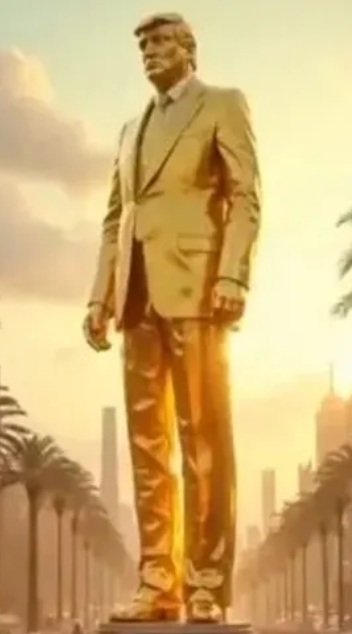
From the AI-generated Truth Social video of “Trump Gaza”
Smith Contra Mercantilism and Monopoly
It’s crucially important to understand the massive context-dropping that lies at the heart of the Trump apologists’ misuse of Smith’s argument. Smith’s advocacy of free trade and the limited use of retaliatory tariffs cannot be separated from his critique of mercantilism, monopoly, and the rule of the tyrannical sovereign, who seeks “to pervert the order of justice.” He cautions:
The statesman who should attempt to direct private people in what manner they ought to employ their capitals would not only load himself with a most unnecessary attention, but assume an authority which could safely be trusted, not only to no single person, but to no council or senate whatever, and which would nowhere be so dangerous as in the hands of a man who had folly and presumption enough to fancy himself fit to exercise it.
Now that sounds a lot more like the current president — a man of “folly,” “fancy,” and presumptuousness, who cannot “safely be trusted” — and whose whiplash tariff policies will most certainly “pervert the order of justice.”
Unlike Trump, Smith embraced the free trade ideal:
To give the monopoly of the home market to the produce of domestic industry, in any particular art or manufacture, is in some measure to direct private people in what manner they ought to employ their capitals, and must, in almost all cases, be either a useless or a hurtful regulation. … If a foreign country can supply us with a commodity cheaper than we ourselves can make it, better buy it of them with some part of the produce of our own industry employed in a way in which we have some advantage.
For Smith, tariffs are an expression of “the wretched spirit of monopoly,” a means of enriching the mercantile class, which is protected from foreign competitors. Yes, Smith carves out a few exceptions for the use of tariffs — in cases pertaining to national security and the need for duties to raise tax revenue, as long as such taxes do not “prevent or diminish importation,” which would be “as destructive of the revenue of the customs as of the freedom of trade.” His view that tariffs can be used as “transitory” retaliations to incentivize the elimination of foreign trade barriers comes with a dire warning, however:
When there is no probability that any such repeal can be procured, it seems a bad method of compensating the injury done to certain classes of our people to do another injury ourselves, not only to those classes, but to almost all the other classes of them. When our neighbours prohibit some manufacture of ours, we generally prohibit, not only the same, for that alone would seldom affect them considerably, but some other manufacture of theirs. This may no doubt give encouragement to some particular class of workmen among ourselves, and by excluding some of their rivals, may enable them to raise their price in the home market. Those workmen, however, who suffered by our neighbours’ prohibition will not be benefited by ours. On the contrary, they and almost all the other classes of our citizens will thereby be obliged to pay dearer than before for certain goods. Every such law, therefore, imposes a real tax upon the whole country, not in favour of that particular class of workmen who were injured by our neighbours’ prohibition, but of some other class.
Smith recognized that when global markets are corrupted by monopolization, the move toward free trade required a certain delicacy, for
the freedom of trade should be restored only by slow gradations, and with a good deal of reserve and circumspection. Were those high duties and prohibitions taken away all at once, cheaper foreign goods of the same kind might be poured so fast into the home market as to deprive all at once many thousands of our people of their ordinary employment and means of subsistence. The disorder which this would occasion might no doubt be very considerable. It would in all probability, however, be much less than is commonly imagined.
Ultimately, Smith argued, “Let the same natural liberty of exercising what species of industry they please, be restored to all his Majesty’s subjects, in the same manner as to soldiers and seamen.” He urged the “break down [of] the exclusive privileges of corporations,” and all such “encroachments upon natural liberty.”
Smith, however, was a realist. He held out no hope that freedom of trade would ever be wholly embraced. True to his Scottish Enlightenment roots, he believed that it was a dream “as absurd as to expect that an Oceana or Utopia should ever be established.” He understood that “the prejudices of the public” would militate against freedom. Even more threatening, however, were the forces of
unconquerable … private interests of many individuals, [who] irresistibly oppose it. Were the officers of the army to oppose with the same zeal and unanimity any reduction in the numbers of forces with which master manufacturers set themselves against every law that is likely to increase the number of their rivals in the home market; were the former to animate their soldiers in the same manner as the latter enflame their workmen to attack with violence and outrage the proposers of any such regulation, to attempt to reduce the army would be as dangerous as it has now become to attempt to diminish in any respect the monopoly which our manufacturers have obtained against us. This monopoly has so much increased the number of some particular tribes of them that, like an overgrown standing army, they have become formidable to the government, and upon many occasions intimidate the legislature. The Member of Parliament who supports every proposal for strengthening this monopoly is sure to acquire not only the reputation of understanding trade, but great popularity and influence with an order of men whose numbers and wealth render them of great importance. If he opposes them, on the contrary, and still more if he has authority enough to be able to thwart them, neither the most acknowledged probity, nor the highest rank, nor the greatest public services can protect him from the most infamous abuse and detraction, from personal insults, nor sometimes from real danger, arising from the insolent outrage of furious and disappointed monopolists.
For Smith, governments acting to protect industries were engaged in a form of class warfare. It’s a theme echoed in the works of Karl Marx and Frederick Engels. In a pamphlet “On the Question of Free Trade,” neither Marx nor Engels was particularly interested in the debate over policies adopted within capitalism, since they sought to overturn it. But like Smith, Engels argued that once a tariff is enacted, “you cannot easily get rid of it,” precisely because “manufacturers [keep] clamoring for protection.” Tariffs are tools of “primary accumulation” that necessarily create
vast interests … And not every one of these interests — the various branches of industry — is equally ready, at a given moment, to face open competition. Some will be lagging behind, while others have no longer need of protective nursing. This difference of position will give rise to the usual lobby-plotting, and is in itself a sure guarantee that the protected industries, if Free Trade is resolved upon, will be let down very easy …
In the expanding global economy, there is no room for autarky. For Engels, no country could be “entirely self-supplying … secluded and isolated from the rest of the world.” In rejecting the “more conservative plan” of protectionism, Engels observed “that the sooner it receives notice to quit, the better for all parties.” It is not without some irony that both Marx and Engels saw “Free Trade as the more progressive plan,” far more “revolutionary” insofar as it hastens the advancement of the capitalist mode of production toward its eventual denouement.
Whether or not one adheres to that Marxist historical projection is irrelevant to the current context. What is relevant is that Trump’s apologists are living in their own Never-Never Land of historical projections that somehow, the president’s “gamesmanship” will usher in a new era of global free trade. That they use the words of Adam Smith to justify the actions of an “insidious and crafty animal,” whose neomercantilist tariff policies are at odds with peace, free trade, and free markets, is a rank obscenity.
Postscript: A Rejoinder to Critics
Some critics of this essay have argued that I did not address the issues of national security, intellectual property theft, and the problems of “comparative advantage” in the context of global competitors, such as China, which are heavily subsidized state capitalist economies.
My article didn’t pretend to explore the internal contradictions generated by the system of global state capitalism. It was an article exploring (1) the internal contradictions inherent in Trump’s tariff policies, which have allegedly been constructed (A) as a way of building a US industrial policy that shores up US manufacturing and builds tax revenue, even as it poses as (B) a “negotiating tool” for the lowering of global tariffs, which, if it were to succeed in doing so, would undermine Position (A). Secondly, the article took to task those libertarians who were relying on Adam Smith’s arguments regarding the use of “retaliatory” tariffs as a means of combating global barriers to trade. Smith’s free-trade views were dialectically connected to a larger critique of mercantilism, monopoly, and the tyranny of sovereign political actors. If I were to develop a book, it would link the arguments presented in my article to a larger critique of the illiberal global system of neomercantilist state capitalism that underlies many of the current problems.
But reciprocal trade barriers, trade embargos, and 125% tariff rates are not likely to resolve these problems, given that goods from China often pour into countries like Mexico to circumvent the barriers, and then, are subsequently trucked into the U.S.. Moreover, the enormous interdependence between the US and China in terms of trade, investment, supply chains, and technology, makes it virtually impossible to disentangle by fiat. Resolving the many problems raised by two countries practicing variants of state capitalism in an entangled global market is outside the scope of the essay I posted, but that doesn’t make the problems any less important. Still, a “hard decoupling” of the US and China is likely to be both impossible and destabilizing.
In citing articles from Reason magazine and the Cato Institute, I have been criticized for using sources that have an inherent confirmation bias. But my article pointed out that “Economists and policymakers across the ideological spectrum have criticized the president’s policies.” Here are a few non-libertarian sources to consult.
The very ‘establishment’ Center for Strategic and International Studies bemoans the illiberal turn in US politics as a means of addressing the problems both within the United States and the problems of US-China relations. Scott Kennedy of CSIS argues: “The Trump administration is in the process of fundamentally changing key characteristics of US foreign policy and domestic governance in a much more illiberal direction.” Kennedy criticizes the Trump administration for its embrace of massive conditional barriers to trade, as well as its open embrace of “territorial expansion as a worthy goal” in the construction of “an illiberal global order. … A shift toward unilateral illiberalism and authoritarian powers offers the false promise of quick solutions for the United States.” On this point, Kennedy doesn’t even address the fact that illiberalism has been on the rise across the globe, from Europe to South America and Asia.
The Council on Foreign Relations, a more ‘globalist’ organization, “underscores the futility of decoupling efforts” between the US and China, given the deep economic ties between the two countries. Yes, there has been a ‘hallowing’ out of US manufacturing, but this is something that has occurred over decades and is a result of broader trends in a world of multinational corporations and global state capitalism. Yes, there are issues of national security, mineral control, and currency manipulation at work, not to mention labor and human rights violations, but tariffs do not solve these problems. If anything, they will harm US consumers, reduce overall trade, and create far more confrontational conditions between the two countries.
Then, we can look at a few outright Marxist analyses of the US-China problems. Daniel Morley argues:
For the US, there is no alternative to Chinese manufactures; they are too cheap and too high in quality. To remove them from the US economy, as Trump is ensuring, would cause unacceptable economic damage long before any renaissance in US manufacturing took hold, if it ever did. … China’s manufacturing expertise, technology, infrastructure, and skilled labour mean that there is simply no alternative supplier for manufactures, whether of finished consumer items like iPhones, or of capital goods and parts. According to Goldman Sachs, for 36 percent of the goods that the US imports from China, China is the dominant supplier, meeting over 70 percent or more of American demand.
Trump’s view that his tariffs will spark US manufacturing, however, is an unlikely outcome because “existing US manufacturing is heavily reliant on Chinese components. Thus, what remains of US manufacturing will suffer enormously because they will either no longer be able to get these vital components at all, or will have to pay vastly more for them, as they will be hit by tariffs. This would make these manufacturers much less competitive and as a result, many US manufacturing jobs could actually be lost— the exact opposite of the aim of these tariffs.” Moreover, “entirely US manufactured items would also be completely uncompetitive on the world stage, so the relatively small scale of US goods exports— a key part of why the US has a large trade deficit with China and other countries— would remain. … China, on the other hand, faces losing its biggest market at a time when it is beset with chronic overproduction.”
Indeed, the Chinese are facing their own problems, Morley argues. Since China “remains part of the same capitalist world market, and it cannot escape the limitations of that,” its heavy investments “in industrial production so as to provide jobs and to outcompete rivals” is reaching an end point, in which “the world becomes flooded with Chinese products, threatening to destroy industries and jobs not just in America, but everywhere. … For these reasons, the Chinese economy is slowing down, jobs are drying up, and its all-important housing and construction sector is in deep crisis. China is also loaded up with debt, because this investment boom has been financed on a capitalist basis, through speculation.”
Another left critic, Doug Henwood, also views tariffs as a highly “regressive consumption tax,” and he cites studies that illustrate the negligible effects of these tariffs in boosting US manufacturing.
Finally, April Holcombe, writing for the Marxist Left Review, is very critical of China and its oppressive state capitalist model and sees the US-China confrontation as “the most dangerous dynamic of twenty-first century capitalism: the drive to war between huge economic and military— indeed, nuclear— powers.” Holcombe’s review of the book, China in Global Capitalism, situates the “state capitalist” and “imperialist” Chinese model in a global context. It exposes “the fragilities in China’s imperialist ascendancy,” in which “projects and investment funds have slowed as Chinese companies face major delays, construction flaws, corruption and debt concerns, and poor planning.” Holcombe is critical of China’s “climate criminality” and its internal oppressive sexual and ethnic policies. The author is just as critical of those “interventionist” policies pursued by both the Trump and Biden administrations that portend “serious preparations being made for war in the long term.”
There are a lot of mitigating factors that are clearly at work, which keep China and the United States at peace. About 15% of China’s exports go to the US; the US is by far China’s largest export market. China depends quite a bit on US trade:
See also this source that visualizes the United States’s top imports from China.
Since the sources I cite show that it would be highly destructive to economically “decouple” China and the US, it can be argued that it is precisely the dependence of each on the other that keeps a ‘cold war’ between them from turning hot. Of course, if China resorts to an open attack on Taiwan … it would be a catastrophic escalation.
The United States has real problems, no doubt, but the offshoring of vast portions of its industrial base is not something that will be resolved with tariffs, in my view. However, that was not the core of my argument here. I made the argument that Trump’s contradictory goals (Position A vs. Position B) cancel each other out and that they will find no support in the works of Adam Smith.

 Notablog