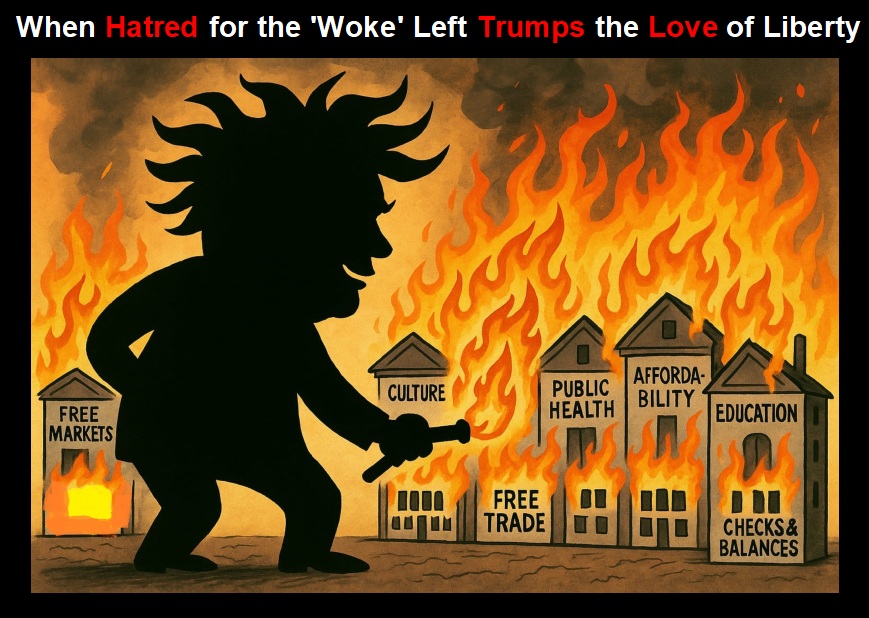
For years now, I’ve been critical of the use of the word ‘woke’ as a mere pejorative to signify anything the reactionary right hates. Indeed, ‘woke’ has become what Ayn Rand once called an “anti-concept,” a grab-bag package deal of disparate, contradictory elements cobbled together with no logical or contextual sense. It is ironic that those who have rejected the pronouncements of the ‘woke’ left have now become champions of their own form of cancel culture, imposed top down through the countless executive orders and intimidation tactics of Donald Trump.
As David French observed: “This is the hole the anti-woke right fell into. … In the contest between a love for liberty and a hatred for the left, hatred won.” When politicians get to decide “where woke goes to die,” the death throes of liberty cannot be far behind.
The thing is, back in the 1930s, as used in black communities, all ‘woke’ meant was to be awakened to and aware of racial prejudice and injustice. Considering the level of institutionalized bigotry at the time and the long history of systemic oppression that blacks suffered, the word ‘woke’ had a clear meaning.
Identity Politics, Left and Right
Over time, however, it became a far more polarizing word, popularized in the identity politics of the progressive left and used to bludgeon the left by right-wing anti-woke crusaders. It’s gotten to the point where ‘woke’ is akin to what Justice Potter Stewart said about hard-core pornography: “I know it when I see it” — which provides no definitional guidelines whatsoever for understanding precisely what it might mean.
We’ve now reached a point where Trump criticizes even the Smithsonian Institution for being ‘woke’, partially because he’s angry that there’s been too much focus on “how bad slavery was.” His virulent attacks on the Smithsonian and other institutions would make the “Marxist maniacs and lunatics” he claims to oppose blush.
Slavery is part of this country’s history. Full stop. Any attempt to “whitewash” the reality of slavery’s impact is an affront to our understanding of the American story. The Smithsonian is a repository of this country’s tapestry, its historic achievements and its painful, complicated past. Scholars, not all of them “radical leftists,” have pushed back against this airbrushing lunacy.
Mind you, it’s not as if the Smithsonian is above criticism. It is made up of more than twenty museums, twenty libraries, educational and research centers, and a national zoo. Five years ago, in the wake of the George Floyd killing, the Smithsonian National Museum of African American History and Culture put up a graphic that identified “whiteness” with “objective, rational linear thinking” and “hard work”. It was roundly criticized, and the graphics were removed almost immediately.
Over the years, plenty of museum exhibits throughout the United States have led to public outcries — whether it was the 1999 “Piss Christ” exhibit at the Brooklyn Museum of Art, which rankled not only Catholics, but then-NYC Mayor Rudy Giuliani, or the Hall of the Age of Man exhibit that ran from 1911 till the mid-1960s, at the American Museum of Natural History, which portrayed evolution as a hierarchical movement toward Nordic racial superiority.
I have no issue with people expressing their outrage over various exhibits or sclerotic cultural tendencies. I too have been critical not only of the reactionary right’s retrogressive cultural views, but also of the stultifying cultural ‘progressivism’ on the left (see here and here). I agree with my friend Ryan Neugebauer, who has observed that many progressives have lost touch with their core economic messaging. They have been more concerned with policing people’s use of proper pronouns within their own homes than with whether they can afford a home in the first place. Though cultural issues appealed to a certain bloc of voters in the run-up to the 2024 election, economics (inflation, affordability, and jobs) and immigration were consistently cited as the most important factors that brought Trump to victory.
Nevertheless, the Trump administration has gone full throttle in the culture wars to exorcise the “woke-mind-virus” from the body politic. It’s a strategy that colors virtually every issue that Trump addresses — from trade and immigration to his battles with cultural, educational, and legal institutions. Indeed, no institution is safe. Not even the Kennedy Center is off limits, as Trump has vowed to keep “wokesters” out. Among the honorees this year are Gloria Gaynor, who has donated to MAGA campaigns, and Sylvester Stallone, who is an avowed Trump supporter. In fact, Trump will host the Kennedy Center Honors on December 7, that historic ‘day of infamy’, after being duly ‘elected’ to serve as its Board Chair. (P.S. — And now the “Kennedy Center” has been renamed by the “board” as the “Donald J. Trump — John F. Kennedy Center for the Performing Arts.”)
Yes, of course, government funding can be problematic. Often, “he who pays the piper calls the tune.” That said, it is not possible, under current conditions, to fully extricate these institutions from public funding or from their 501(c)(3) status, which Trump has threatened to revoke from such universities as Harvard.
It is a tactic that could easily backfire for all schools, including the very conservative and Christian Hillsdale College, whose tax-exempt status could be threatened by some future administration, even though, on principle, it doesn’t receive any government funding at all.
The war on ‘woke’ has been fueled by the mores of White Christian Nationalism, which, over the past half-century, has had a profound impact on voting demographics. Studies have shown that “support for Christian nationalism is the animating force of today’s MAGA-controlled Republican Party,” even though it does not constitute a majority of the electorate. Still, Trump could never have attained the GOP nomination in three consecutive presidential election cycles if he had not courted that constituency. While there are distinctions among voters in this bloc, it has generally been resistant to civil rights and prone to xenophobic exclusionary thinking concerning the nation’s White Anglo-Saxon Protestant “identity.”
Trump didn’t have to refashion himself dramatically to appeal to that constituency’s prejudices. Back in 1973, the Justice Department sued both Donald Trump and his father Fred, whose real estate firm had a history of housing discrimination against blacks. With the help of the infamous Roy Cohn, Trump signed a consent decree in 1975, with no admission of guilt. For decades thereafter, Trump stoked the flames of bigotry; in 1989, he took out full-page newspaper ads calling for the death penalty for the likes of the Central Park Five, whose wrongful conviction for the rape of a white woman jogger was later overturned. In 2011, he became a vocal advocate for ‘birther’ conspiracy theories swirling around Barack Obama. And by 2015, his racist dog whistling accompanied the launch of his first presidential campaign.
Charles A. Kupchan has observed that, in his 2024 campaign, Trump played to the electorate’s worst fears, highlighting the “waves of immigration” that “sparked an angry ethno-nationalism” across the West. But for Kupchan, “Trump is more demolition man than architect,” who “may well bring down the old [order] and simply leave the United States and the rest of the world standing in the rubble.” It’s a demolition strategy that has emboldened “ideological extremes” and what Pierre Lemieux has dubbed “The Political Economy of Cruelty”:
Cruelty will likely increase as political rulers discover that hatred can be used to further their ambitions. Scapegoats, preferably unarmed and defenseless, are useful for a politician to both explain away his failures and enflame his supporters. Propaganda can present hated or to-be-hated minorities as “the worst of the worst” or “animals.” The more the rule of law has been compromised … the more we would expect cruelty to follow hatred.
Targeting Populations: From Transgender to Immigrants
As part of his assault on all things ‘woke’, Trump has unleashed a level of hatred and cruelty against the smallest of minorities, which has also been the target of White Christian nationalist vitriol — transgender individuals, who constitute less than 1% of the population. He has reinstated the ban on transgender troops in the military and has signed an executive order restricting gender-affirming care.
His pettiness extended even to the Stonewall National Monument in New York City, which officially scrubbed the “T” and the “Q” from the “LGBTQ” acronym on its website. Remarkably, in his 2016 presidential campaign, Trump swore to protect “LGBTQ citizens” from harm, in the wake of the mass shootings at the Pulse Nightclub in Orlando, Florida. He enunciated every letter of the acronym in front of the Republican National Convention, congratulating the crowd for cheering his words. At the time, he even rejected North Carolina’s anti-trans bathroom ban.
Unfortunately, Trump has engaged in a little ‘transitioning’ of his own, suffering from some kind of political dysphoria. On the heels of the horrible tragedy in Minneapolis, in which the mass shooter was identified as transgender, the gung-ho Second Amendment Trump Justice Department is now considering a ban on gun ownership by trans people. This will, allegedly, “ensure that mentally ill individuals suffering from gender dysphoria are unable to obtain firearms while they are unstable and unwell.” Given that the Trump administration considers transgender individuals to be unstable and unwell by definition, both the National Rifle Association and the Gun Owners of America have condemned this proposal unconditionally for arbitrarily stripping law-abiding citizens of their constitutional rights without due process.
For what it’s worth, there is no “epidemic” of trans mass shooters in this country. Though statistics vary, a very small percentage of mass shooters has been identified as transgender. If anything, trans individuals are disproportionately at risk for violent victimization.
Trump’s politics of cruelty is not limited to trans people. Perhaps his most sadistic war is being waged against non-white immigrants. That war has taken on a dystopian hue. Even those immigrants who have been in this country for years, working peacefully and productively, are not safe.
Immigrants are damned for entering the United States unlawfully — even though there is a less than one-percent chance of immigrating to this country legally. And if they have entered this country illegally, they are damned for not self-deporting. And if they happen to follow the rules, seeking asylum through immigration court hearings, they can be arrested by ICE agents at the courthouses, detained and deported, sometimes to wretched foreign prisons. Indeed, the Trump administration has paid $6 million to the El Salvadoran government to house hundreds of deported immigrants in its notorious CECOT prison system. Studies suggest that 75% of those deported to CECOT had no domestic or foreign criminal records, and dozens of them had never violated any US immigration law. As ICE funding has reached astonishing levels, part of a “lop-sided enforcement-only … Deportation-Industrial Complex,” an unknown number of American citizens has been snatched off the streets and deported as well.

In addition to the human costs of Trump’s policies, there are the financial costs. It isn’t enough that Trump’s lifelong obsessive admiration for neomercantilist tariffs, designed to “protect” US manufacturers, has punished American consumers. It isn’t enough that Trump’s mercurial tariff policies have disrupted international trade. For his immigration policies are now inflicting serious damage on the US labor market. There has been an estimated decline of over 1.2 million immigrants in the workforce. Immigrants, documented and undocumented, are leaving labor markets due to deportation or threats of deportation, deleteriously affecting farming, fishing, freight, forestry, meatpacking, the auto industry, construction, and the service industries. Trump’s deportation policies have also severely impacted home care, given that immigrants make up nearly a third of the long-term care workforce. This is but another casualty of the administration’s gutting of public health institutions.
In a twist of historic irony, last week’s raids on a South Korean battery maker at a Hyundai plant in Georgia, which led to the arrests of nearly 500 workers and executives, were justified by Homeland Security as illustrative of the Trump administration’s “commitment to protecting jobs for Georgians and Americans, ensuring a level playing field for businesses that comply with the law, safeguarding the integrity of our economy and protecting workers from exploitation.” It’s the kind of rhetoric that channels the reactionary gate-keeping of early twentieth-century organized labor, which viewed the influx of immigrants as a threat to the livelihood of the American worker.
The costs of Trump’s policies also extend to the federal budget. The Department of Government Efficiency (“DOGE”) claims to have saved US taxpayers $205 billion — downsized from its $2 trillion projection. In fact, the “savings” were closer to $1.4 billion. But Trump’s “One Big Beautiful Bill” (now rebranded as the “Working Families Tax Cut Act”) has spared no expense in increasing ICE’s budget to $175 billion over a four-year period, with no oversight or guardrails. As Katherine Culliton-Gonzalez and Lama Elsharif explain, that budget includes $45 billion allocated “to pay private contractors to implement mass detention of immigrants, paving the way for a huge windfall to companies that donated big to support Trump.” With approximately 90% of detained immigrants sitting in proprietary detention facilities — the highest percentage in US history — the system incentivizes the lobbying of politicians by private prison companies who seek patronage and largesse to carry out the administration’s deportation plans.
The ICE taxpayer tab does not include the $200 million allotted by the Department of Homeland Security for Kristi Noem’s relentless ad campain touting the virtues of deportation. Nor does it include expenses covered by the taxpayers of states like Florida, who will allegedly be reimbursed by the federal government. Among the expenses are those entailed in the building of the “Alligator Alcatraz” detention center, which was slated to be shut down but can remain open, according to a federal appeals court. And Governor Ron DeSantis promises to construct other centers, including “Panhandle Pokey” and “Deportation Depot” — such quaint names for facilities embedded in the infrastructure of violence.
Trump’s Identity Project
But make no mistake about it. Trump’s cultural, trade, and immigration policies are not motivated by either economic literacy or political liberty. They are expressions of Trump’s identity project, which stands at the core of his worldview. While his administration’s repudiation of ‘woke’ has been touted as a reaction to the identity politics of the progressive left, it has simultaneously championed Trump’s own brand of identity politics. As Tal Axelrod and Zachary Basu explain:
Through immigration crackdowns and cultural purges, President Trump is wielding government power to enforce a more rigid, exclusionary definition of what it means to be American. … The MAGA movement’s obsession with American identity and Western civilization is shaping federal policy far more than in Trump’s first term — fueling a reckoning over who belongs and what history should be remembered. In MAGA’s telling, America is the heir to ancient European civilizations, built on a Judeo-Christian foundation of white identity, meritocracy, traditional gender roles and the nuclear family. These tenets are cast as universal truths — and mantras such as “America is an idea” or “diversity is our strength” are dismissed as liberal fictions. …
All 55 million current visa holders will face “continuous vetting” for “any indications of hostility toward the citizens, culture, government, institutions, or founding principles of the United States.” … The Justice Department continues to pursue a ban on birthright citizenship for the children of undocumented immigrants — a right enshrined in the 14th Amendment — while prioritizing denaturalization for naturalized citizens who commit certain crimes. …
Trump also has leaned into lower-hanging symbolic fights that reinforce MAGA’s identity project. … He signed an executive order declaring English the official U.S. language — elevating it from a practical tool to a marker of identity and belonging. … He restored Confederate names to U.S. military bases and ordered the return of certain Confederate monuments, condemning their removal as erasures of “heritage.” … He reimposed the ban on transgender troops, aligning service with traditional gender norms. … He carved out exceptions for white South African farmers even as he slashed refugee admissions from elsewhere. … He ordered new federal buildings to adhere to “classical” styles, tying civic identity to Greco-Roman and European tradition. …
MAGA’s utopia looks a lot like America in the 1950s — before the sexual revolution, mass immigration, the Civil Rights Act and expanded LGBTQ rights reshaped the country’s culture and demographics. … The movement has been clear about its ideal image of America for a decade, but it took Trump until his second term to prioritize making that vision a reality.
This kind of identity project is nothing new in American history. In fact, identity politics did not begin on the progressive left. Identity politics began as a force of reaction, in which an entrenched majority used economic and political means to oppress and marginalize the disenfranchised. In Federalist №10, James Madison warned that the most toxic faction of all was one that emerged “by the superior force of an interested and overbearing majority. … When a majority is included in a faction,” it will “sacrifice to its ruling passion or interest both the public good and the rights of other citizens.”
It was the identity politics of the majority that propelled the conquest and slaughter of indigenous peoples, the building of the Southern slave economy, and later, the tyranny of Jim Crow segregation and KKK terrorism. It is the height of irony that Trump wants to count only “citizens” in a newly proposed census, when the constitution once allowed states to count three-fifths of enslaved people, who were not citizens, toward their congressional representation. Even today, segregation manifests on various levels, through highly disparate forms of mortgage discrimination in housing, discriminatory zoning policies, and disparate rates of incarceration, in a country that still has the highest incarceration rate of any independent democracy in the world.
The newest incarnation of reactionary identity politics has embraced the goals of white Christian nationalists, who hope to purify the country by crushing or deporting the “vermin” that infest it. They repudiate the “cruel and dangerous cult” of “wokeism” and the “godless tyranny” of the Left’s promotion of “promiscuity, licentiousness, wickedness, and lack of human self-control,” which sows “chaos” as the “first step to power.” They attack the corrupting influence of “cultural Marxism” and its “long march through the institutions.”
The Welfare-Warfare State
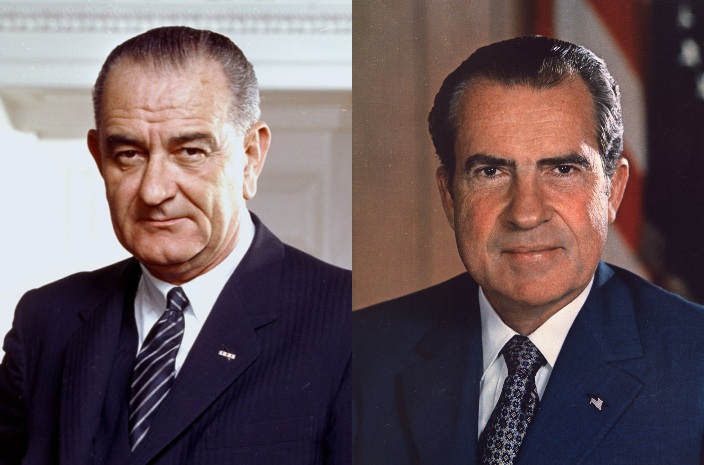
These critics have argued that the country’s downward spiral was exacerbated during the presidency of Lyndon B. Johnson, who greatly expanded the scope of the welfare state. As the publisher of Project 2025, The Heritage Foundation, a driving force in Trump’s war on academia, has long criticized “The Not-So-Great Society” for having undermined traditional values and the family, while promoting greater reliance and dependency on the government.
Paradoxically, however, Trump has openly embraced additional reliance on government to smash “elitist” left-wing cultural institutions and launch mass deportations. Moreover, he seeks to embolden domestic manufacturers through destructive protective tariffs and an aggressive state-led industrial policy of corporate welfare, which both subsidizes favored interests and punishes transgressors at home and abroad. That industrial policy seeks to intensify government “strategic investments,” while furthering the consolidation of government power through the outright extortion and bribery of various corporate actors, from law firms and universities to media outlets.
“Big Government Conservatism” is not an oxymoron. It should be remembered that the welfare state was first instituted by an ultraconservative authoritarian, Otto von Bismarck in Germany, as a way of appeasing the working classes and stunting the growth of socialist parties. These “reforms” were wedded to highly protectionist economic policies and a nationalist “Germanization” agenda.
In the United States, there was a comparable synthesis. The Progressive Era was marked by the rise of the nativist movement and the “new nationalism,” amidst calls for immigration restrictions and alcohol prohibitionism. And while many Progressives opposed high tariffs as tools of big business, the rise of the federal regulatory state offered alternative protection to monopoly capital. It institutionalized the mechanisms of corporate privilege through the state-banking nexus and those alphabet-soup agencies that benefited the very businesses being regulated — whether from their inception or through regulatory capture. In their war on rivalrous competition, corporate actors used the levers of politics to increase their wealth and power. These interventions compounded the effects of the boom-bust cycle and led to the systemic creation of an underclass.
Following the blueprint for state-business consolidation in the “War Collectivism” of the First World War, Franklin Delano Roosevelt’s New Deal furthered the political economy of corporatism, even as it attempted to bring labor unions into the system as junior partners. In the process, FDR also implemented Social Security, unemployment insurance, and public works projects.
Decades later, LBJ’s “Great Society” was designed, ostensibly, to redress many of the inequities that still plagued the system through programs such as Medicare, Medicaid, and Food Stamps. Some on the right have viewed this period as an outgrowth of a power grab by the Democrats (who, in reality, were sharply divided on LBJ’s various legislative initiatives). But like most interventionist policies, many of its constituent elements grew as unintended consequences of the problems created at least partially by previous interventions. It cannot be denied, however, that just as the regulatory state had a stake in the institutionalization of corporate privilege, so too, the welfare bureaucracy had a stake in the regulation of the poor and the institutionalization of poverty.
But the 1960s also saw the growth of the warfare state, which both Democrats and Republicans supported, providing aid and comfort to a growing military-industrial complex that was wreaking havoc throughout the world. While Trump was getting five deferments to avoid the draft during the Vietnam War, black men were disproportionately being conscripted to fight and die in the jungles of Southeast Asia.
And LBJ’s Republican successor, Richard Nixon, further destroyed minority communities with his War on Drugs. Nixon’s own domestic policy chief, John Ehrlichman, admitted that it was a blatant strategy “to go after anti-war protesters and ‘black people’.” By 1973, urban communities were under siege. They were targeted and militarized as 300,000 people were arrested every year under Nixon’s drug prohibitionism, the majority of whom were black.
The Trump administration is now amping-up that war in its use of the military to combat drug cartels. It has already destroyed a “drug vessel operated by a designated narco-terrorist organization” from Venezuela — in international waters, no less. Vice President J. D. Vance may not “give a shit” if this qualifies as a war crime, but such blatantly illegal actions are not going to end either the demand for drugs or the tragedy of substance abuse in the United States. Threatening to strike drug cartels even within Venezuela, the administration can serve other political and economic objectives.
Given this history and the current political climate, Trump’s dramatic cuts to welfare programs can’t go too far without having a deleterious impact on his own populist base. It is not just minorities who are hanging on by a thread during these turbulent economic times. Many MAGA supporters are among the beneficiaries of these programs. Polls suggest that nearly half of Trump voters and their families rely on Medicaid, while those living in Red states will be among the hardest hit by SNAP benefit reductions. Over 40 million people receive SNAP assistance. And over 83 million people depend on Medicaid — including 20 million seniors and people with disabilities. In 2022 alone, Medicaid covered 61% of the $415 billion spent on long-term home-based services in the United States. (In the interests of full disclosure: I’m a beneficiary of Medicare, Medicaid, and SNAP assistance; given my current context, I’d be dead without them.)
Even more telling is that Trump’s trade policies have become one of his “art of the deal” negotiating tools — touted by the White House as the “Trump Effect” — not for the achievement of global free trade, mind you, but for the government benefits bestowed on AI businesses, energy companies and, of course, the military-industrial complex. His higher tariff rates on other countries are sometimes negotiated down (to levels still much higher than before), as long as the targeted countries purchase more US-made munitions, thus benefitting Lockheed Martin, RTX, Northrup Grumman, Boeing, and General Dynamics. In addition, the US government already has high stakes in large computer chip manufacturers, and the administration is considering “taking stakes” in “defense” firms, such as Lockheed-Martin. It wouldn’t be too much of a stretch; all these “defense” contractors are already embedded in Uncle Sam’s back pocket since the vast majority of their revenue derives from government contracts that create the instruments of war, distributed far and wide throughout the world. The only refreshing change is Trump’s executive order renaming the Department of Defense as the Department of War — which is how it was known from 1789 through 1949. It would certainly be a more honest reflection of what that federal agency is all about, given that Trump has increased its annual war-making budget to $1 trillion.
If this is the “Peace President” who is “draining the swamp,” you could have fooled me.
The War on Liberalism: From Gramsci to Trump?
So, if Trump’s policies have not fundamentally changed the essence of the welfare-warfare-corporate state, how is the Trump trajectory likely to head into far more destabilizing territory?
Some writers, such as Matthew McManus, have done fine work in tracing the origins of the reactionary New Right that has shaped this moment. It jettisons the unstable Reaganite fusion of social conservatives, neoconservatives, and free marketeers, while attracting adherents to National Conservatism, White Christian Nationalism, and Post-liberalism, united in their critical challenges to the liberal order. McManus and others have focused worthy attention on the destabilizing threats to liberalism coming from contemporary right-wing Dark Enlightenment and anti–Enlightenment thinking.
My focus here, however, is on how the reactionary right has appropriated strategies from the work of Italian Marxist Antonio Gramsci in its confrontation with the liberal ideals of individual rights, liberty, political equality, free trade, and free markets.
Writing for Socialist Worker, Thomas Foster examines the Trump administration through the lens of Gramsci’s insights from his Prison Notebooks, a series of essays written between 1929 and 1935, during his imprisonment by the Italian Fascists:
There is no shortage of signs of authoritarianism under the Trump administration. … What Trump is doing is a symptom of the US experiencing a wider crisis — a crisis of hegemony. … Italian Marxist Antonio Gramsci used the term hegemony to show how sections of society could direct, lead and control others. A crisis of hegemony, therefore, is a crisis of ruling class authority. … as huge swathes of the Republican party have turned to Trump’s far right politics. …
To shore up its support, a ruling class often constructs some apparent existential threat … Trump does this most intensely with scapegoating against migrants and refugees, establishing a nostalgia for a time when immigration hadn’t supposedly ravaged white-people’s lives. …
[In] a crisis of hegemony, … a hasty collapse of the existing order does not necessarily follow. There is often an intermediary stage, where a ruling class grasps for a new consensus of how to govern. As Gramsci writes … “The crisis consists precisely in the fact that the old is dying and the new cannot be born, in this interregnum a great variety of morbid symptoms appear.” …
There are certainly a great deal of “morbid symptoms” within the Trump administration. … [As] “the charismatic leader”, … Trump [uses] more authoritarian and fascist tactics to fill the vacuum left open by the failure of mainstream politics. Within this dangerous trajectory, a turn to fascism, while not inevitable, is a possibility.
And yet, just as Foster uses Gramsci to explain this period, the reactionary right has hijacked Gramsci’s strategic views to advance its own political and cultural agenda. As Nathan Sperber and George Hoare explain:
In a 1991 essay titled “Winning the Culture War: The American Cause,” radical conservative thinker Sam Francis summoned up the ghost of the late Italian communist Antonio Gramsci in order to offer the American far right a strategic path forward. Railing against the US establishment for doing “nothing to conserve what most of us regard as our traditional way of life,” Francis called for nothing less than “the overthrow of the dominant authorities that threaten our culture.” But as for the political methods required to enact such an overthrow, he admitted that “we will find little in conservative theory to instruct us in the strategy and tactics of challenging dominant authorities.”
Instead, he argued, his camp had to “look to the left” and, specifically, to the ideas of Gramsci on “cultural power” and “counterhegemony.” Gramsci, he wrote, had stressed the necessity of constructing “a countervailing cultural establishment” that would be “independent of the dominant cultural apparatus” and be “able to generate its own system of beliefs.” Francis ominously concluded: “The strategy by which this new American revolution can take place may well come from what was cooked up in the brain of a dying communist theoretician in a Fascist jail cell 60 years ago.”
The authors also highlight the work of pro-Trump activist Christopher F. Rufo, whose 2023 book, America’s Cultural Revolution: How the Radical Left Conquered Everything, draws on Gramsci in crafting tactics to “achieve cultural hegemony over the bureaucracy” and to reshape “the structures of American society.”
Right Gramscianism frames itself as a defensive project, aggrandizing the power of its left opponents in order to adopt a posture of rightful resistance against the annihilation of its values. … Beyond the elaboration of its own doctrines, Right Gramscianism has sought to shape the broader ideological and cultural landscape, particularly through social media.
The authors point out, however, that the reactionary right has reduced Gramsci’s message
to a mere “battle of ideas” or “culture war” — as if narrative contestation alone could transform a social order. … Gramsci understood that politics and culture are closely intertwined and shape each other, rather than politics simply being “downstream” of culture. For him, the war of position was not just about exerting influence on the media, education, science, religion, high culture, and the arts — important as these institutions of “civil society” are. Crucially, it also meant constructing and steering mass organizations capable of sustaining political mobilization of the working class.
Key to this mobilization is Gramsci’s notion of the “historic bloc,” as Alfonso Gonzales Toribio has stressed. This idea helps
to explain the unification of a constellation of groups with opposing interests into an apparently seamless front. Such a bloc … blurs the lines between the state and society and functions to repress dissent in moments of crisis … These blocs congeal by demonizing their enemies foreign and domestic, declare states of emergency and criminalize legitimate social protest in the name of national unity. They can unleash a viciousness among the state security forces and among armed citizens. Such blocs don’t have to be based on truth, facts or coherent arguments.
Never rational, such authoritarian movements are based on pure emotion and a sort of identity politics of the right, using common-sense ideas about how the world works among the working class to draw them from the left. The bloc depends on an intense identification with a strong-man leader, the romanticizing of violence for resolving conflicts and a selective reading of history and national culture that appeals to groups that find protection by joining the bloc even if in a subordinate position.
Jerry Harris argues that Trump has given expression to the reactionary right’s project of “counter-hegemony,” which seeks to offset the Left’s ‘monopolization’ of
the press, the universities, civil society, and most government institutions. To counter that, they have built their own media and think tanks, cultivated an institutional base in Christian churches, and developed a narrative focused on attacking abortion rights, LGBTQ+ rights, immigrants, and the civil rights advances since the 1960s. … The movement behind Trump is a coalition of reactionary and conservative forces. … This movement desires to coalesce as a long-term ruling hegemonic bloc, turning the US into an authoritarian Christian country, [to] end bourgeois democracy, and severely curtail civil society.
But the reactionary right appropriation of Gramsci doesn’t fully grasp his bottom-up vision of cultural transformation that would ultimately inspire radical political and social change. For Gramsci, that change could only occur “through the transformation of general ideas … a slow remolding of minds.” Ironically, this is a vision that even Ayn Rand proposed in her criticisms of those libertarians who focused exclusively on the structural dimensions of politics and economics, disconnected from the personal and cultural prerequisites necessary to the achievement of human freedom and personal flourishing. For Rand, as for Gramsci, a shift in the dominant culture is necessary to spark and sustain genuinely radical changes among social relations across all dimensions.
By contrast, the reactionary right is engaged in a top-down attempt to refashion American cultural, educational, and legal institutions. This top-down strategy led Fortune magazine to ask: “Is MAGA going Marxist and Maoist?” After all, it doesn’t take a rocket scientist to see that the administration is staging an all-out assault on free markets and free trade:
Unlike any leader of any free-market economy around the world, President Trump has seized control of private enterprise’s strategic decision-making and investment policies while invading corporate board rooms so that he may dictate leadership staffing, punish corporate critics, and demand public compliance with his political agenda. This is far more dangerous to capitalism than a city-run grocery store.
Many free-market economists and business leaders who have long worshipped the free-market ideals of Adam Smith, Friedrich Hayek, Ayn Rand, and Milton Friedman should be aware that their idols would be rolling in their graves right now, as rather than pursue standard laissez-faire conservative economic policies, MAGA has gone Marxist and even, increasingly, Maoist.
Zachary Basu of Axios argues similarly that
Trump is breaking sharply from free-market orthodoxy in his second term, blending bursts of anti-capitalism with a top-down, nationalist agenda for American dominance. Critics on the left and right warn of an emerging “MAGA Maoism” — a movement that demands ideological purity, glorifies economic sacrifice, and embraces state power as a means to reshape society.
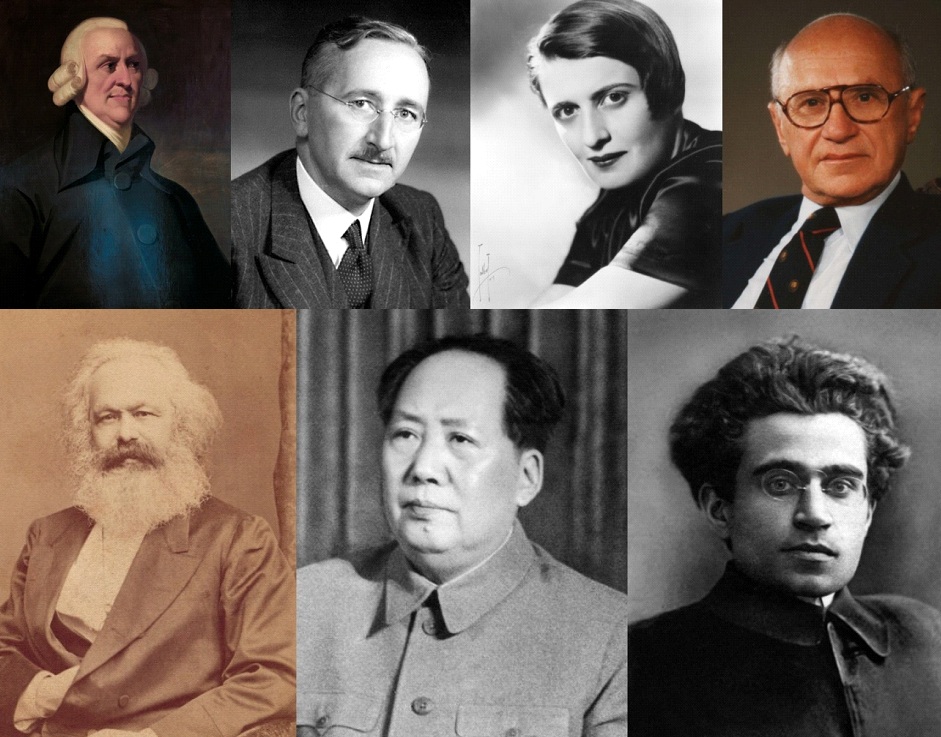
Bottom, left to right: Karl Marx, Mao Zedong, and Antonio Gramsci
The Warning Signs Grow
As provocative as many of these insights are, I do not believe that Trump and his MAGA minions are Marxists, Maoists or Gramscians. But they are, indeed, trying to affect social change through top-down executive edicts, with the full cooperation of a Republican-controlled Congress and a Trump-friendly Supreme Court. While we have not yet seen a full-fledged MAGA ‘Maoist’-like cultural revolution, in which the military is used to purge the country of its perceived enemies, alarming signs continue to grow.
Trump’s “strong man” overreach entails the invocation of “emergency” decrees. He has already declared nearly a dozen emergencies on which he has engaged police, military, and other resources. As Adam Kushner puts it:
Trump can deport immigrants without due process, he says, because it’s an emergency to fight a Venezuelan gang’s invasion. He can dispatch federal troops to L.A. and D.C. because it’s an emergency to quell protests and fight crime. He can ask the Supreme Court for emergency rulings because we can’t afford to wait for judges to debate his policies.
Even when Trump doesn’t declare a legal emergency, he describes crises that justify dramatic action … Even if the courts constrain Trump’s legal declarations of emergency, the spirit of emergency seems to inflect everything that the White House does. … The climate of emergency can be used to rationalize virtually any action.
Unfortunately, the slow, grinding process of judicial review has typically allowed the administration to continue on its merry way even when decisions go against Trump’s “emergency” policies. But court decisions can’t fully reverse the damage that has already been done. For example, the most recent court rulings against some of Trump’s tariffs do not affect “sector-specific” tariffs, which would be safe even if the Supreme Court upholds the appellate decision. At the same time, the courts have been inundated with cases challenging Trump’s use of wartime statutes during peacetime to quell urban “rebellions” or to bolster the deportation of “alien enemies.” The whole purpose of Trump’s strategy of “flooding the zone” with countless policy directives is that it becomes virtually impossible to launch any coordinated response against them.
Moreover, Trump’s war on ‘woke’ has been systematized, a warped kind of ‘Denazification’ program designed to rid cultural and educational institutions of the dreaded vices of diversity, equity, and inclusivity. And, as Kushner notes, while deportations without due process are being carried out by ICE agents, Marines and National Guard units are being foisted on “Blue” cities to “fight crime”. Boston and Chicago are next on Trump’s Urban Hit List.
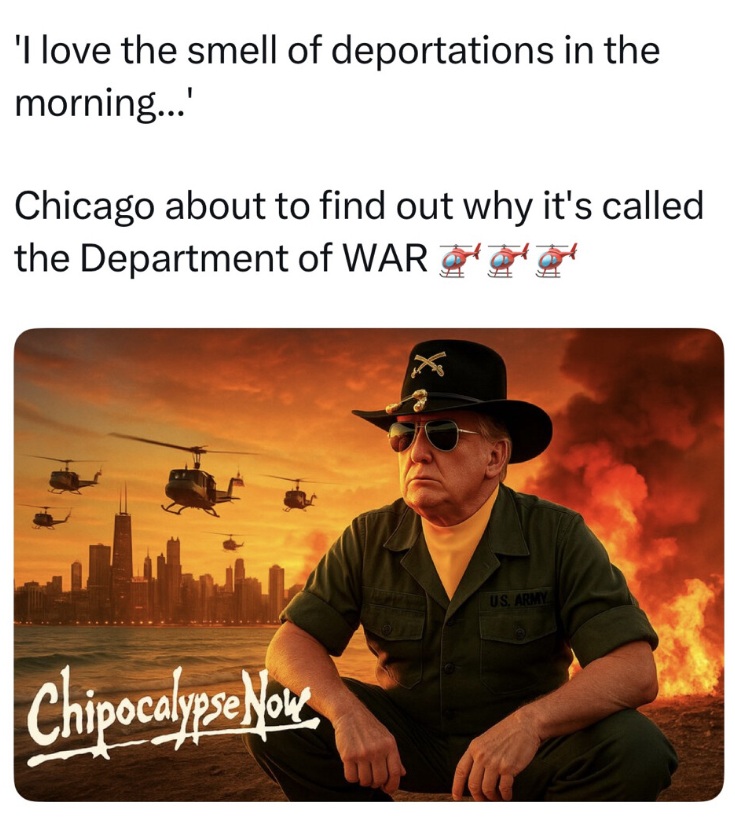
Whereas traditional conservatives emphasized the importance of federalism, decentralization, and states’ rights, the reactionary right will have none of it. In direct opposition to the Posse Comitatas Act, which forbids the military from engaging in civilian law enforcement, the administration is aiming to escalate the militarization of America’s police forces to combat a “manufactured crisis” — a prelude to authoritarianism, as Radley Balko has warned. Balko even wonders if “due process itself is woke now.”
The reactionary right applauds it all, because their hatred and fear of perceived enemies at home and abroad has trumped the liberty they claim to defend.
In this political battle, Trump has always understood the crucial importance of symbolism in communicating not only his identity project but his personal identity. His insistence on resurrecting the fallen statues of the Confederacy is nothing compared to the iconic image of his defiant, clenched fist raised in the aftermath of a July 2024 assassination attempt. Despite the right’s criticisms of the progressive left’s obsession with competitive grievance and weaponized victimhood, Trump himself has learned to play the ‘victim card’ to his full advantage. He has stoked victimhood as a symbol of his ability to overcome adversity in both business and politics.
And yet, in the newly militarized Washington D.C., a different kind of symbol recently emerged. Never in the history of the United States has a sitting President’s image on large banners been affixed to the exterior facades of government office buildings. Until now. Trump pennants have taken a prominent place at the Department of Agriculture on the National Mall (left, below) and the Department of Labor (right, below). This is quite apart from the growing number of portraits of himself that Trump has installed within the White House.

The symbolism here goes a bit deeper. In the first pairing, Trump’s banner sits alongside that of Abraham Lincoln, who, as the first Republican President was not just the “Great Emancipator”. He also embraced high protectionist tariffs, which were part of the Grand Old Party’s creed from its founding in the nineteenth century through the Great Depression. In his passion for tariffs, Trump harks back to a more authentically original Republican vision than that offered by Ronald Reagan. Lincoln also suspended the writ of habeas corpus during the Civil War — something that White House Deputy Chief of Staff Stephen Miller is “actively looking at” to transform the administration’s handling of immigrants facing deportation. Perhaps like Lincoln, Trump could suspend habeas corpus, and get Congressional approval retroactively. Then again, Trump’s own Homeland Security Secretary Kristi Noem didn’t actually know what the writ of habeas corpus was. Before a Congressional hearing, she defined it as “a constitutional right that the president has to be able to remove people from this country and suspend their rights.” Nice, huh?
In the second pairing, Trump’s banner appears with that of Theodore Roosevelt. Both banners made their debut in late August before the Labor Day weekend, and contain the phrase: “American Workers First.” Roosevelt’s “New Nationalism” sought a more active role for the federal government in the regulation of business and an expansion of US “spheres of influence”, which promoted US imperialism abroad.
It is no coincidence that, along with George Washington and Thomas Jefferson, the sclupted images of both Lincoln and Roosevelt appear on Mount Rushmore. And, geological difficulties be damned, it is no secret that Trump would like his face carved into that national monument. There’s even a Congressional bill (H.R.792) that was introduced by Florida Representative Anna Paulina Luna, directing the Secretary of the Interior to arrange for the Trump addition. Trump has been pining for this monumental tribute since 2020 and tweeted an AI-generated image just last week, with “Hold On I’m Comin’” by Sam & Dave as the musical backdrop.
Mounting Rushmore aside, I must admit that when I saw these colossal banners of the Queens-born Trump hanging over the facades of those government buildings, I yelled out loud, with typical Brooklyn flair: “Make America Great Again? Where the fuck are we?”
I cannot imagine the reactions of Old Right or Goldwater conservatives if FDR or LBJ had the coglioni to do such a thing. It’s the kind of authoritarian iconography used by dictators in other countries to project personal power and self-glorification.
Some have dismissed these parallels by suggesting that this is just Trump being Trump, whether they view him as a narcissist or a solipsist, a comedian, huckster, or conman.
Alas, trying to understand this man’s soul is a fool’s errand, for even Trump wonders if he’ll ever get into Heaven.
On one level, Trump is using the presidency for personal profit, which is now estimated at an unprecedented $3.4 billion since his first term — another manifestation of his crony capitalist career. Moreover, Trump has always been obsessed with his personal branding, which extends even to his gaudy White House aesthetics, adorned by the kind of “gold” that some critics have characterized as representative of “the traditional Cadbury bunny style.”
But on another level, Trump is aiming at something much wider than self-enrichment. When Trump famously declared, “I am your Warrior. I am your Justice. And for those who have been wronged and betrayed, I am your Retribution,” it became a quasi-Biblical pronouncement. He has also proclaimed, “I am the chosen one.” Having faced countless lawsuits, two impeachments, and two assassination attempts, he swears: “I was saved by God to make America great again.” Whether this is rhetorical showmanship or personal conviction, there is no doubt that Trump views himself as the man who will deliver punishment to those who have sought to destroy him, and more broadly, toward all those whom he believes are destroying this country.
There is no inherent conflict between these two goals, especially if one collapses the distinction between the personal and the political. It’s about as close to “L’état, c’est moi” that this country has ever come. It also makes for a very powerful conjunction that moves far beyond the problematics of a charismatic or cult leader.
Next year, Trump aims to preside over the 250th anniversary of this country’s founding. Whatever the profound flaws of the founders, their Declaration of Independence recognized that all men are created equal, endowed with those unalienable rights to life, liberty, and the pursuit of happiness. Though that message may have been diluted by the continued presence of slavery and privilege, the ideals have been central to the liberal project. For those of us who still share a love of liberty, who continue to stand by the principle that all people have rights, not just those of a certain race, creed, sexuality, gender, nationality or citizenship status, that document remains a revolutionary clarion call for human emancipation.
Trump would have us believe that the United States cannot survive the hated “enemy from within,” those of the ‘woke’ left and the “criminal illegal aliens” who have been “poisoning the blood of our country” — despite the fact that this country has displayed remarkable resilience for nearly two-and-a-half centuries. It has survived a Civil War, a Great Depression, two devastating World Wars, a Cold War, the post-9/11 “War on Terror,” and many constitutional crises.
It will survive the Trump presidency.
But at what cost to its politics, its culture, and its founding ideals?
This essay also appears on Medium (see also here). It is also mentioned in a Substack post, “Summer Writings.“

 Notablog