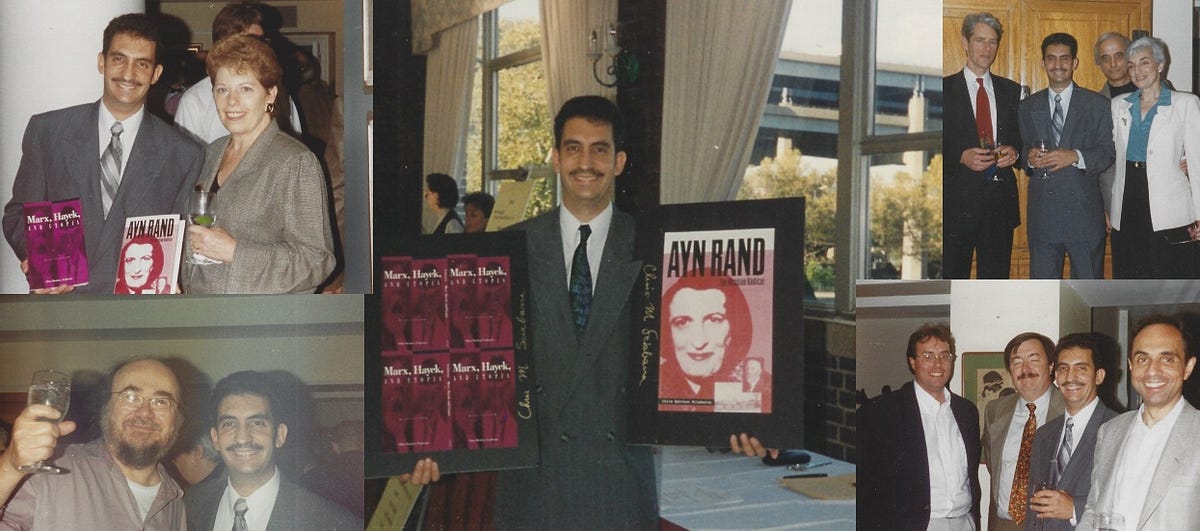
From 1995, Top left: Book party, sponsored by Andrea Rich at her home in Greenwich Village; Top right: at the Rich residence, David Kelley, me, Louis Torres, Michelle Kamhi; Bottom right: at the Rich residence, Peter Boettke, Douglas Rasmussen, me, Mario Rizzo; Bottom left: at the Rich residence, Bertell Ollman and me; Center: at the Fort Hamilton Officer’s Club, Book Party
This essay also appears on Medium. It has also been uploaded to Academia.edu and ResearchGate.
Over the last several years, a debate has been raging about the nature of libertarianism. Much of it has been sparked by omnipresent themes in the culture wars, pitting those who uphold socially conservative values against those who adopt a wider, liberatory message. But there is also a fundamental divide between those who argue that libertarianism is essentially — and only — an anti-state ideology versus those who argue that libertarianism, as a child of liberalism, is, at its core, a social theory that embraces the twin values of human freedom and personal flourishing.
For four decades, I have argued that any commitment to human freedom and personal flourishing requires a broader investigation of the contexts that nourish — or hinder — their achievement. Freedom and flourishing cannot be sustained in the absence of a certain constellation of cultural values. A robust libertarian project is one that must embrace methods of social inquiry that explore the interrelationships among personal, cultural, and structural (political-economic) factors. This is a fundamental requirement of any analysis, especially today, as we seek to comprehend the rising tide of illiberal, authoritarian tendencies across the globe. A genuinely radical approach that begins with the interconnected causes and effects of given conditions is a prerequisite to the consideration of any alternative.
These are the fundamental guiding principles of a dialectical libertarianism.
This year marks the thirtieth anniversary of the publication of Marx, Hayek, and Utopia and Ayn Rand: The Russian Radical — the first two books of my “Dialectics and Liberty Trilogy.” Indeed, it was thirty years ago this week that I received advance copies of both books. This year also marks the twenty-fifth anniversary of the publication of the trilogy’s finale: Total Freedom: Toward a Dialectical Libertarianism.
So, while I’m in a celebratory mood, I’m also of the conviction that this anniversary speaks not to a past achievement but to the present moment — and to the future of any movement dedicated to the creation and sustenance of a free society. I’m marking these anniversaries by summarizing each of these books and reflecting on their contributions to the scholarly literature. I also consider their implications — and what I might have done differently, if the books were published today.
Beginnings
As a student at New York University from September 1977 through May 1988, in the course of completing my undergraduate, graduate, and doctoral degrees, I had the privilege of studying and interacting regularly with key figures in the traditions of both Austrian economics and Marxian social theory. Among the former were such scholars as Israel Kirzner, Mario Rizzo, Gerald O’Driscoll, and Roger Garrison; among the latter were theorists in economics (James Becker), sociology (Wolf Heydebrand), and political philosophy (my doctoral dissertation adviser, Bertell Ollman).
What I learned at the time was that both traditions had utilized elements of a dialectical methodology, rooted in ancient Greek philosophy and first articulated as a theoretical approach in the works of Aristotle. Dialectics is the art of context-keeping. Dialectics asks us to understand any event, issue, or problem from different “points of view,” elucidating its interrelationships with other events, issues, or problems — all embedded in a larger system that develops over time. Understanding the wider context of a problem by comprehending it from different vantage points and on different levels of generality makes transparent the relationships among diverse problems as both preconditions and effects of the system they jointly constitute.
While I would never claim to be the first “dialectical libertarian” — precisely because I have argued that a dialectical sensibility has informed the writings of many significant thinkers in the classical liberal and libertarian traditions throughout intellectual history — I was the first writer to identify explicitly these dialectical tendencies in those traditions. To my knowledge, I am the first person to coin the phrase “dialectical libertarianism.” As such, dialectical libertarianism is an approach to social theory that entails the use of the dialectical method in exploring the contexts necessary to the achievement and sustenance of human freedom and personal flourishing — as well as those contexts that undermine them.
My usage of this phrase was met with resistance by writers on both the socialist left and the libertarian right. There were socialist critics who viewed Marxism as having a monopoly on — or a virtual identity with — dialectical method, and who dismissed my claims on the face of it. And there were classical liberal and libertarian critics who were aghast to see anybody connect a liberal politics to a method that they decried as “Marxist,” and hence as anathema to the project for liberty. In a sense, critics on both the socialist left and the libertarian right accepted the false premise that dialectics was an exclusively Marxist “construct.” The mere mention of the word “dialectics” conjured up images of the “thesis-antithesis-synthesis” waltz typically associated with Hegel (even though that triad more appropriately belonged to Fichte) or the historical materialist dismissal of logic as a “bourgeois” prejudice. Indeed, some Marxists have argued that dialectics “transcended” logic, becoming a means of “resolving” actual logical (and hence, ontological) contradictions, thus showing that “A” and “non-A” were one and the same. (They seemed to have forgotten that even the law of noncontradiction contains a contextual proviso: a thing cannot be A and non-A at the same time and in the same respect. On this, see Sciabarra 2024.)
The Need for a Dialectical Turn
To be criticized by those on both sides of the divide suggested to me that I had struck a nerve. It only reinforced my belief in the need for a dialectical turn in libertarian thinking.
Karl Marx had derided bourgeois theorists for putting forth a dogmatic, ahistorical, atomistic notion of human liberty that saw individuals as entirely separate from one another. The individual depicted in the Robinson Crusoe narrative of the bourgeois theorists is unrelated to other individuals and to any social or historical context. Marx’s opponents in mainstream neoclassical economics largely failed to challenge this critique. Even worse, their own static conceptions of perfect competition posited a rationalistic model of Economic Man in possession of perfect knowledge, a model that illustrated the very “Robinsonade” narrative that Marx rejected.
It took a major effort by twentieth-century thinkers — such as Friedrich Hayek and his teacher, Ludwig von Mises — to provide a thorough reconceptualization of the market society and its foundations. As members of the Austrian tradition founded by Carl Menger, these thinkers viewed the market in dynamic, institutional, historical, and contextual terms. And others in the libertarian intellectual tradition — Ayn Rand, for example — posited a vision of “capitalism: the unknown ideal,” which refused to disconnect the defense of freedom from the identification of the larger context that made freedom and personal flourishing possible.
And so, it became the self-conscious goal of my Dialectics and Liberty Trilogy to recapture dialectics by challenging its exclusive connection to the left and by reclaiming its rightful place as a handmaiden of logic and an essential methodological tool that might help us to understand the various forces that nourish — or undermine — the achievement of a free society.
Though some of my early essays focused on “the crisis of libertarian dualism” — the problems that were inherent in nondialectical, atomistic, utopian approaches to the defense of liberty — it wasn’t until the completion of my 1988 doctoral dissertation, “Toward a Radical Critique of Utopianism: Dialectics and Dualism in the Works of Friedrich Hayek, Murray Rothbard, and Karl Marx,” that my intellectual project was fully outlined. It is somewhat ironic that these studies were nurtured under the mentorship of Marxist theorist Bertell Ollman. Ollman had developed a deep appreciation for the work of many libertarian thinkers. He was a Volker Fellow who studied with and worked for Hayek at the University of Chicago in 1959–1960 and he interacted with such libertarians as Rothbard and Leonard Liggio in the Peace and Freedom Party throughout the 1960s in opposition to the draft and the war in Vietnam. And while few libertarians embraced the direction of my work, some thinkers, such as Don Lavoie and Douglas Rasmussen, who exhibited dialectical themes in their own work, provided me with enthusiastic support. Ultimately, the reframing of a libertarian social theory as a dialectical project became one of the primary goals of my lifelong intellectual journey.
Marx, Hayek, and Utopia
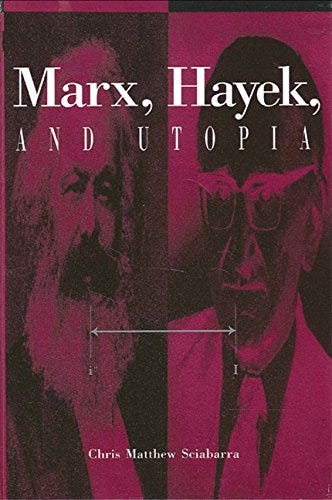
The first book in my trilogy was Marx, Hayek, and Utopia, which was published in 1995 by the State University of New York Press. It had been slated for publication in 1989 by a West German press, Philosophia Verlag, but they were going through hard times, and the book’s publication was long delayed. Perhaps there is some symbolism in the fact of its delay — since there is no longer an East and West Germany to talk about!
The book built upon the Marx and Hayek portions of my dissertation and explored provocative parallels between the theoretician of “scientific socialism” and the Austrian “free market” Nobel laureate, highlighting their surprisingly convergent critiques of utopianism and their mutual appreciation of context in defining the meaning of political radicalism.
In his emphasis on process and spontaneous order, Hayek enunciated a profoundly dialectical critique of utopianism. He rejected both organic collectivist and atomistic individualist conceptions of the human being. For Hayek, since no human being can know everything there is to know about society, people cannot simply redesign it anew. Human beings are as much the creatures of their contexts as they are their creators. His critique of utopian social planning is, at root, a rejection of what he calls “constructivist” rationalism. Hayek argued that utopians rely on a “pretense of knowledge” in their attempts to construct a bridge from the current society to an ideal future one.
Marx too was critical of this constructivism in the works of the utopian socialists. But his own work succumbs to the same constructivist impulse. Implicit in his communist ideal is the presumption that human beings can achieve God-like control over society, as if from an Archimedean standpoint, virtually eliminating unintended social consequences such that every action brings about a known effect. Hayek saw this ahistorical, exaggerated sense of human possibility as a “synoptic delusion,” an illusory belief that one can live in a world in which every action produces consistent and predictable outcomes. And, invariably, in the real world, the quest for total knowledge disintegrates into totalitarian control.
Whatever problems there are in Hayek’s various theories of social evolution (and I discuss these in Marx, Hayek, and Utopia), I believe that he contributes much to a dialectical libertarian approach. In his seminal work on the corrosive nature of government control, The Road to Serfdom, for example, Hayek does not focus on the one-dimensional economic effects of state regulation. Rather, he explores the insidious, multidimensional effects of statism — how its consequences redound throughout a nexus of social relations: economic, political, and even social-psychological. For Hayek, “the most important change which extensive government control produces is a psychological change, an alteration in the character of the people.” The system both depends on and requires a form of social-psychological corruption. The political-economic and social-psychological are preconditions of one another, part of a system of mutually reinforcing processes. Hayek emphasizes: “The important point is that the political ideals of a people and its attitude toward authority are as much the effect as the cause of the political institutions under which it lives” ([1944] 1994, xxxix). He writes:
Freedom to order our own conduct in the sphere where material circumstances force a choice upon us, and responsibility for the arrangement of our own life according to our own conscience, is the air in which alone moral sense grows and in which moral values are daily re-created in the free decisions of the individual. Responsibility, not to a superior, but to one’s conscience, . . . the necessity to decide which of the things one values . . . and to bear the consequences of one’s own decision, are the very essence of any morals which deserve the name. That in this sphere of individual conduct the effect of collectivism has been almost entirely destructive is both inevitable and undeniable. A movement whose main promise is the relief from responsibility cannot but be antimoral in its effect, however lofty the ideals to which it owes its birth. (231–32)
Hayek understood that under advancing statism, culture tends to both promote and reflect those social practices that undermine individual self-responsibility. Likewise, a free society is one in which the culture tends to promote and reflect those social practices that require self-responsibility. For Hayek, political change is built on a slow and gradual change in cultural mores, traditions, and habits, which are often tacit; trying to impose such change from the top down, without the requisite cultural foundations, is doomed to fail. Moreover, Hayek argued, those cultural foundations are reflective of the historically specific circumstances of a particular time and place. Despite having often been derided as a reactionary, Hayek embraced the essence of a radical, rather than a utopian, approach. Hayek (1960) famously declared he was not a conservative, even as he took up the mantle of radicalism: “[W]e are bound all the time to question fundamentals,” he said; “it must be our privilege to be radical” (Hayek [1967] 1980, 130).
Marx, Hayek, and Utopia challenged the conventional opposition between polarizing figures. It illustrated Marx’s and Hayek’s like-minded critiques of utopian theorizing and used a dialectical methodological barometer by which to measure their commonality.
Ayn Rand: The Russian Radical
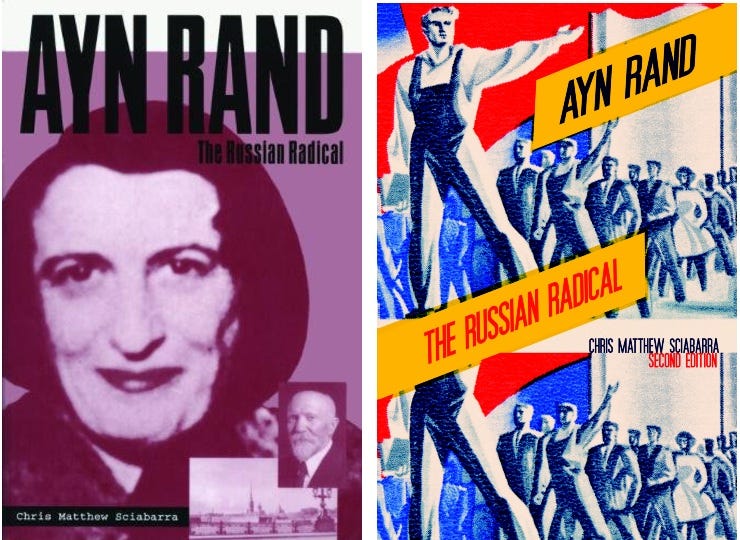
The next book of my trilogy focused on Ayn Rand’s historical lineage, reconstructing her thought and its contributions to the dialectical libertarian turn. Ayn Rand: The Russian Radical was published by Pennsylvania State University Press in 1995. After seven printings, a second expanded edition was released in 2013.
Russian Radical generated enormous controversy for its two novel claims: First, that Ayn Rand was born in a particular place and at a particular time that had a crucially important impact on the evolution of her thought. She came to intellectual maturity in the waning days of Silver Age Russian culture — a culture marked by Nietzschean themes and the use of literature as a guide to revolutionary action. But it was also a culture imbued with a dialectical sensibility — taught by the professors of the courses she attended and the textbooks that she read as a student at the University of Petrograd, from which she graduated in 1924. And second, I argued that this dialectical sensibility thoroughly permeates Rand’s approach to philosophy, her libertarian political and social analyses, and her cultural critique.
Rand, of course, would not have self-identified as either a “dialectical” thinker or as a “libertarian,” since she typically linked the former term to the historical materialists she encountered in the Soviet Union and rejected the latter term because of its use by anarcho-capitalists, whose position on the nature and necessity of government she repudiated. But this is immaterial from my perspective.
In Russian Radical, I illustrate how Rand used dialectical tools not only throughout the structure of her philosophy (discussed in Part II of the book, “The Revolt Against Dualism”), but also in the structure of her analysis of social problems (discussed in Part III, “The Radical Rand”). By no means did Rand reject the law of noncontradiction or deny the existence of logically opposed alternatives (such as existence versus nonexistence, life versus death, good versus evil, and so forth). We can clearly see, however, that Rand rejected many conventional dualities and that her dialectical revolt against dualism is a revolt against false alternatives. For Rand, such false alternatives are often variants of the mind-body dichotomy, which she rejects in all its manifestations: spiritual versus material, analytic versus synthetic, rational versus empirical, logic versus experience, reason versus emotion, values versus facts, morality versus prudence, theory versus practice, and so forth. Such false dichotomies obscure the essentially integrated nature of human existence. Much the same can be said of Rand’s rejection of all the other false alternatives generated by modern philosophy, such as classical objectivism (which she dubbed “intrinsicism”) versus subjectivism in epistemology, classicism versus romanticism in aesthetics, deontologism versus consequentialism in ethics, and contemporary ‘liberalism’ versus ‘conservatism’ in politics.
But there is a subtlety in Rand’s analysis that many of her defenders and detractors often miss, for even when she identified valid dichotomies — that is, those things and phenomena that she regarded as mutually exclusive and opposed — she provided a wider context for understanding their relationships. For example, when Rand spoke of the opposition between selfishness and altruism, she discarded conventional definitions of selfishness (the brute, uncaring sacrifice of others to oneself) and of altruism (the caring, benevolent sacrifice of oneself to others).
Rand sought to define a non-sacrificial credo, “a new concept of egoism” — the subtitle to her 1964 book, The Virtue of Selfishness. She extolled human life as the ultimate standard of value, and reason, purpose, and self-esteem as necessary to its achievement. Her elucidation of the virtues of rationality, independence, honesty, integrity, justice, productiveness, and pride is central to her ethical vision. She celebrates the exchange of value for value in social relations.
Rand rejects the master-slave dichotomy, giving voice to a principle recognized by Aristotle and Hegel alike. She views masters and slaves as relational opposites that require and imply one another. As she puts it in The Fountainhead: “A leash is only a rope with a noose at both ends” (Rand [1943] 1993, 661) — alluding to the fact that masters and slaves are in a mutually destructive relationship of codependency.
In Atlas Shrugged, Rand focuses greater attention on social relations as manifested within a larger system, developing over time toward the inexorable rupture of coercive, collectivist statism and to the creation of a new, humane community that recognizes the sociality of each individual as something that is not in conflict with, but a natural harmonious by-product of, genuine individualism. In the process, Rand illustrates how human beings can flourish only under social conditions that recognize the efficacy of reason and the necessity of rights. Like Hayek, Rand repudiates both organic collectivism and atomistic individualism. Her neo-Aristotelian conception of individual authenticity is at odds with stultifying social conformity and the unearned pseudo-self-esteem of conceit or vanity.
Also like Hayek, Rand proclaimed herself a radical “in the proper sense of the word: ‘radical’ means ‘fundamental’” (Rand 1967, 201). On this basis, Rand (1964b, 15) wore the label as a term “of distinction . . . of honor, rather than something to hide or apologize for.”
Rand developed what I have dubbed a Tri-Level Model of Social Relations, which led her to analyze social problems as they evolve over time, through mutually reinforcing levels of generality: the personal, the cultural, and the structural. That Tri-Level Model has enormous analytical potential, even for those who disagree fundamentally with Rand’s premises and/or conclusions. One can separate the content of Rand’s analysis from the model and still use it as a blueprint for a broader focus that goes beyond political and economic questions — precisely because social relations of power manifest across multiple dimensions that are both preconditions and effects of one another. So too, free social relations require their own set of mutually reinforcing preconditions and effects.
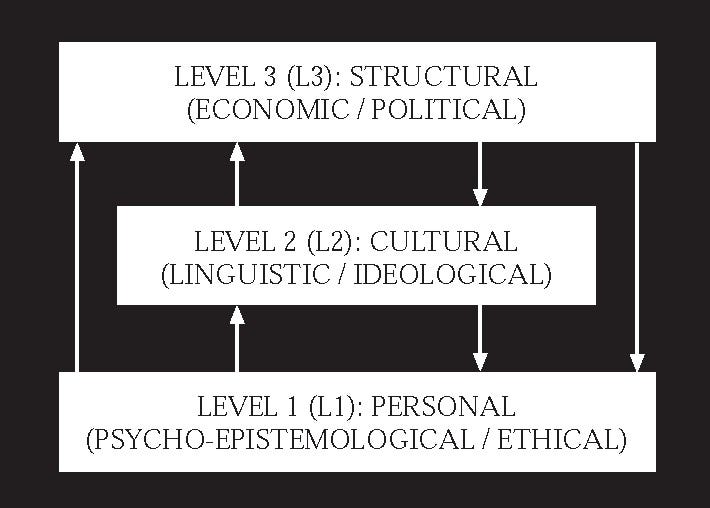
A full elucidation of the Tri-Level Model can be found in Part Three of Russian Radical and in Chapter 9 of Total Freedom: Toward a Dialectical Libertarianism.
My book on Rand had an impact beyond the scope of my trilogy. When the book was first published, it caused an uproar among many Rand fans and orthodox Objectivists for what I believed was a fairly innocuous claim—that Rand learned something from her teachers and from the wider cultural milieu of her formative intellectual years. Since 1995, there has been a proliferation of studies that have contextualized Rand’s work in terms of what she rejected — and what she absorbed — from her Russian background. Historian Bernice Glatzer Rosenthal (2004), author and editor of books on Nietzsche’s influence on the Russian Silver Age into which Rand was born, analyzed Russian subtexts in The Fountainhead and Atlas Shrugged. Michael G. Simental (2013) argued that Anthem can be read not merely as an indictment of political collectivism but as a militant condemnation of “religion as the ultimate collectivist evil,” a by-product of Rand’s exposure to both Soviet communism and Russian orthodoxy. Aaron Weinacht’s 2021 book, Nikolai Chernyshevskii and Ayn Rand: Russian Nihilism Travels to America, found in Chernyshevsky’s immensely influential 1863 novel, What Is to Be Done?, important antecedents to Rand’s egoism. Some of these themes also appeared in Adam Weiner’s 2016 book, How Bad Writing Destroyed the World: Ayn Rand and the Literary Origins of the Financial Crisis. Derek Offord, in his 2022 book, Ayn Rand and the Russian Intelligentsia: The Origins of an Icon of the American Right, has argued further that the dystopian elements in Rand’s fiction are vestiges of the Russian literary model put forth by Chernyshevsky, Fyodor Dostoevsky, Yevgeny Zamyatin, and Alexander Herzen. Alexandra Popoff, in her 2024 book, Ayn Rand: Writing a Gospel of Success, rooted Rand’s thought in her Russian Jewish upbringing. Wolfram Eilenberger, in his 2023 book, The Visionaries: Arendt, Beauvoir, Rand, Weil, and the Power of Philosophy in Dark Times, focused further attention on the impact of the Soviet system on Rand’s burgeoning thought. And Ludmila Nikiforova and Mikhail Kizilov’s 2020 Russian-language book, Ayn Rand, placed Rand’s thought within a Russian cultural and intellectual context.
This is not to say that all these works owe a debt of gratitude to Russian Radical. Rather, it is to acknowledge that Russian Radical took the first step on the interpretive road of situating Rand’s thought in the context from which it emerged. There has been no turning back.
Total Freedom: Toward a Dialectical Libertarianism
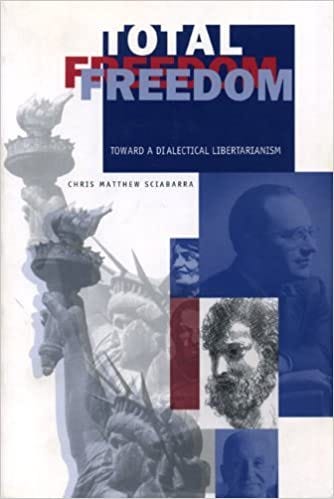
The third and concluding book in my “Dialectics and Liberty Trilogy” is Total Freedom: Toward a Dialectical Libertarianism, published on November 1, 2000, by Pennsylvania State University Press. Although each of the works in my trilogy can be read on its own terms, each remains an extension of the other, and together, the significance of each work becomes more apparent. (One might say that the relationship among these works is as dialectical as the themes they explore.)
Total Freedom answers many of the outstanding questions raised by the first two books in the trilogy. But it goes far beyond its predecessors. Part I offers a rereading of the history of dialectical thinking, a redefinition of dialectics as an indispensable tool for any defense of human freedom and a critique of those aspects of modern libertarianism that are decidedly undialectical and, hence, dangerously utopian in their implications.
Though I have often referred to dialectics as “the art of context-keeping,” Part I of Total Freedom develops a much more refined definition of dialectics, viewing it as a species of the genus “methodological orientations.” I compare it with other such orientations — strict atomism, dualism, monism, and strict organicism.
Because human beings are not omniscient, because none of us can see the “whole” as if from a synoptic, God-like perspective, it is only through a process of selective abstraction that we are able to piece together a more integrated understanding of the phenomena before us — including an understanding of their antecedent conditions, interrelationships, and tendencies. In social theory, the object of our inquiry is society: social relations, institutions, and processes. Society is not some ineffable organism; it is a complex nexus of interrelated institutions and processes, of volitionally conscious, purposeful, interacting individuals — and the unintended consequences they generate. Understanding the complexities at work within any given society is a prerequisite for changing it.
In my reconstruction of the history of dialectics, which takes up the first three chapters of the book, I begin with the ancient Greeks. Even Hegel, Marx, and Lenin viewed Aristotle as the father of dialectics, the man whom Hegel ([1840] 1995, 130) himself called “the fountainhead” of dialectical inquiry. In works such as the Topics — the very first theoretical treatise on dialectics — Aristotle presented numerous techniques by which one might gain a more complete picture of an issue by varying one’s “point of view.” The Topics serves as a grand discussion of how shifts in one’s perspective can reveal different things about the objects of our inquiry and about the perspectives from which those objects are viewed. But examples of the use of dialectical techniques abound throughout the Aristotelian corpus.
In rereading the history of dialectical thinking, from the ancients to the postmodernists, I place special emphasis on the unheralded dialectical approaches of classical liberal and libertarian thinkers such as Herbert Spencer, Carl Menger, Ludwig von Mises, Friedrich Hayek, Ayn Rand, Nathaniel Branden, and Murray Rothbard.
Part II of Total Freedom is devoted to a critical exegesis of Rothbard’s thought— a way of illustrating how thinkers can exhibit both dialectical and nondialectical elements in their work, with conflicting radical and utopian implications. At his most dialectical, Rothbard analyzes class dynamics and structural crises from many vantage points and on several levels of generality (Sciabarra 2000, 267–307). Indeed, the very notion of a “state-banking nexus,” in Rothbard’s approach, is inherently dialectical, because it is both a precondition and effect of the institutions in their organic relationship. That nexus makes possible the emergence of class conflict, domestic and foreign interventionism, and the boom-bust cycle. For Rothbard, the state cannot be what it is in the absence of its support from the banking system, and the banking system cannot be what it is in the absence of the state.
And yet, there is a fundamentally dualistic conception that animates Rothbard’s quest “for a new liberty” — specifically his view of the state and the market as binary adversaries, leading him to advocate the monistic absorption of the state’s functions into the market (his notion of “anarcho-capitalism”). This doesn’t necessarily mean that a nondualistic anarchism is impossible (see, for example, Johnson 2008). But Rothbard’s focus is primarily political and propertarian, a structural “anti-state” focus that does not pay enough attention to those broader cultural prerequisites for the nurturing of a free society. In his later years, Rothbard showed a greater concern for those prerequisites. However, his rejection of liberal cosmopolitan values in favor of a paleoconservative cultural foundation for a libertarian society was a problematic and regrettable turn in his thought. I argue that Rothbard’s embrace of “Liberty Plus” reactionary values could only result in minus liberty (Sciabarra 2000, 355–62).
Post-Trilogy Lessons Learned
After my trilogy was completed in 2000, my education and intellectual evolution continued. Thank goodness! I am often asked if any of my post-trilogy learning would have had any effect on my exposition in any book or all the books of the trilogy.
I think Marx, Hayek, and Utopia would have remained largely the same. It is the most straightforward book in the trilogy insofar as it presents a clear, challenging, and concise comparison of two canonical thinkers. While it’s certainly true that I could have explored my criticisms of both Marx and Hayek in greater detail, I think it would have made the book twice as long and half as interesting.
The same can be said of Ayn Rand: The Russian Radical, which is largely an exploration of Rand’s intellectual roots and a dialectical reconstruction of her work, rather than a sustained critique of her views on various thinkers and traditions or her perspective on many historical, political, and cultural issues. And to be clear, I take great exception to Rand’s views on a wide variety of topics.
Nevertheless, I have always thought of Russian Radical as an ongoing archival project. I would change nothing about my central methodological thesis concerning Rand’s dialectical sensibility or my reconstruction of her philosophic worldview and her cultural critique. But my knowledge of Rand’s educational background has expanded enormously over the past 30 years.
In the early 1990s, when I was conducting original historical research, I didn’t have access to archives that would have provided much more detailed information about Rand’s education at the University of Petrograd. I acquired additional documentation in 1999, four years after the publication of Russian Radical, which led to the publication of “The Rand Transcript” in the first issue of The Journal of Ayn Rand Studies (JARS). A second set of archival documents provided me with an opportunity to expand on earlier studies with the 2005 JARS publication of “The Rand Transcript, Revisited.” These two essays became appendices in the 2013 second edition of Russian Radical.
In my view, the most definitive archival investigation of Rand’s university years was published in JARS in 2021, “The Rand Transcript Revealed,” which I co-authored with Pavel Solovyev, and which presented full graphic images and a thorough explanation of newly unearthed archival materials relevant to Rand’s college education.
If I’d had access to that information in the early 1990s, and had included it in Russian Radical, it might have led me to add a ‘question mark’ to the title of Chapter 2: “N. O. Lossky, The Teacher?” I am still not convinced that Rand’s recollections of Lossky as the teacher of the course she took on the “History of Worldviews (Ancient Period)” were apocryphal. That said, the 2021 study would have added enormous depth to my discussion of Rand’s university studies. If it had cast some additional doubt on Rand’s recollections of Lossky, it would have simultaneously bolstered my case that Rand was educated in dialectical methods, which had a profound impact on the ways in which she approached philosophy and the world at large. The various matricula analyzed in that 2021 co-authored study prove beyond a reasonable doubt that Rand was exposed to a wide variety of preeminent scholars whose dialectical sensibility informed virtually all the history and philosophy courses and various texts that Rand studied at the university.
Aside from archival issues, there are other changes I would have made to Russian Radical and the other two books in the trilogy. Though I rarely used the word “capitalism” as a synonym for a libertarian social system, in 2005, I explicitly rejected the use of the word “capitalism” as synonymous with libertarianism or with “the market”. I was less interested in the ahistorical “unknown ideal” projected by Rand and other libertarians, and far more interested in understanding “capitalism: the known reality.” Capitalism did not have a virgin birth through the homesteading of untouched lands and the sanctity of individual rights. The whole schema of private property and the consequent recognition of the rights to such property only happened after the state — working at the behest of large medieval landowners — used such tools as the enclosure acts to nullify peasant land tenure rights through the theft of the commons. With a legacy of colonialism and mercantilism, the system evolved in such a way as to wholly dispossess indigenous populations. In its origins, capitalism — like every other social system before it — was bathed in blood. Its history is not remotely in accord with the Weberian ideal-type “definition” that Rand provided. Rand recognized this to an extent by labeling capitalism as an “unknown ideal.” But her defense of “free minds and free markets” might have taken a different turn if she had provided a detailed examination of the genesis of capitalism, which was a far cry from that “unknown ideal.”
Of course, Rand was intimately educated on the historical record of “socialism” in the twentieth century, which was also bathed in blood. Marx’s conception of communism was as “ideally” conceived as Rand’s capitalism. It projected a post-state, post-scarcity society in which the abundance of goods is such that each person can take according to their needs, without sacrificing anyone else in the process. No such post-scarcity society has ever existed and the state has never withered away. The results have been murderous.
The larger point is that the “mixed” economy (a “mixture” of market and state) has existed in some form throughout history. Libertarian theorists have long emphasized the importance of markets and civil society in contradistinction to coercive state power. But a dialectical libertarian perspective is as critical of market worship as it is of state idolatry. Markets—those vast entrepreneurial networks of trade and exchange that often undermine conventions and traditions—are also reflective of the cultural and structural frameworks within which they are embedded. Markets operating in a reactionary culture will tend to efficiently serve its values. The triumph of genuine human freedom and personal flourishing requires not only a change in political and economic structures, but also a cultural transformation from the bottom up.
As for Total Freedom, there is no doubt that Part I could have been expanded into a book-length treatment of the history of dialectical thinking. I would have considered many more theorists and traditions as part of that history, especially Saul Alinsky and Murray Bookchin. At the time, I wasn’t aware of Alinsky’s Rules for Radicals (1971) or of Bookchin’s The Philosophy of Social Ecology: Essays on Dialectical Naturalism (1996). Indeed, Bookchin’s neo-Hegelian perspective and its implications for a dialectical left libertarian approach would have been a worthy addition to the discussion.
Libertarianism: Quo Vadis? (Where are you going?)
I should note that, in the wake of my trilogy, I have been less interested in defending ‘isms’, and more interested in understanding not only how the current system works, but in forging strategies for changing that system, given the conditions that exist.
This raises the question, then, why have I held onto one ‘ism’ in particular, since I call my approach ‘dialectical libertarianism’? Indeed, though libertarianism is not a monolith, it has become similarly fraught with major definitional problems. (The issue would not have been resolved if I’d changed the name of the approach to “dialectical liberalism”, given that “liberalism” has had starkly different meanings over the last 400 years.) Many folks who call themselves “libertarians” have garbled its tenets beyond recognition. Among the most vocal are those who are singularly focused on the “anti-state” credo, while tossing aside any concern for the moral and cultural foundations of a free society. Worse still, these folks have used their warped conception of libertarianism to justify everything from alt-right conspiracy thinking to MAGA Mania. I am most distressed with the illiberal shift among right-libertarians, in particular, whose ‘anarcho-capitalist’ vision of private property fiefdoms jettisons those cosmopolitan values that are essential to the creation and sustenance of both human freedom and personal flourishing.
I have been criticizing this butchered distortion of libertarianism from the moment I identified it more than thirty years ago.
My only response to these ideological shifts has been to emphasize that the adjective “dialectical” is a necessary modifier of the word “libertarianism.” It provides me with the requisite tools to critique what I see as profound departures from the libertarian vision that I’ve championed throughout my life. I believe that a dialectical approach eschews ideological rigidity and compels us toward a greater understanding of the real-world context upon which any social change must be built. Echoing the words of Saul Alinsky (1971), we deal with the world as it is, not with the world as we wish it could be. There is “simply no other place to start from.”
Alinsky’s Rules for Radicals is instructive because it explicitly embraces radical theorizing, even as it rejects utopian thinking. From the very first book in my trilogy, I present a fundamental distinction between dialectical, radical thinking and nondialectical, utopian thinking. As I explain in Marx, Hayek, and Utopia:
[T]he radical is that which seeks to get to the root of social problems, building the realm of the possible out of the conditions that exist. By contrast, the utopian is, by definition, the impossible (the word, strictly translated, means, “no place”). …. [U]topians internalize an abstract, exaggerated sense of human possibility, aiming to create new social formations based upon a pretense of knowledge. In their blueprints for the ideal society, utopians presuppose that people can master all the sophisticated complexities of social life. Even when their social and ethical ends are decidedly progressive, utopians often rely on reactionary means. They manifest an inherent bias toward the statist construction of alternative institutions in their attempts to practically implement their rationalist abstractions. (Sciabarra 1995, 1–2)
Given this critique of utopianism, it is important to recognize that there is a role for “utopian” ideas. Even Hayek ([1949] 1980, 194) urged the projection of “a liberal Utopia, a programme which seems neither a mere defense of things as they are nor a diluted kind of socialism, but a truly liberal radicalism which does not spare the susceptibilities of the mighty … which is not too severely practical and which does not confine itself to what appears today as politically possible.” My acknowledgment of the inspirational role of utopian ideas is encapsulated in an epigram from Robert Browning that opens Marx, Hayek, and Utopia: “Ah, but a man’s reach must exceed his grasp, Or what’s a heaven for?”
But the final paragraph of that book summarizes a sobering theme that is omnipresent throughout my trilogy:
By gaining a deeper understanding of the dialectical relationship between goals and context, future generations of radical thinkers might pave the way for progressive alternatives to the status quo, alternatives that are rooted in viable, if distant, possibilities, and that uplift the human imagination without endangering the survival of the species.
The dialectical libertarian project seems daunting, for the invitation to large-scale theorizing might give the impression that one must analyze everything before one can change anything. But this specter of “analysis paralysis” is as much an example of the synoptic delusion fallacy as is the notion of central planning. What is required is a more fully developed critique of the system that generates the social problems in our midst — and a corresponding vision for social change that resolves these problems at their root, in all their personal, cultural, and structural manifestations. A genuinely radical project beckons, one that integrates the explanatory power of libertarian social theory and the context-keeping orientation of dialectical method.
Some critics of my trilogy have suggested that my work was merely an attempt to gain favor with the left academy by peddling the radical chic of dialectics. Using today’s parlance, those critics would have indicted my trilogy for being, pardon the expression, excessively “woke.”
I have never liked the word “woke,” because it has become an “anti-concept,” as Rand would have called it, insofar as it entails some kind of “‘package-deal’ of disparate, incongruous, contradictory elements taken out of any logical conceptual order or context.” Indeed, at this stage, it has become a mere pejorative, which in the hands of its opponents is used as a bludgeon against anything they hate. The ‘ominous parallels’ between ‘woke warriors’ and ‘anti-woke crusaders’ has become all too apparent.
And yet, to a certain extent, this trilogy was “woke” before that term became fashionable, whether as a badge of honor or disdain. I say this because its purpose was to awaken people to important dialectical subtexts in the works of classical liberal and libertarian thinkers. When these works are reconsidered and reconstructed along dialectical lines, their emancipatory power becomes even more pronounced, rivaling and surpassing some of the most insightful contributions of the left academy. Yes, the trilogy upholds the progressive values of our shared humanity. But I can assure the cynics that one doesn’t gain favor with left-wing academics by “virtue signaling” Friedrich Hayek or Ayn Rand as a dialectical thinker.
Given that dialectical libertarian assumptions are often implicit in the works of many scholars whose perspectives were developed long before the publication of my trilogy, I cannot claim any credit or responsibility for the directions this approach has taken over the past three decades. Indeed, even if my explicit articulation of dialectical libertarianism has influenced others, I have not necessarily been in agreement with every application of its guiding principles. But that’s irrelevant. What is relevant is that dialectical libertarianism is not a sclerotic deduction from fixed axioms. It is a broader, living research program — a foundation for many different theoretical perspectives with varying strategic implications.
I was therefore very happy to be among the coeditors of The Dialectics of Liberty: Exploring the Context of Human Freedom (2019). That anthology included contributions from a broad group of scholars — Roger Bissell, Jason Lee Byas, Robert Campbell, Troy Camplin, Kevin Carson, Gary Chartier, Billy Christmas, Nathan Goodman, Robert Higgs, Steve Horwitz, Stephan Kinsella, Roderick Long, Deirdre McCloskey, David Prychitko, John Welsh, and Ed Younkins — each of whom represents a different approach to dialectical libertarianism. These writers draw from interdisciplinary studies, integrating lessons from different thinkers and traditions. But the listing of these contributors does not in any way, shape, or form suggest their full agreement with, or endorsement of, my perspective on dialectical libertarianism.
On a More Personal Level …
These anniversaries have had a special meaning for me. I had dedicated my first book to my mother, Ann Sciabarra, who, sadly, did not live to see it published. She died on April 21, 1995. Marx, Hayek, and Utopia came out two months too late. Its official date of release was August 31, 1995, though I received copies of it in early June. At the same time, new copies of Ayn Rand: The Russian Radical arrived, with a release date of June 19, 1995. I had dedicated that book to my Uncle Sam, who, sadly, did not live to see it published. He died on January 23, 1994.
I must have looked like an amazingly prolific author to have published two books in virtually the same June 1995 week. Yes, I know, not exactly light summer reading! But when it came time to publish Total Freedom, I joked: “Nobody seems to live to see their dedication in print. Who shall be sentenced to the next dedication?” I found strength in numbers, dedicating that book to my sister Elizabeth, my brother Carl, my sister-in-law Joanne, my friend Matthew, and my dog Blondie. They all lived to see the book published, though my sister and Blondie are no longer with us.
Looking back on the initial publication of the first two works of my trilogy, I was very excited to attend several conferences and gatherings. In late August-early September 1995, I traveled to Tacoma, Washington, where I participated in a panel discussion on the impact of Rand’s work, hosted by the Liberty Foundation, along with philosopher John Hospers and Rand biographer Barbara Branden. My presentation included an illustration of my Tri-Level Model, which was shown on a screen through an overhead projector. We didn’t have PowerPoint in those days. On October 15, over a hundred people gathered for a book party in my honor at the Fort Hamilton Officer’s Club in Brooklyn, thanks to my late Aunt Mary, who was able to secure that lovely facility overlooking the Verrazzano-Narrows Bridge because she was the surviving spouse of a World War II vet, my Uncle Tony.
Sandwiched between these two events, there was another joyous gathering on September 12 at the Greenwich Village home of Andrea Rich, who was the proprietor of Laissez-Faire Books. Her apartment had a magnificent view of the Empire State Building to the north and the Twin Towers to the south.
Andrea invited a wonderful group of people that included historians George Kline and Bernice Rosenthal, as well as Mario Rizzo, Doug Rasmussen, David Kelley, Father James Sadowsky, and Joan Kennedy Taylor. Bertell Ollman was there too. I remember all too well how he took me to the side and whispered: “Jesus Christ! I didn’t realize you knew all these libertarians. Somebody just tried convincing me about the need for inheritance!” He was a good sport.
Pete Boettke introduced me, declaring that there are those who write scholarly works that reproduce the wisdom of the ages, and those whose works annoy, aggravate, and challenge. “Chris writes books in the latter vein,” he said, eliciting much laughter from the crowd. I took questions, provided some answers, and had a great time.
Unfortunately, lifelong, congenital medical problems compelled me to cancel trips to Chicago to discuss parallels in the works of Rand and Hayek, and to Washington, D.C., where I’d hoped to address the Cato Institute. But those several brief shining moments in the spotlight were a lot of fun.
Other book projects might be on the horizon. But for now, I’m flourishing by having the freedom to write articles on a wide range of topics. There’s lots more to come. Stay tuned.
—
Some of the book summaries herein derive from my essay, “Toward a Dialectical Libertarianism,” Chapter 1 in Bissell, Sciabarra, and Younkins 2019, 21–42.
References
Alinksky, Saul. 1971. Rules for Radicals: A Practical Primer for Realistic Radicals. New York: Random House.
Bissell, Roger E., Chris Matthew Sciabarra, and Edward W. Younkins, eds. 2019. The Dialectics of Liberty: Exploring the Context of Human Freedom. Lanham, Maryland: Lexington Books.
Bookchin, Murray. 1996. The Philosophy of Social Ecology: Essays on Dialectical Naturalism. Second edition.
Eilenberger, Wolfram. 2023. The Visionaries: Arendt, Beauvoir, Rand, Weil, and the Power of Philosophy in Dark Times. Translated by Shaun Whiteside. Penguin Press.
Hayek, F. A. [1944] 1994. The Road to Serfdom. Chicago: University of Chicago Press.
— . [1949] 1980. “The Intellectuals and Socialism.” In Studies in Philosophy, Politics, and Economics. Chicago: University of Chicago Press, Midway Reprints, 178-94.
— . 1960. “Why I am Not a Conservative.” In The Constitution of Liberty. Chicago: University of Chicago Press, 395–411.
Hegel, G. W. F. [1840] 1995. Lectures on the History of Philosophy: Volume 2 — Plato and the Platonists. Translated by E. S. Haldane. Introduction by Frederick C. Beiser. Lincoln: University of Nebraska Press, Bison Book Edition.
Johnson, Charles. 2008. “Liberty, Equality, Solidarity: Toward a Dialectical Anarchism.” In Anarchism/Minarchism: Is Government Part of a Free Country? , edited by Roderick T. Long and Tibor R. Machan. Abingdon, Oxon, UK: Ashgate, 2008, 155–88.
Nikiforova, Ludmila L., and Mikhail B. Kizilov. 2020. Ayn Rand. Moscow, Molodaya Gvardiya.
Offord, Derek. 2022. Ayn Rand and the Russian Intelligentsia: The Origins of an Icon of the American Right. London, Bloomsbury Publishing.
Popoff, Alexandra. 2024. Ayn Rand: Writing a Gospel of Success. Jewish Lives Series. New Haven: Yale University Press.
Rand, Ayn. [1943] 1993. The Fountainhead. 50th anniversary edition. With a new afterword by Leonard Peikoff. New York: Signet.
—. 1964a. The Virtue of Selfishness: A New Concept of Egoism. New York: New American Library.
—. 1964b. “Alvin Toffler’s Playboy interview with Ayn Rand: A Candid Conversation with The Fountainhead of ‘Objectivism’.” The Objectivist (March). Reprint.
— . 1967. Capitalism: The Unknown Ideal. New York: New American Library.
Sciabarra, Chris Matthew. 1987. “The Crisis of Libertarian Dualism.” Critical Review 1, no. 4 (Fall): 86–99.
— . 1988. Toward a Radical Critique of Utopianism: Dialectics and Dualism in the Works of Friedrich Hayek, Murray Rothbard, and Karl Marx. Ph.D. diss. New York University.
— . 1995. Marx, Hayek, and Utopia. Albany: State University of New York Press.
— . [1995] 2013. Ayn Rand: The Russian Radical. 2nd ed. University Park: Pennsylvania State University Press.
— . 2000. Total Freedom: Toward a Dialectical Libertarianism. University Park: Pennsylvania State University Press.
— . 2024. “It Really Does Depend on the Context.” Center for a Stateless Society (19 February).
Sciabarra, Chris Matthew and Ryan Neugebauer. 2024. “Therapy for Radicals.” Center for a Stateless Society (24 June).
Simental, Michael G. 2013. “The Gospel according to Ayn Rand: Anthem as an Atheistic Theodicy.” The Journal of Ayn Rand Studies 13, no. 2: 96–106.
Rosenthal, Bernice Glatzer. 2004. “The Russian Subtext of Atlas Shrugged and The Fountainhead.” The Journal of Ayn Rand Studies 6, no. 1: 195–225.
Weinacht, Aaron. 2021. Nikolai Chernyshevskii and Ayn Rand: Russian Nihilism Travels to America. Lanham, Maryland: Lexington Books.
Weiner, Adam. 2016. How Bad Writing Destroyed the World: Ayn Rand and the Literary Origins of the Financial Crisis. Bloomsbury Publishing, 2016.

 Notablog