
This morning, I awoke to the news that Elon Musk is leaving government work! The man whom Trump put in charge of the “Department of Government Efficiency,” who promised to cut government ‘waste, fraud, and abuse’ by $2 trillion—revised downward to $1 trillion, further revised downward to $175 billion (and even this figure is in doubt)—is now so disillusioned with Washington, D.C. that he’s decided it’s time to go back into the “private” sector. He’ll no doubt pay a lot more attention to his many businesses, especially Tesla, which has suffered from a drop in its stock value and even violent attacks against some of its dealerships.
Moreover, after spending $288 million in support of the 2024 Trump campaign and another $25 million in the Wisconsin Supreme Court race (1 out of 2 ain’t bad), the billionaire says his days of spending money on political candidates are over. “I think I’ve done enough,” Musk declared. The New York Times reports:
Mr. Musk was the biggest known political spender in the 2024 election, and he told Mr. Trump’s advisers this year that he would give $100 million to groups controlled by the president’s team before the 2026 midterms. As of this week, the money hasn’t come in yet, according to multiple people familiar with the matter, who spoke on the condition of anonymity to describe the behind-the-scenes dynamic.
Add to this Musk’s criticisms of Trump’s aggressive tariffs and Trump’s “big, beautiful” tax and spending bill, which will increase estimated deficits between $3 and $4 trillion over the next decade—well, I can’t imagine any of this endearing him to our Grand High Exalted Mystic Ruler.
Musk and The State
Nevertheless, Musk’s departure from the Trump administration does not in any way, shape, or form indicate a severing of his incestuous relationship with The State. Musk’s long march through the political institutions, which reached its apex with the DOGE appointment, is as vibrant as ever.
Giving credit where credit is due, there is no doubt that Musk is a smart guy who has made a lot of lucrative, innovative investments over the course of his life. But there are many political ingredients that went into the creation of his big economic pie. He has allegedly claimed that “patents are for the weak,” but patents are a massive part of his investment strategy. Musk’s direct involvement in creating technologies is very limited. Estimates vary, but it appears that he holds about 28 patents (in contrast to thousands attributed to his various companies). Even these patents are typically collaborative, and most stem from his early software development and his involvement with Tesla. It is very difficult to discern exactly what Musk has invented himself.
It should be noted, however, that during his DOGE tenure, Musk and his team were busy mining government databases on patent applications, a strategy easily used to squash competitors. (As of yesterday, the courts cleared the way for DOGE to have detailed access to U.S. Treasury Department systems, reigniting the debate over privacy concerns.)
Even Musk’s stance on free trade is suspect. He guards enormous international investments, including billions of dollars in the Chinese EV market (China is Tesla’s second largest market worldwide). “Tesla secured roughly $1.6 billion in loans from Chinese banks to finance the project, and has also received a $1.8 billion investment from Tencent, one of China’s largest tech companies.” High tariffs are not in the interests of anyone, except those domestic industries that benefit from neo-mercantilist economic protectionism. But high tariffs on China are clearly not in Musk’s political or economic self-interest, which provides a better understanding of his opposition to Trump’s mercurial policies.
Just as problematic has been Musk’s overt public and financial promotion of far-right nationalist, nativist political parties on six continents, which enabled him to provide global political actors with direct access to the Oval Office while he headed DOGE.
Astonishingly, Musk’s involvement in the Trump administration were coincident with a dramatic halting or dismissal of investigations into Musk’s companies, across multiple federal agencies. More than $2 billion in potential liability issues with Tesla, Space X, and Neutralink have essentially vanished. It doesn’t matter whether one believes that government should even be involved in the business of regulating business. The fact is that regulation is part of the fabric of our political economy. Differential regulatory treatment is the very essence of privilege within state corporate capitalism.
Personnel is Policy
It has been a mantra of public administration that “personnel is policy.” This phrase has been interpreted to mean: ‘just get the right people in administrative positions, and we’ll get the job done.’ But it has far greater significance in the context of the regulatory state. It is well known that people who have been deeply embedded in certain industries often become part of the very regulatory apparatuses that are responsible for the regulation of their industries. This is a key component to the creation of monopoly and oligopoly control of markets and the squashing of market competition—whether one chalks this up to the initial intent of regulation (as Gabriel Kolko argued in The Triumph of Conservatism and Railroads and Regulation) or to “regulatory capture” after the fact. Indeed, as Patrick Newman has pointed out, interest groups that secure advantages from regulatory agency policies have often benefited precisely because individuals from these groups populate the agencies doing the regulating. This insight has been key to the entire history of the creation and sustenance of the regulatory state.
The structural conflicts of interest inherent in Musk’s DOGE appointment were so apparent to me that I was baffled even by those within libertarian circles who were applauding his ‘chainsaw’ attack on government waste, fraud, and abuse. As I wrote back in February 2025:
Musk has become the quintessential crony capitalist. He has amassed billions of dollars in his contracts with the Departments of Energy, State, Commerce, Veterans Affairs, Interior, Homeland Security, Agriculture, Transportation, and Defense. Not to mention the GSA, the EPA, and, of course, NASA. Like any statist businessman, he needs to keep those subsidies coming, while staving off competitors, regulatory battles, and federal investigations. To anyone who thinks Musk gave $288 million to the 2024 Trump campaign out of a sense of civic duty, I got a wonderful bridge in Brooklyn I can sell you.
It doesn’t matter that Musk’s crony credentials sit alongside innovative investments. Even Ayn Rand, who once lamented that big business was “America’s most persecuted minority,” recognized that the vast majority of businesspeople in this country’s political economy—which she dubbed “The New Fascism”—were hybrid cases. The point is that in an economy such as this, political skills are nourished systemically. Friedrich Hayek’s famous “Road to Serfdom” warned back in the 1940s that the more political power comes to dominate social life, the more political power becomes the only power worth having. Those most adept at using the levers of political power tend to have a comparative advantage. That’s only one of the reasons “why the worst get on top.”
You don’t have to be a commie, pinko anti-capitalist to see that Musk’s DOGE is one of the surest ways of putting the fox in charge of the chicken coop. Elevating an obvious rent-seeker who has earned billions of dollars from his government connections to a position in charge of “government efficiency” is such a glaring conflict of interest that I’m astonished anyone would be blind to it. Sure, DOGE will uncover glaring government inefficiencies and wasteful spending. Other commissions have done the same. But putting Musk in charge won’t “drain the swamp”; he’s part of it. As are so many of the other billionaires whom Trump has appointed to various posts. The conflicts of interest are legion.
Of course, such conflicts don’t faze our plunderer-in-chief, whose “art of the deal” has led him to monetize the presidency in astounding ways — “the likes of which we’ve never seen before,” as he might say — more than any other modern executive.
But, hey, don’t you dare suggest such a thing or you’ll be accused of suffering from Trump Derangement Syndrome. Alas, criticisms of Musk have also been dismissed as expressions of wealth “envy” and “Musk Derangement Syndrome.” I don’t doubt that some folks suffer from these afflictions. But to go so far as to suggest that Musk is the prototype of an Ayn Rand hero—a Howard Roark, a Hank Rearden, or a John Galt—is unfathomable to me. As Paul Crider has observed, Musk’s attitudes and behavior are far closer to that of an Ayn Rand villain.
Musk may have left government work, but make no mistake about it. He will still be working on the government as long as billions of dollars in largesse are at stake.
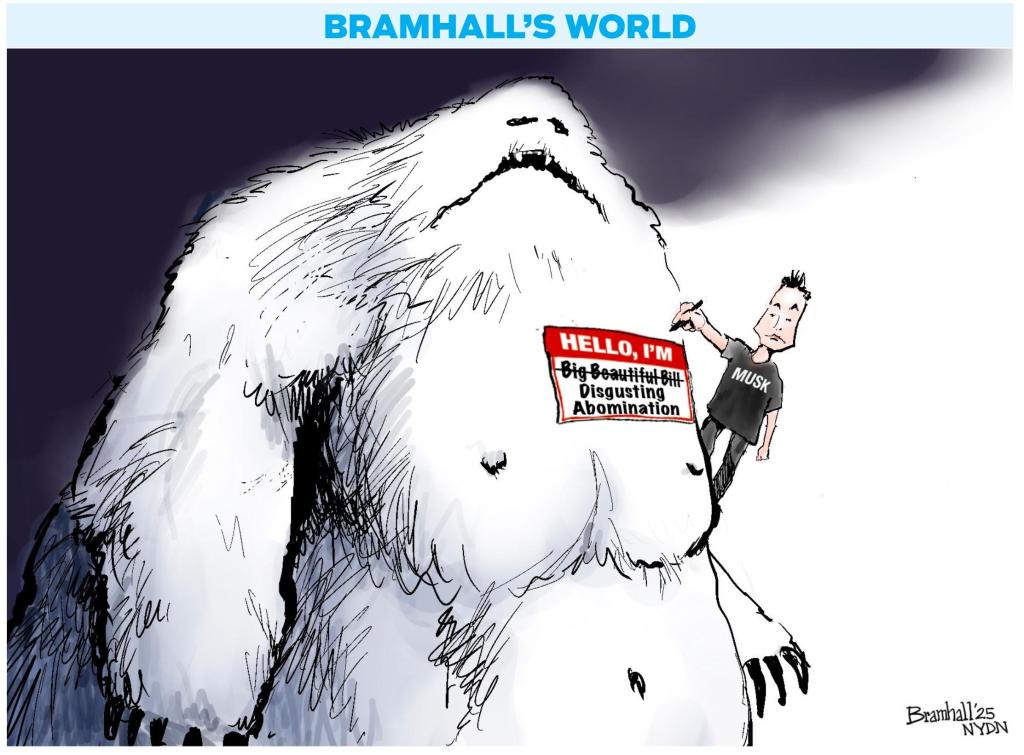
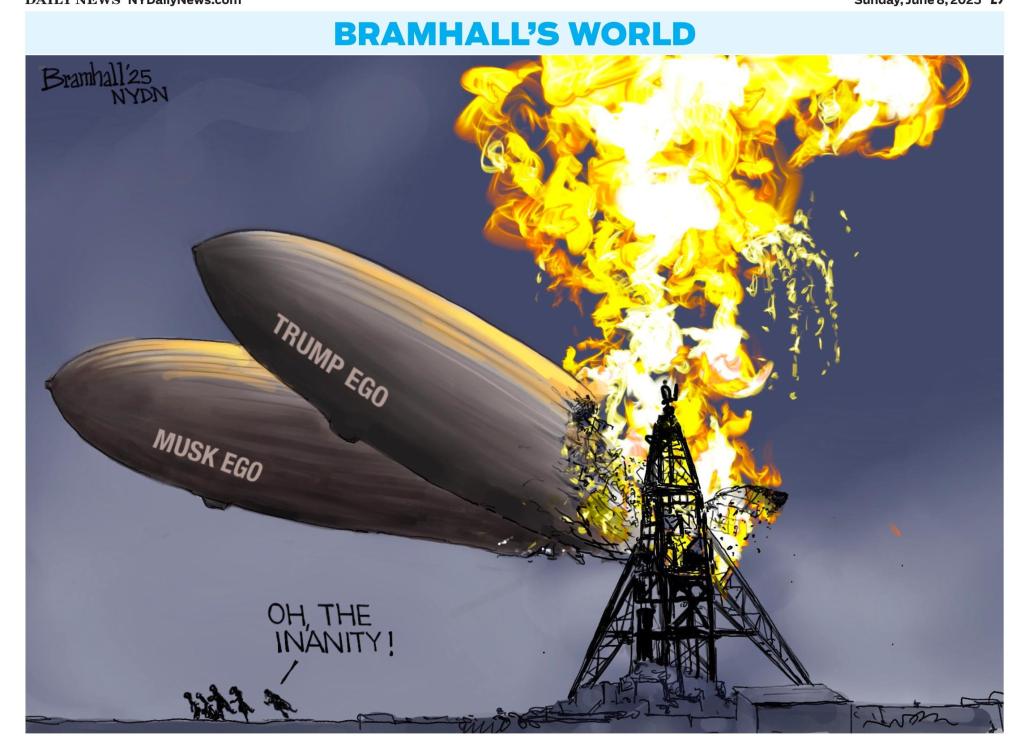
Postscript (June 5, 2025) – With Musk’s departure from Washington, the animus between Musk and Trump is now reaching fever pitch. As long as Musk was singing Trump’s praises, his political investments were safe. Now, as Musk amps up his criticisms of Trump’s “big, beautiful bill” as a “disgusting abomination,” Trump and his allies are striking back. Trump claims that Musk has gone “CRAZY.” Steve Bannon has called on Trump to deport Musk as “an illegal alien.”
As Trump might say to Musk: “You don’t have the cards.” When you slurp at the public trough and you turn on the guy in the White House whom you helped get elected, don’t be surprised when that guy announces: “The easiest way to save money in our Budget, Billions and Billions of Dollars, is to terminate Elon’s Governmental Subsidies and Contracts.”
Musk is trying to play a few cards of his own. He’s threatening to decommission Space X’s Dragon spacecraft, which is responsible for ferrying astronauts and cargo to and from the International Space Station. Moreover, let’s not forget that Musk and his DOGE crew were given full access to data across federal agencies, violating the privacy of millions of Americans. (As an aside, this information has been funneled to Peter Thiel’s Palantir, a company that is building a massive database that might very well expand the surveillance state exponentially.) Is it any wonder that Musk is now claiming that Trump’s name can be found deep within the files surrounding Jeffrey Epstein? Musk announced on X: “Time to drop the really big bomb.”
It’s getting ugly. But given the nature of the folks involved, none of this is surprising.

 Notablog