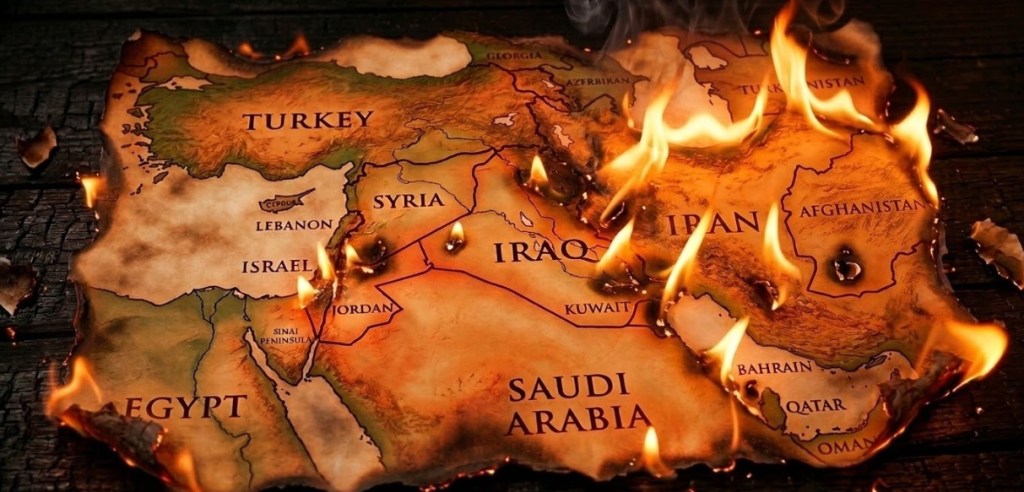
The title of this essay finds its macabre origins in the nineteenth century when physicians rarely washed their hands between surgeries. They performed their operations with increasing technical proficiency, only to find their patients dying from raging infections and gangrene.
As an idiomatic phrase, however, it is an apropos expression of what often happens in war. The strategies might be executed perfectly, but unfortunately, the people they were allegedly designed to help were executed in the process.
For those of us who have had a long history of being critical of US foreign policy, the adage has more relevance today than ever.
The Iran War
As I wrote in my last essay, “Two Wrongs Don’t Make a Reich”, Trump announced “major combat operations” in Iran. He claimed to be defending “the American people by eliminating imminent threats” from the Iranian regime—this, despite his June 2025 insistence that the US had “obliterated the regime’s nuclear program” in Operation Midnight Hammer.
In an 8-minute video posted to Truth Social at 2:30 am (ET) on February 28, 2026, Trump declared: “For 47 years, the Iranian regime has chanted ‘Death to America’ and waged an unending campaign of bloodshed and mass murder.” Now, “a massive and ongoing operation to prevent this very wicked, radical dictatorship from threatening America and our core national security interests” is being waged.
Trump provided a long list of grievances against the Iranian regime, denouncing not only its “nuclear ambitions,” but the 1979 takeover of the US embassy and the hostage crisis, the 1983 attack in Beirut, the 2000 attack on the USS Cole, and the use of proxies to foment violence in Lebanon, Yemen, Syria, Iraq, and Israel.
The “Peace President” acted as if the history of US-Iranian relations began 47 years ago. In a case of massive historical context-dropping, he gave no consideration at all to the actions taken by the US government prior to 1979, which set subsequent events in motion.
Instead, Trump told “the great proud people of Iran” that their “hour of … freedom is at hand. … When we are finished, take over your government. It will be yours to take. This will be probably your only chance for generations.” By ending the “mass terror” of the regime, Trump reiterated, “now is the time to seize control of your destiny, and to unleash the prosperous and glorious future that is close within your reach. This is the moment for action. Do not let it pass.”
In the days thereafter, the administration floated various other reasons for having launched an attack. In direct contradiction to Trump, Defense (War) Department head Pete Hegseth claimed: “This is not a so-called ‘regime change’ war, but the regime sure did change and the world is better off for it.” It won’t be an “endless” war, he insisted, but one with “a clear, devastating, decisive mission: Destroy the missile threat, destroy the navy, no nukes.” Vice President Vance concurred that the war would be guided by the principle: “Go big and go fast.” And Secretary of State Marco Rubio, resident neoconservative warmonger, emphasized that the war would “eliminate the threat of Iran’s short-range ballistic missiles, and the threat posed by their navy.” And—if you can follow this circular logic—because Iran was preparing to strike back at the US and Israel in the event of an attack, the US and Israel needed to pre-empt such an attack, by attacking Iran first.
Amidst all this hoopla, some commentators engaged in scare tactics, familiar to anyone who lived through the drive toward war with Iraq in 2003. They argued that Iran was months away from developing a nuclear weapon. Alas, there isn’t even a remote possibility that the Iranian regime has had weapons of mass destruction or missiles that could reach the United States.
Other commentators have suggested more subversive or covert motivations; they wonder if this is a “Wag the Dog” strategy to divert attention from the Jeffrey Epstein files, or perhaps another example of Trump’s geopolitical chess games, designed to isolate Iran’s “best friend”, China.
Trump insists, however, that the end goal is, indeed, “regime change”. He hopes to do this without putting US boots on the ground—though he won’t rule it out. Indeed, there are now more than 50,000 US troops deployed in the region.
How Trump hopes to achieve regime change is anyone’s guess. A classified intel report by the National Intelligence Council, completed a week before the US-Israeli strikes on February 28, finds that “even a large-scale assault on Iran” would be unlikely to oust the regime’s “entrenched military and clerical establishment.” Equally “unlikely” is the possibility that a “fragmented opposition” would take control.
Regime Change … to What?
Let’s put all this in perspective. There are about 93 million people who live in Iran. The vast majority are Shi’a, including Persian or Fars (61%) and Azerbaijanis or Azeris (16%). Kurds, who are Sunni, constitute about 10%, and it is reported that the US is reaching out to Kurdish leaders to take up arms against the regime.
An August 2025 study reports that about 70% of the population opposes the continuation of the Islamic Republic. The youngest among these believe that regime change is necessary to any transition. About 11% of the population still support the principles of the Islamic Revolution, while 89% support democracy. Though the vast majority of people reject religious and military rule, almost half the population is open to the establishment of another authoritarian government.
Among those seeking change, about 26% support a secular republic, 21% support monarchy, and only 15% support a federal system. But 20% of the population or 18 million Iranians, support a continuation of the theocracy. Though the current war might alter the perceptions of some Iranians, the statistics suggest a high probability of post-war strife.
As this war heads into its second week, Trump said he was surprised that the “evil” Iranian forces were hitting “neutral” countries, those Gulf nations that are now angry at the US for having provided no advance notice of an attack on Iran and for the devastating consequences that await the region. The list of countries struck by Iranian missiles or drones in the aftermath of the joint US-Israeli attack shows that they are hardly neutral. They host US military bases or personnel under a wide variety of arrangements, from the United Arab Emirates, Saudi Arabia, Qatar, Bahrain, and Oman to Kuwait, Iraq, Cyprus, Syria, and Jordan. Nevertheless, Iran’s President Masoud Pezeshkian has apologized to “neighboring countries”, promising no future strikes “unless we are attacked by those countries.” Somehow, he believes that the problem can be resolved “through diplomacy.”
Trump is adamant, however, that there is no room for diplomacy and that the war will end only with the Iranian regime’s “unconditional surrender”—something that Iran’s President has rejected unequivocally. Moving forward, Trump promises “very hard” bombardment; he also demands to be involved in choosing the next Iranian leader, who must be “GREAT & ACCEPTABLE”. He said that he would consider somebody from within the current regime but claims that the US has killed all the potential candidates in its initial strikes. He has even floated the possibility of bringing back the exiled former Shah’s son, Reza Pahlavi, who “looks like a very nice person.”
Good luck with that.
This war shows no sign of ending anytime soon. And the fact remains that the US is as incapable of creating a liberal democratic revolution in Iran as it promised to create in Iraq. It is too busy destroying the lives and liberties of countless people both at home and abroad.
Trump’s “Operation Epic Fury” may yet result in Epic Blowback. It might very well lead not to regime change but to regime collapse, devolving into sectarian rivalry, civil war, and terrorism exported to distant American shores. Though 74 retired generals and admirals back the strikes on Iran, contending that the regime wants to “spill American blood,” war only increases the possibility that American blood will be spilled on American soil in retaliatory attacks. If any such attack occurs, I have no doubt that Trump will blame Joe Biden for having let ‘them’ in, and he’ll use it as a pretext to triple down on his deportation efforts.
How Did We Get Here?
Over twenty years ago, I addressed many significant issues surrounding US foreign policy. In the aftermath of 9/11, I argued that the incestuous ties between the US government, the military, corporate business and oil interests, and autocratic foreign despots created the context that nourished anti-American terrorism. As we witnessed the devastation on that September morning in 2001 here in New York City, we were told that we were attacked because “they hate our freedom”. It never dawned on those who were clamoring for war that the attacks were provoked not by hatred of “our freedom”, but by a long trail of US policies that had brutally impacted the region from which the terrorists originated.
If it’s not obvious, let me be clear: Explaining the factors at work by placing them in a larger systemic and historical context is not the same as justifying the actions of those who made missiles out of commercial jets, killing and injuring thousands of civilians, including many people I knew.
That fateful day brought not just bloodlust for Al Qaeda, which was responsible for the attacks. It brought on a wave of government violations of people’s liberties at home, and an extension of the war into Iraq. The Big Lie told by the Bush-Cheney administration—that Iraq had weapons of mass destruction and that there was a link between Saddam Hussein and Al-Qaeda—stoked palpable fears among the post-9/11 American public so as to justify a US invasion.
A History of Interventionism
Western colonialism and imperialism have long been at the heart of the region’s historic instability. In the aftermath of World War I, French and British politicians redrew the map of the Ottoman Empire, creating spheres of influence and wholly artificial nation-states—from Iraq and Iran to Syria and Lebanon—to serve their colonial interests, with little regard for ethnic or cultural demographics.
By the 1930s, the US became a key player in the Middle East, enabling a consortium of American companies to gain oil concessions from the Saudi government. The 1938 founding of ARAMCO (the Arabian-American Oil Company) solidified the growth of the oil monopoly, and, over time, the US government lent further support to these arrangements with outright military intervention to “stabilize” the region. Severe challenges to the alliance emerged with Saudi nationalization and OPEC, but the political and economic ties of the Saudi-US-financial nexus remained strong.
In the aftermath of World War II, as the Cold War birthed the modern national-security state, US CIA and British M16 forces orchestrated a 1953 coup, approved by the Eisenhower administration, to overthrow Iran’s democratically elected leader. Mohammad Reza Pahlavi was installed to serve the interests of Western oil companies in the Persian Gulf against any Soviet incursions. The CIA further assisted the new regime in establishing SAVAK, the notoriously vicious secret police of the Imperial State of Iran. Its forces were trained to torture and murder dissidents, thereby helping to centralize the Shah’s power. Moreover, the Shah’s regime purchased billions of dollars in US weaponry, further enriching the US military-industrial complex, even as it destabilized Iranian society.
Is it any wonder, then, that in 1979, Iranians toppled the Shah in an act of revolution against domestic oppression, while storming the US embassy and taking hostages in retaliation against the “Great Satan”, proclaiming “Death to America”? That they established their own brutal, oppressive theocracy only compounded the tragedy of Iran, as those deemed disloyal were imprisoned and killed by the mullahs and their Revolutionary Guard.
In that same year, 1979, the Carter administration began a covert operation to fund the mujahideen in Afghanistan six months before the Soviet invasion. Reagan continued to support these “freedom fighters” through further and more elaborate covert operations. In later years, many of these “freedom fighters” became the core of Al-Qaeda.
And let’s not forget that other Reagan policy fiasco, in which the administration sold arms to the Islamic Republic of Iran to secure the release of American hostages in Lebanon, only to funnel the proceeds of these arms sales to the ‘anti-communist’ Contras in Nicaragua, who were attempting to overthrow the Sandinista government.
Oh, but the fun doesn’t stop there!
Every US action has led to a reaction. US policies bolstered the Iraqi Ba’athist regime of Saddam Hussein and aided its eight-year war against Iran (1980-1988), only to oppose Hussein in the Gulf War so as to protect Saudi oil fields in response to the Iraqi invasion of Kuwait. And in the aftermath of 9/11, orchestrating Hussein’s demise, the US created conditions that led to sectarian civil war, the rise of ISIS, and the growth of Iranian-backed Shi’ite militias in that country.
Even the Saudi Arabian dictatorship, which has benefited from 70 years of US support—and which has recently invested $2 billion in Trump son-in-law Jared Kushner’s private equity firm—has shown few signs of liberalization. With fifteen of the nineteen 9/11 hijackers identified as Saudi nationals, the Saudis continue to deny any complicity despite circumstantial evidence to the contrary.
The costs of the twenty-year “War on Terror”: An estimated $14 trillion in the funding of military operations, homeland security, and care for veterans whose lives were destroyed by those “endless wars” that Trump so often decried.
The human toll is estimated at 900,000 lives.
But the lethal effects of US foreign policy in that region extend much further. Whereas the MAGA movement embraced the batshit quackery of the ‘great replacement theory’, the destabilizing influence of US interventions contributed to the great displacement of over 37 million people—perhaps as many as 48-59 million refugees, who have run for their lives out of a perpetually war-torn region.
Whatever role the US has played in the Middle East, ‘liberator’ is not among the titles I’d use.
It should be noted that US policies in the region have been aided by the US-Israeli alliance. The US used Israel as a “strategic asset” in opposing those Soviet-aligned Arab neighbors during the Cold War, while Israel has been the leading beneficiary of foreign aid through massive US economic and military assistance. But to blame Israel for this war is to deny any agency to the United States in its nearly century-long quest for regional hegemony.
This war with Iran is an extension of the dynamics that have always driven US foreign policy. And nothing will stop this President from the path of destruction he has chosen—certainly not the Congress, which has long been ceding its constitutional responsibilities to the executive branch. Indeed, House Speaker Mike Johnson denies that the US is even involved in a “war”. And Senate Republicans have blocked any war power limits to this operation, giving Trump a rubberstamp to do whatever the hell he wants.
The Dynamics of War
The warmongers among us serve the administration by labeling as “traitors” those who oppose US intervention abroad. This has become a virtual rite of passage for critics in times of war. When I was a vocal opponent of “Operation Iraqi Freedom” in 2003, I was castigated as a supporter of the brutal regime of Saddam Hussein. One critic went so far as to label me a “Saddamite”—with obvious allusions to another of my ‘vices’. Unfortunately, the same formula has been applied to recent debacles. If you opposed the kidnapping of Maduro, you must be in favor of the despotic, oppressive Venezuelan government he led. Likewise, if you oppose “Operation Epic Fury,” you’re clearly in the back pocket of the Iranian clerics, who have arrested and slaughtered countless thousands of protesters.
That one must even articulate one’s disgust for the abhorrent regimes targeted by the US military is infuriating. One can morally oppose tyranny wherever it appears, without also granting moral sanction to the US role in toppling—or propping up—tyrants abroad.
When even the most tyrannical regimes pose no direct or imminent threat to the people of the United States, and the risks of blowback are high, the US government has no moral right to engage in warfare abroad. And to endorse the principle that the US has a right to topple any such regimes by “choice”, one must ask: Why not target larger-scale geopolitical players? Why not topple China, which signed a 25-year cooperation agreement with Iran in 2021, while purchasing at deep discount more than 80% of Iran’s crude oil exports? Or Russia, which might be providing intelligence to the Iranians on the location of US forces? Let’s start World War III while we’re at it.
Not even at the height of the Cold War would the US government have been so stupid as to start down the path of mutually assured destruction. So, it has given us a host of undeclared wars with ‘lower hanging fruit’—from Korea and Vietnam to Afghanistan, Iraq, and Iran. Each of these wars has served to bolster the power of the national-security state and to enrich those who produce the machinery of death. Millions of people have been massacred in the process.
But at least we can now understand why it was so important for Trump to secure a $1 trillion budget for the aptly renamed “Department of War”—easily the most honest designation Trump has ever bestowed. Having lost $2 billion in military hardware in the first four days of the war, Trump is now proposing a $1.5 trillion Pentagon budget for 2027. As Trump meets with munitions manufacturers to quadruple the production of “exquisite” weapons, it is no surprise that more than half of the budget goes to private for-profit contractors in the military-industrial complex.
Meanwhile, the country is headed toward $40 trillion in debt, in the midst of escalating inflation. In just the first half of the fiscal year, US government deficits stand at $1.31 trillion. As if that’s not enough, the administration is conducting other wars—an escalated War on Drugs to topple “narco-terrorists” in the Caribbean, Ecuador, and elsewhere; the military seizure of Maduro in Venezuela that left his administration intact as that country turns into a quasi-vassal state for petroleum and mineral extraction. Who knows what else this administration has in store? Cuba? Greenland? The Panama Canal?
If this is “America First”, you could have fooled me. That some MAGA advocates are seeing through the fog of war is a hopeful sign, but even those who have criticized the administration for its actions in Iran still share the core principles of the project upon which their movement was founded.
When Trump was inaugurated on January 20, 2025, the clear strategy was to “flood the zone” with so many policy directives and executive actions that it would become virtually impossible to launch any kind of coordinated response. In just over 400 days, we are barely keeping our heads above the sewage.
To return to the title of this essay and its origins, unlike the surgeons of yore, I’d like to wash my hands of this newest US folly, but I fear none of us can clean off the filth of the past, the present, or the dark future that awaits.
—
This essay also appears on Medium.

 Notablog