“We all see the same thing,” Deputy Attorney General Todd Blanche said, when viewing the latest video of the latest U.S. citizen shot to death by ICE agents.
Actually, we all do not see the same thing. Where many of us see the murder of another US citizen, the supporters of this administration see “professional agitators” and “domestic terrorists” paid by foreign agents to undermine the legitimacy of the law they fully support: The deportation of every “illegal” immigrant and the apprehension, arrest, and killing, if necessary, of any person interfering with this operation. Indeed, supporters of this administration’s mass deportation efforts argue that every immigrant who has entered this country “illegally” is, by definition, a criminal. And with every protest against Trump’s relentless campaign to rid the country of “vermin”, there is the promise that a “day of reckoning and retribution is coming.”
Trump campaigned on this promise. He seeks to deport an estimated 15-20 million undocumented immigrants from the United States, who ‘invaded’ this country from the Southern border. But upon entering office, he claimed he’d go after “the worst of the worst“: the murderers, the rapists, and the gangbangers who were committing crimes on America’s streets. That immigrants are less likely to commit crimes than US citizens and that crime has dropped to historically low levels is immaterial.
As I have argued, Trump’s project is less about controlling crime, and more about deporting those “illegals” who don’t fit into his vision of a country dominated by white identity politics.

The current immigration system has made it almost impossible for people to become citizens; less than 1% of people who seek to move permanently to this country can do so legally. Trump and his minions are not interested in massively overhauling the immigration system or in providing productive people with a path toward citizenship. His administration has halted the processing of asylum applications and as of January 21, 2026, it has paused the issuance of immigration visas for nationals from 75 “shithole” countries, as Trump once called them.
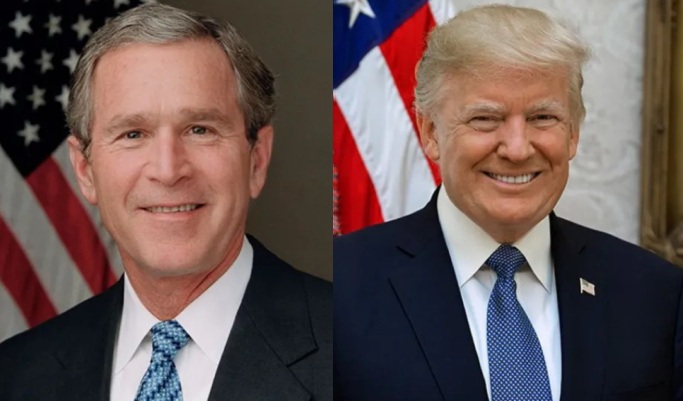
The irony of all this is that Trump once decried the administration of George W. Bush as “failed and uninspiring.” But if it were not for the ‘innovations’ of Bush’s presidency, crafted nearly a quarter-century ago, Trump would not have had the instruments of domestic warfare and ethnic cleansing that he’s been using with impunity.
The Bush-Cheney ‘War on Terror’
The dust had not quite settled from the collapse of the Twin Towers in New York City before the Bush-Cheney regime embarked on a “War on Terror” that transformed the soul of this country. A long history of deleterious US intervention in the Middle East had laid the groundwork for the blowback of 9/11. Instead of fundamentally altering the trajectory of US foreign policy, the Bush administration invaded Afghanistan and began the project of regime change in Iraq on the pretense that Saddam Hussein was harboring weapons of mass destruction. The lies told by that administration are legion.
The war in Iraq did not and could not create the conditions of ‘democratic’ nation-building. Ultimately, that horrific war gave birth to ISIS, while significantly empowering Iran—just as earlier intervention in Iran had inspired theocratic revolutionaries to topple the US-backed Shah. And the displacement of whole South Central Asian and Middle Eastern populations during the ‘War on Terror’ fueled a migration crisis that inspired authoritarian nativism on the European continent and in the United States as well.
Bush’s ‘War on Terror’ was also a war on the American people. Aside from creating the USA PATRIOT Act, which expanded the government’s surveillance capacity, the Bush-Cheney regime gifted us the Department of Homeland Security, which centralized and consolidated 22 agencies to coordinate responses to “emergencies”. One of its ‘innovations’ was the creation of the agency for US Immigration and Customs Enforcement (ICE). It’s not that there were no immigration enforcement agencies prior to ICE. ICE centralized the Immigration and Naturalization Service (INS) and its US Border Patrol, both of which had been operating under the Department of Justice, and the US Customs Service, which was operating under the Department of the Treasury. Centralization achieved consolidation of power, and hence, significantly increased the chances for its abuse. Lacking in checks and balances, such consolidation has led to predictable human rights violations.
The Trump Turn
Despite his antipathy toward the Bush-Cheney administration, Trump has used the executive powers created by that administration to bolster immigration enforcement in ways, “the likes of which have never been seen before.” Just as DHS was formed to coordinate responses to “emergencies”, Trump has used the leitmotif of “emergencies” to dramatically expand its power. He has already declared many emergencies on which he has engaged police, military, and other resources. As Adam Kushner writes:
Trump can deport immigrants without due process, he says, because it’s an emergency to fight a Venezuelan gang’s invasion. He can dispatch federal troops to L.A. and D.C. [and Minneapolis] because it’s an emergency to quell protests and fight crime. He can ask the Supreme Court for emergency rulings because we can’t afford to wait for judges to debate his policies.
Even when Trump doesn’t declare a legal emergency, he describes crises that justify dramatic action … Even if the courts constrain Trump’s legal declarations of emergency, the spirit of emergency seems to inflect everything that the White House does. … The climate of emergency can be used to rationalize virtually any action.
It is no surprise that even his Treasury Secretary Scott Bessent declared: “The national emergency is avoiding a national emergency”—a sure prescription for the vast expansion of government power.
Now with a four-year budgetary commitment of $150 billion to combat the immigration “emergency”, ICE has had a 120% increase in the number of its agents, more than doubling its force from 10,000 to 22,000 officers. Many of these officers have been recruited from far-right spaces. About a third of these officers are military veterans, like machine-gunner Jonathan Ross, who as an Iraq war vet, shot Renee Nicole Good, calling her a “fucking bitch” as he walked away from the crime scene.
These recruits have been instructed to bypass the Fourth Amendment, forcibly entering homes without identifying themselves and without a judicial warrant.
Back in September, the President declared that American cities would be used as “training grounds” for the military. He has yet to invoke the Insurrection Act that would introduce the US military onto the streets of American cities to quell unruly populations. But who needs the US military when we’ve got masked ICE agents acting as a rogue paramilitary group to fight “the enemy from within”?
The administration’s deportation efforts have slowly devastated labor markets in farming, fishing, freight, forestry, meatpacking, the auto industry, construction, the service industries and home healthcare—where immigrants make up nearly a third of the long-term care workforce.
ICE agents have instilled fear throughout whole communities in this country. They pursue immigrant workers across farmland; they break car windows and pull drivers out of their vehicles; they tear-gas, flash-bang, pepper-spray and tackle ‘suspects’ and protestors alike. As an army of occupation, they frequently funnel people into a “Deportation-Industrial Complex,” run by for-profit private prison corporations.
Advocating the abolition of these departments and agencies is clearly not enough—not when so many interests have ‘skin in the game’, making it virtually impossible to dismantle this growing enforcement apparatus.
History will no doubt show that Trump has created a transformative presidency that has fundamentally altered the political landscape and its public ideology. Let it also show that this transformation could not have been possible without the regrettable legacy of the administration of George W. Bush, whom Trump so often vilified.

 Notablog