Back in July 2016, when I predicted that Donald Trump would win his first campaign for the White House, I wrote skeptically about the coming “Trump Revolution.” I was encouraged by only one thing: That Trump might foster a less interventionist foreign policy than, say, Hillary Clinton. He was belatedly critical of the Iraq War and when questioned by Bill O’Reilly about how Russia had interfered in U.S. elections, he replied correctly: “You think our country’s so innocent?” Indeed, the United States government has been responsible for toppling more governments abroad (both covertly and overtly) than perhaps any other government in the history of the world.
Unfortunately, not even in his first term did Trump live up to the ‘promise’ of a revolution in foreign policy. As I wrote in January 2021:
… those who think that the Trump years brought “peace” in foreign affairs, should check their premises. Like Obama before him, Trump focused on proxying-out military intervention. Sometimes it’s been trumpeted as good for the economy; after all, when the U.S. gives money to the Saudi government, the Saudis spend that money by purchasing U.S.-manufactured munitions, which are then used against countries like Yemen. … Trump’s promise to end “the era of endless wars” has only led to the repositioning of troops rather than their return home.
Indeed, Trump “dropped more bombs during his first term than either George W. Bush or Barack Obama did in their first terms,” and there was no relative decrease in the number of US bases or troops abroad. He vetoed every bill to disengage US forces from the Saudi war in Yemen or to halt sales of US-made weapons. Military spending rose by 39 percent, providing a huge windfall to the military-industrial complex. Arms sales revenue for Lockheed Martin, Boeing, Raytheon, Northrop Grumman, and General Dynamics rose 30 percent between 2015 and 2019, part of an enormous $718 billion Pentagon budget.
Alas, this is nothing compared to Trump 2.0. As I observed in September 2025, in his second Oval Office term,
Trump’s trade policies have become one of his “art of the deal” negotiating tools — touted by the White House as the “Trump Effect” — not for the achievement of global free trade, mind you, but for the government benefits bestowed on AI businesses, energy companies and, of course, the military-industrial complex. His higher tariff rates on other countries are sometimes negotiated down (to levels still much higher than before), as long as the targeted countries purchase more US-made munitions, thus benefitting Lockheed Martin, RTX, Northrup Grumman, Boeing, and General Dynamics. In addition, the US government already has high stakes in large computer chip manufacturers, and the administration is considering “taking stakes” in “defense” firms, such as Lockheed-Martin. It wouldn’t be too much of a stretch; all these “defense” contractors are already embedded in Uncle Sam’s back pocket since the vast majority of their revenue derives from government contracts that create the instruments of war, distributed far and wide throughout the world. The only refreshing change is Trump’s executive order renaming the Department of Defense as the Department of War — which is how it was known from 1789 through 1949. It would certainly be a more honest reflection of what that federal agency is all about, given that Trump has increased its annual war-making budget to $1 trillion.
If this is the “Peace President” who is “draining the swamp,” you could have fooled me.
The list of Trumpian interventions abroad grows with each passing month. It’s not just his flirting with the annexation of Canada, the Panama Canal, Greenland, and Gaza. Or his attack on Iranian nuclear facilities and strikes in Syria, Nigeria, Iraq, Somalia, and Yemen. His augmenting of the “War on Drugs” has led to a series of unlawful lethal attacks on boats in international waters operated by alleged “narco-terrorists”—though Trump’s hypocritical anti-drug crusade also entailed pardoning Honduran President Juan Orlando Hernandez, who had been serving a 45-year sentence for cocaine importation.
That the “War on Drugs” is itself a violation of individual rights is a notion that no Trumpist could possibly entertain. It is also a pretext for something else entirely. In fact, it has always been a pretext for something else entirely, since the days of the Nixon administration when it was instituted as a strategy to target antiwar activists during the Vietnam War and those in the black community.
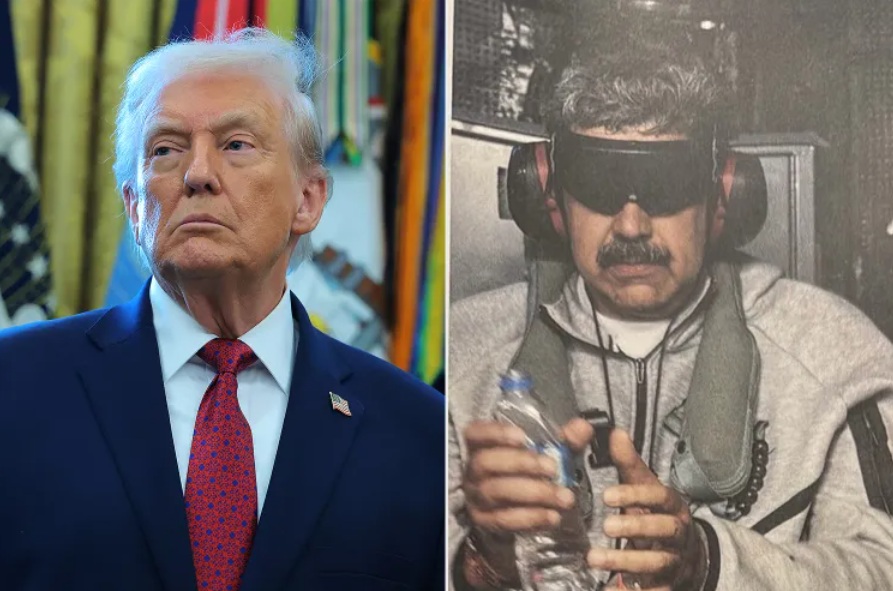
Now that the US military has successfully captured, arrested, and imprisoned the Venezuelan tyrant, Nicolás Maduro—who has terrorized his own people for over a decade—on charges of narco-terrorism, drug trafficking, money laundering and corruption, it is clear that Trump’s literal war on drugs has also been a pretext. For regime change and lots more.
First, regarding the “War on Drugs”: Does anybody seriously believe that bombing boats in the Caribbean or interdicting the flow of drugs into the United States is going to stop the tragedy of substance abuse in this country? Drug prohibitionism has never worked. It didn’t work in the aftermath of the Eighteenth Amendment, when ‘progressive’ do-gooders tried to control the consumption of alcohol. It hasn’t worked despite decades of oppressive law enforcement and the mass incarceration of drug dealers. Profit-making drug cartels have flourished because there is a high domestic demand for drugs. Black markets raise prices and even the lethality of the substances themselves, as many suppliers have transitioned from plant-derived drugs to stronger synthetic alternatives. Of course, the plant-derived drug industry still flourishes, but it remains vulnerable to crop eradication and detection.
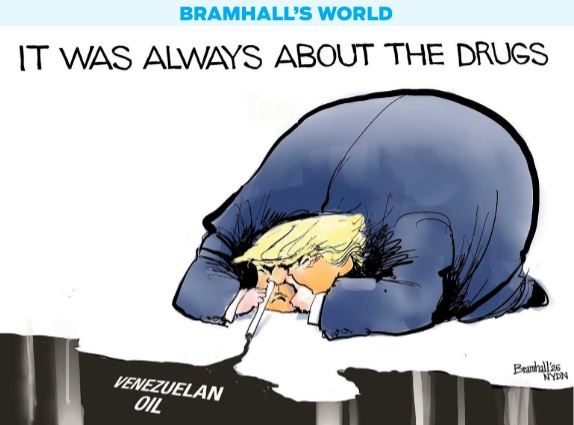
Second: Trump has been very explicit that Venezuela will be “run” by the United States “until such time as we can do a safe, proper and judicious transition.” What this means in practical terms is anyone’s guess. But it appears that Venezuela might become a US vassal state until such time that US oil companies can take back “our oil” and redevelop the country’s petroleum industry. On this point, Trump has been unapologetically honest.
US intervention on behalf of oil companies is nothing new. When the Bush administration was busy ‘liberating’ Iraq from the clutches of Saddam Hussein and his nonexistent weapons of mass destruction in 2003—even though Hussein had no role in 9/11—I was adamantly opposed to the nation-building agenda it had embraced, the same nation-building agenda that Trump himself criticized. I argued that the US government had nourished an incestuous relationship with the oil industry and its host countries for decades. As I wrote, those corporations engaged
in joint business ventures with the Saudi government—from petroleum to arms deals—utilizing a whole panoply of statist mechanisms, including the Export-Import Bank. The US is Saudi Arabia’s largest investor and trading partner. Historically, the House of Sa’ud’s alliance with—and exportation of—intolerant, fanatical Wahhabism has been strengthened by the US-Saudi government partnership with Western oil companies, especially the Arabian American Oil Company (ARAMCO), a merger of Esso, Texaco, and Mobil. … This US-Saudi-Big Oil Unholy Trinity sustains the undemocratic Saudi regime, … [which] depends upon a barbaric network of secret police and sub-human prisons, using the kinds of torture tactics that would have made Saddam proud: routine floggings, rotisserie hangings, amputations, penis blocking, and anal molestations. Such is the “pragmatic” nature of official US government policy, which goes to war for “human rights” in Iraq, while tacitly sanctioning their eradication in Saudi Arabia.
It’s this kind of pragmatism that has been the midwife to anti-American terrorism—from US support of the Shah of Iran that led to the establishment of an anti-American Islamic theocracy to US support of the Afghani mujahideen that led to the establishment of an anti-American Taliban.
The situation differs somewhat in Venezuela. After siding with Venezuela in an 1895 boundary dispute with Great Britain, in which Grover Cleveland asserted the principles of the Monroe Doctrine, the US government sent three battleships in support of a 1908 coup that placed Juan Vicente Gómez in control of the country. Gómez’s brutal dictatorship dominated the country in various ways for 27 years. In return for US assistance, Gómez granted major concessions to international oil companies (such as Standard Oil and Royal Dutch Shell) to explore, produce, and refine petroleum—with substantial kickbacks that increased his personal fortune. The US continued to back repressive dictators thereafter, including Marcos Pérez Jiménez, whose virulent anti-communism aligned him with the West, even as he intimidated the press, abolished labor unions, and incarcerated, tortured, and murdered hundreds of his opponents. By the 1970s, the Venezuelan government nationalized the oil industry in pushback against Western dominance. Some oil companies, such as British Petroleum, Statoil, and Chevron, accepted the terms of the nationalization; others, such as ExxonMobil, refused to accept the terms and their assets were seized. Over the years, however, the US continued to meddle in Venezuelan politics, tacitly approving a failed military coup against Hugo Chávez in 2002 and imposing crushing sanctions for over two decades.
The Trump administration is now telling US oil companies that if they wish to regain their assets, they will have to return to Venezuela and spend billions of dollars to revive that country’s shattered infrastructure over the course of many years. Perhaps their risks will be socialized by the US taxpayer. But let’s not forget that new oil deposits have been discovered off the coast of Guyana in territory that the Maduro regime was claiming as its own. With Chevron a key actor in Venezuelan petroleum and ExxonMobil a central force in Guyana, and with oilfield service companies like Halliburton involved—you know Halliburton, which raked in nearly $40 billion in no-bid US government contracts for Iraqi oil infrastructure reconstruction—it’ll be interesting to see how the whole crony capitalist drama plays out.
Given its military successes in extracting Maduro from Venezuela, the administration is already setting its sights on Cuba, Colombia, and Mexico. Like many of its predecessors, it justifies its actions by claiming an expansive view of the Monroe Doctrine. That doctrine has been used as a rationale by previous administrations to undermine Latin and South American governments through both covert and overt means. Perhaps armed with their own renditions of the Monroe Doctrine, China can now claim the moral high ground when it annexes Taiwan, just as Russia expands its own sphere of influence in Ukraine and beyond.
There are countless worst-case scenarios that Trump’s actions have unleashed.
So, what if it’s different this time? Why should we live under the shadow of the failed missions in Vietnam, Afghanistan, and Iraq? After all, this is the “Peace President”—who, apparently wants a piece of this land and a piece of that land.
Nearly 8 million Venezuelans fled their native country seeking refuge from the butchery of the Maduro regime. It is ironic that the 700,000 to 900,000 Venezuelans who came to the US have been vilified by the Trump administration for having crossed into this country “illegally.” He often claimed, without evidence, that Maduro emptied his prisons and sent an invading army of criminals into the US. “They’re taking their drug dealers and their people in jail, lots of people in jail, they’re taking their murderers, their killers, they’re taking them all and they’re sending them into the United States,” he said. Indeed, he regularly referred to Venezuelans as “rapists,” “savages,” “monsters,” and “the worst of the worst”—and successfully stripped protected status from nearly 350,000 of them. Perhaps a stable Venezuela will give Trump the opportunity to deport every one of them back to the country of their birth.
So much for Trump’s love of the Venezuelan people.
And yet, so many Venezuelans—and many people of good will—celebrate the downfall of Maduro, even though his regime remains fully intact. But the change that has come to Venezuela has been imposed from without. It has not come from within. And that outside force may very well bring “boots on the ground” to police any transition. Regime change is a bloody business with unpredictable long-term consequences. Indeed, as Trump once acknowledged, this country is not “so innocent” in its historic record as an agent of disruptive global change. Why should this episode be any different?

 Notablog