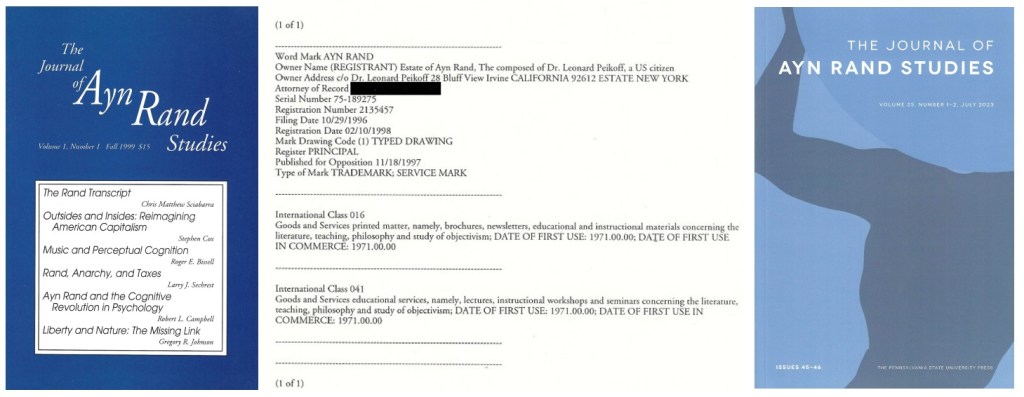
For more than two decades, I was associated with The Journal of Ayn Rand Studies (JARS). That journal’s debut issue was published in September 1999. The brainchild of Bill Bradford, the journal became the first (and only) nonaligned, interdisciplinary double-blind peer-reviewed scholarly periodical to feature critical commentary on Rand’s work, life, and legacy. Along with Bill and Stephen Cox, I was a founding coeditor and a member of the Board of Trustees.
That first issue, which included six essays, was a triumph in and of itself. Over time, we added a slate of academics from disciplines as varied as anthropology, economics, philosophy, politics, psychology, and literature to our editorial and advisory boards. Indexed by nearly two dozen abstracting services in the social sciences and the humanities, JARS joined the Pennsylvania State University Press Journals Program in 2013.
Back in July, in my Notablog essay, “Reflections on ARI 40”—an exploration of the impact of the Ayn Rand Institute on Rand studies—I wrote in passing: “Aspects of the adversarial relationship between JARS and ARI is a subject I’ll discuss in a future post.”
Well, that future post has arrived! After more than a quarter-century, I thought it was time to share one story about the journal’s early obstacles that I’ve never made public.
Not too long after the debut of that first issue, Bill received a threatening letter addressed to The Journal of Ayn Rand Studies Foundation, dated September 30, 1999—twenty-six years ago today. It was from the New York offices of a prestigious law firm specializing in intellectual property rights. The lawyer wrote on behalf of their clients: Leonard Peikoff as the sole heir and executor of Rand’s estate, and the Ayn Rand Institute.
We were informed that the Estate owned a valid federal trademark for the name “AYN RAND”, which had been registered on February 10, 1998 (Registration No. 2,135,457). They were right! We substantiated their claim by obtaining public information about the trademark from the United States Patent and Trademark Office website. (In the image above, I’ve redacted the name of the lawyer identified in our search. And for the record: I’m not publicizing the name of the law firm in this post.)
The lawyer for the Estate told us that the Institute had received hundreds of phone calls and email inquiries concerning JARS and that our use of the name “AYN RAND” was in violation of Section 43(a) of the Lanham Act, 15 U.S.C. §1125(a). Such use would cause “public confusion,” constituting “unfair competition and dilution.” They demanded that we “cease and desist” from the use of that name in the journal and its foundation.
This language channeled the spirit of the Sherman Antitrust Act and the Federal Trade Commission Act, unusual references for organizations upholding the name of Ayn Rand, given that the author’s advocacy of intellectual property rights did not extend to any endorsement of those pieces of legislation.
Alas, stipulating the use of Rand’s name, words, and philosophy was nothing new in Rand-land. As far back as April 1965, in The Objectivist Newsletter, Nathaniel Branden first expressed Rand’s position on these matters, as a warning not only to the “enemies” of Objectivism but to “Objectivism’s professed friends.” Approved was the use of Rand’s name among college clubs, with such designations as “‘The Ayn Rand Society,’ ‘The Ayn Rand Study Club,’ ‘Students of Objectivism,’ etc. … Such names make it clear that the members of the club are students and admirers of Ayn Rand’s work, but not her representatives.” Rand rejected the use of the names of any of her fictional characters for such organizations, including “any designation such as ‘The John Galt Society.’” She also opposed naming any organization “The Objectivist Society.”
After the Rand-Branden break in 1968, lawyer Henry Mark Holzer put forth some changes to previous policies (“A Statement of Policy: Part II,” The Objectivist, June 1968). Holzer stated that such designations as “The Ayn Rand Society” were “intended exclusively for college groups, but it has led to other and totally inappropriate uses of Miss Rand’s name. Therefore, Miss Rand hereby withdraws the permission to use her name in connection with any group or organization of any kind.” This policy change was necessary to combat “the mistaken notion that Miss Rand is the leader of an organized movement.” It was okay to use such names as “Students of Objectivism,” “Objectivism Study Club,” and “Society of New Intellectuals,” but Rand continued to oppose the use of her fictional characters’ names for any organizations. She regarded such use as a “brazenly offensive misappropriation of … [her] intellectual property.”
Holzer went on to condemn the use of Rand’s name in the title of individual articles, courses, lectures, and so forth, as “opportunistic schemes” by those who “have nothing of their own to offer.” Such appropriation was regarded “as bait to capture an audience composed predominantly of students of Objectivism.” Holzer enumerated additional rules for Rand studies in the July 1968 issue of The Objectivist, arguing that copyright laws regulated the paraphrasing of Rand’s ideas and extensive quotations from her work.
Trying to enforce these positions legally was another matter. As Scott McLemee reported back in 1999 in his Lingua Franca article, “The Heirs of Ayn Rand”:
Rand’s feelings about academia did not mellow with age, as Mimi Reisel Gladstein of the University of Texas at El Paso learned while working on a critical study, The Ayn Rand Companion. Toward the end of Rand’s life, Gladstein wrote to her, informing Rand of the project. Rand warned that, if the study appeared, she would sue. When Douglas J. Den Uyl of Bellarmine College and Douglas Rasmussen of St. John’s University were putting together a collection titled The Philosophic Thought of Ayn Rand, they faced similar discouragement from the author. (Both volumes finally appeared in 1984, unlitigated.)
Clearly, the lawyers for the Estate and the Ayn Rand Institute drew upon Rand’s own history of threatening litigation.
But our lawyer Murray Franck stood firm. His reply, dated October 13, 1999, rejected the logic of the attorney for the Estate and ARI, given that the “Ayn Rand” name had been used by The Ayn Rand Society of the American Philosophical Association, Eastern Division; that it appeared in countless book titles, articles, courses, lectures, and clubs; that it had been used at auctions and throughout the media. Murray closed his letter with the following warning: “Your clients’ notorious record of baseless legal harassment does not auger well in the event of litigation in which our clients will seek substantial punitive damages.”
We never heard from the Ayn Rand Estate, the Ayn Rand Institute, or their legal representatives again.
In its two-plus decades of existence, JARS published over 400 articles by nearly 200 authors—only one of them a then-affiliated scholar of the Ayn Rand Institute. That writer later expressed “regret” for his “thoughtless decision to contribute to” JARS and apologized profusely for having “failed to properly use [his] mind.” He called on all those “sincerely concerned with Objectivism” to “repudiate” and “boycott” JARS and “all of Mr. Sciabarra’s work.”
All these events etched into stone an adversarial relationship between JARS and ARI. The legal harassment didn’t work. The public repudiation didn’t work. The calls for a boycott didn’t work. Despite their attempts to control the narrative of Rand’s life and thought, with legal intimidation if necessary, the Estate and the Ayn Rand Institute could do nothing to stop JARS from flourishing. The journal published in-depth symposia on such varied topics as Rand’s ethics and aesthetics, her literary and cultural impact, her relationship to Austrian economics, her engagement with the work of Friedrich Nietzsche, and the first book-length discussion of Nathaniel Branden’s work and legacy, with contributions from philosophers, political theorists, literary critics, and both academic and clinical psychologists.
JARS ended its run on its own terms with a truly grand double-issue finale in 2023. Till this day, readers continue to download hundreds of JARS articles from JSTOR, Project Muse, and the Scholarly Publishing Collective. It is a publication record that my colleagues and I share with a deep sense of accomplishment and pride.

 Notablog