
The President and CEO of the Ayn Rand Institute (ARI), Tal Tsfany, gave a provocative talk at OCON (an acronym for “Objectivist Conference”) on July 3 in Boston entitled, “Spreading Objectivism: A Vision for ARI’s Future.” Though I was not in attendance — and have never been to any ARI event in my life — I thought that this presentation, celebrating forty years of the Institute’s existence, offered quite a few “big swings” regarding the Institute’s plans.
To say I’ve had an ‘interesting’ relationship with the Ayn Rand Institute since the 1990s is an understatement. Those who are curious about the various issues I’ve had with ARI can check out a slew of links: here, here, here, here, here, here, and here. And I’m not the only one who has expressed concerns about the Institute. Alas, so much has been written over the past forty years regarding the conflicts and schisms within — and purges from — the organization that there’s a whole website run by an anonymous writer who is on “watch” of “Who’s Who among current and former ARI people.” Whoever runs the site isn’t enamored of my work either. Having simply “leafed through” my book, Ayn Rand: The Russian Radical, and having “decided not to read any more,” the writer dismisses it as “simple-minded” and full of “irrelevancies.” (The ARI site also addresses these schisms in an essay written by Onkar Ghate and Harry Binswanger.)
As a long-time Rand scholar, I wish to focus today on some of the positive contributions that ARI is making to advance Rand studies, even as I reflect on some core issues dealing with the nature and evolution of Rand scholarship. Oh, and yeah, there’s a moment in Tal Tsfany’s OCON 2025 video presentation that got my attention.
The Ayn Rand Archives
Established in 1985, the Ayn Rand Institute has taken on many roles. It engages in marketing efforts aimed at educational institutions, distributing over 5 million Rand books to teachers and more than 80,000 digital copies of Rand’s books to students. It has developed a multifaceted website and instructional plans for various intellectual retreats. It also houses the Ayn Rand Archives. Archivists have uncovered and organized a vast array of useful resources on Rand’s life, work, and legacy. Recently, as they pored through Rand’s personal calendar, they were able to locate a previously unknown 1961 Mike Wallace interview and they are negotiating with WBAI-FM in New York City to secure more than sixty Rand radio shows originally broadcast on that station (53:20–53:58; these numbers refer to time stamps in the Tsfany OCON video).
Tsfany also reports on the transcriptions of Rand’s papers. Archivists have already transcribed over 3,250 pages of handwritten notes into a database of searchable, publishable text. Tsfany projects a “five-year plan” in which all of Rand’s papers will be transcribed. Many are already available as facsimiles and in transcripts on the ARI site. The goal is to provide researchers with effective tools to conduct their studies. The comprehensive archival database within the Archives already includes over 26,000 unique records. In launching an Ayn Rand Center, which ARI hopes to open on September 2, 2028 (to match a date significant to readers of Atlas Shrugged), there are plans to build archival storage units with high density compact shelving, climate control, air filtration, and flexible workplaces for those conducting research (51:43–53:13).
Led by Archivist Audra Hilse and Associate Archivist Brandon Lisi, the Ayn Rand Archives are also poised “to acquire high-resolution scans of the Ayn Rand papers held by the Library of Congress” (Ayn Rand Archives brochure; right, above). Their exemplary efforts to develop a state-of-the-art archival repository will greatly benefit future generations of scholars.
Archival Challenges
This promising work in the Archives is of particular interest to me. I have been critical of former archival access policies practiced by the Institute. Back in the 1990s, I was denied access to a single document — Rand’s college transcript — due to my rejection of unacceptable conditions as part of the agreement; I was told that I could research the material, provide the archives with the results of my research, but never present my findings in a published article. Others have been denied access altogether. One colleague, Robert L. Campbell, discussed his inability to gain access to the archives in his 2017 essay, “Six Years Outside the Archives: The Chronicle of a Misadventure, in Three Acts,” published in The Journal of Ayn Rand Studies. Campbell’s request for access was officially denied because he was deemed, in the words of Digital Archivist Jennifer Woodson, “disrespectful of both the Ayn Rand Institute and of some of the Institute’s scholars.” In her letter dated November 11, 2016, Woodson told Campbell: “The Ayn Rand Archives is currently working to make some of our material available online. When that happens, the material will be accessible to everyone; there will be no need to apply for access.” But unless all archival materials are placed online, a requisite loyalty litmus test might still be used to block archival access to selective scholars in the future. While I have been encouraged to learn that the Institute has welcomed a growing number of non-ARI-affiliated scholars to its collection (including Jennifer Burns, Aaron Weinacht, and Alexandra Popoff), it is my hope that the Ayn Rand Archives will adopt a more open access policy moving forward.
In addition to expanding access to its archives, it is also important for the Institute to continue its policy of publishing a growing collection of Rand’s letters and journals online — both transcriptions and facsimiles. Moreover, it would be very helpful if every available course ever offered throughout the history of the Objectivist movement — from the days of the Nathaniel Branden Institute to the current Ayn Rand Institute — were made available in the archives and/or on the ARI site. The addition of Rand’s lectures, broadcasts, and interviews, including those crucially important Biographical Interviews conducted in 1960-1961 by Barbara Branden and Nathaniel Branden, would provide a boon to Rand scholars the world over.
This is important because many of the available published resources have been poorly handled by editors. In a recent Atlantic article, for which I was interviewed, I was the unnamed “Rand scholar” who, in 1998, criticized those editorial changes made to Rand’s published journals. That critique appeared in a September 1998 article in Liberty magazine. I had noted distinctive differences between Rand’s journal entry, dated January 20, 1947, which was published in the April 1984 issue of The Objectivist Forum and that same entry published in 1997 by editor David Harriman, with the approval of the Estate, in Journals of Ayn Rand. Harriman’s version had changed or deleted some words and completely omitted Rand’s reference to Albert Jay Nock. I noted six alterations in a single three-sentence paragraph and asked: “Which version is accurate? The first? The second? Neither? … How many other revisions of the historical record are there?”
Over a decade later, in her 2009 book, Goddess of the Market: Ayn Rand and the American Right, historian Jennifer Burns acknowledged that I was correct to note “discrepancies” in the two published versions of that journal entry. She confirmed my suspicions, adding that “Rand’s letters and diaries have been significantly edited in ways that drastically reduce their utility as historical sources” (Burns 2009, 291). Indeed, the editing of Rand’s journals was “far more significant and problematic,” extending to “nearly every page,” serving “to significantly alter Rand’s meaning” (291–92). Burns went so far as to characterize Harriman’s book “as an interpretation of Rand rather than her own writing” (292).
I had raised additional concerns about the editing of Rand’s 1958 lectures on fiction-writing, a course that I listened to with great interest and in great detail. When those lectures were published in 2000 as The Art of Fiction, edited by Tore Boeckmann, I noted similar problems. Leonard Peikoff claimed in the introduction to that book that Boeckmann “produced … AR’s exact ideas and language,” though free of Rand’s “lapses in extemporaneous speech.” Alas, the editing fell quite short in my estimation, as noted in my published Full Context review. Burns confirms that such “problems plague Ayn Rand Answers (2005), The Art of Fiction (2000), The Art of Non-Fiction (2001), and Objectively Speaking (2009). These books are derived from archival materials but have been significantly rewritten” (293).
The expansion of access to the Ayn Rand Archives and the placement of key archival resources online will enable future scholars to grapple with Rand’s actual words, without any significant rewriting by others.
Objectivism: Closed or Open? Dead or Alive?
Tsfany argues that ARI is the only organization to offer an uncompromising portrait of Ayn Rand’s philosophy. “Please don’t add to it,” he states. “Please don’t make it your own. Please don’t call it ‘open Objectivism’. Don’t bastardize it. Don’t trivialize it. Don’t conventionalize it. Don’t popularize it. Please. If you want to add to it, great. Call it whatever you want.” But don’t call it Objectivism.
Tsfany’s concerns in protecting the integrity of Ayn Rand’s ideas are understandable. I have always appreciated the old Spanish proverb frequently referenced by Objectivists: “God said, take what you want and pay for it” — which I’ve reworked as: “Take what gems you can find in each writer and/or school of thought you are exposed to; criticize that which you reject (but … understand what you’re accepting and what you’re rejecting), and Move the F&*k On!”
But Tsfany’s defense of ‘closed Objectivism’ means that Objectivism died with Ayn Rand on March 6, 1982. So, this leads to the question: What exactly constitutes Objectivism?
In “A Statement of Policy” published in the June 1968 issue of The Objectivist, after her break with the Brandens, Rand detailed those works that she considered to be part of her philosophy:
My role in regard to Objectivism is that of a theoretician. Since Objectivism is not a loose body of ideas, but a philosophical system originated by me and publicly associated with my name, it is my right and my responsibility to protect its intellectual integrity. I want, therefore, formally to state that the only authentic sources of information on Objectivism are: my own works (books, articles, lectures), the articles appearing in and the pamphlets reprinted by this magazine (The Objectivist as well as The Objectivist Newsletter), books by other authors which will be endorsed in this magazine as specifically Objectivist literature, and such individual lectures or lecture courses as may be so endorsed. (This list includes also the book Who is Ayn Rand? by Nathaniel Branden and Barbara Branden, as well as the articles by these two authors which have appeared in this magazine in the past, but does not include their future works.) (Rand 1968, 471)
Rand’s statement entails an explicit endorsement of the Brandens’ works prior to their break with Rand. Hence, the Objectivist corpus includes Nathaniel Branden’s course “The Basic Principles of Objectivism” (later published in 2009 as The Vision of Ayn Rand: The Basic Principles of Objectivism) as well as Barbara Branden’s course, “Principles of Efficient Thinking,” later published in 2017 as part of the posthumous work, Think as If Your Life Depends On It. Gregory Salmieri, a frequent ARI lecturer and senior scholar of philosophy in the Salem Center at the University of Texas, Austin, argues that it is difficult to assess the status of Nathaniel Branden’s “Basic Principles” course, given that recordings and transcripts of it were released after his break with Rand and “no complete set of original recordings is available” (in Gotthelf and Salmieri 2016, 469). That said, Salmieri recognizes that all of Nathaniel Branden’s essays, which appeared in Objectivist periodicals, are among the “authentic sources of information on Objectivism” that Rand endorsed. Branden’s essays on psychology and self-esteem, which were originally published in those periodicals, were republished as The Psychology of Self-Esteem by Nash Publishing in 1969, the year after his break with Rand. Among other “authentic sources” are Barbara Branden’s biographical essay appearing in Who is Ayn Rand? (1962) and Nathaniel Branden’s three essays in that book: “The Moral Revolution in Atlas Shrugged,” “Objectivism and Psychology,” and “The Literary Method of Ayn Rand.”
Nevertheless, for many years, few references could be found to the “authorized” Branden works in articles or books published by ARI-affiliated scholars. This tendency to airbrush the Brandens out of the Objectivist corpus was palpable. Thankfully, trends began to change over the last decade as evidenced in various essays featured in the superb Blackwell volume, A Companion to Ayn Rand (Gotthelf and Salmieri 2016).
No such airbrushing is evident in my own reconstruction of Objectivism in Ayn Rand: The Russian Radical, which includes plentiful citations not only to the works of Nathaniel Branden and Barbara Branden but also to the works of many writers associated with Rand studies — from Leonard Peikoff and Harry Binswanger to Allan Gotthelf, George Walsh, and David Kelley.
But there are other issues relevant to understanding what precisely constitutes the “closed system” of Objectivism. For example, Peikoff’s book Objectivism: The Philosophy of Ayn Rand (OPAR) is an edited revamping of the 1976 course that he gave with Rand in attendance. The book itself was published in December 1991 nearly a decade after Rand’s death. Peikoff himself claims that the book “is the definitive statement of Ayn Rand’s philosophy — as interpreted by her best student and chosen heir” (Peikoff 1991, xv). Salmieri views “OPAR … as a quasi-primary source for Objectivism — a sort of extension or supplement to Rand’s corpus” (in Gotthelf and Salmieri 2016, 9).
Salmieri argues, however, that “Rand’s posthumously published material cannot be considered part of her corpus,” given that Rand didn’t edit them and may have considered their informal character inexact. Still, Rand’s unpublished works “contain many valuable ideas that she did not express in print” (467). Indeed, one will find kernels of wisdom in the unpublished sources that shed important light on her published work. In my view, those previously unpublished sources can augment our interpretation of Rand’s work and its implications.
This only underscores the need for the Ayn Rand Institute to provide full scholarly access to the unexpurgated letters, journals (including those journals detailing Rand’s relationship with the Brandens), marginalia, courses, interviews (especially the Branden Biographical Interviews), question-and-answer sessions, early fiction and nonfiction manuscripts, and the epistemology workshops published posthumously as part of an expanded second edition of Introduction to Objectivist Epistemology. Salmieri tells us that Benjamin Bayer’s transcription of all these workshops, including previously omitted sections, is available in the Ayn Rand Archives (468).
There is one question that has never been resolved to my complete satisfaction: Where do we draw the line between Rand’s basic philosophical views and her opinions on subjects as diverse as: the history of philosophy; the history of what I’ve called “capitalism, the known reality” (versus Rand’s “unknown ideal”); the history of science and the meaning of various scientific theories; Rand’s evaluations of various thinkers; her rejection of the very idea of a woman president; her aesthetic evaluations of various painters, sculptors, and composers; her condemnation of Native Americans and Arabs as “savages”? Are all her published and publicly stated views part of Objectivism? I don’t believe so. But if not, why not? And how do we determine this? Do we draw the line around core ideas in metaphysics, epistemology, aesthetics, ethics, and politics and exclude the rest? If so, then any departure from Rand on any select technical issue in the core of her philosophy would require one to forfeit identification as an Objectivist.
By contrast, if every viewpoint ever expressed by Rand is constitutive of Objectivism, does the rejection of any specific Rand opinion mean that one cannot be classified as an Objectivist? How about Rand’s views on masculinity, femininity, and sexuality — including homosexuality, which she characterized as “immoral” and “disgusting”? I have written about evolving perspectives on sexuality among Objectivists in my monograph, Ayn Rand, Homosexuality, and Human Liberation (2003), showing far more tolerance and acceptance among latter day self-identified Objectivists than those who were steeped in the culture of the original movement of the 1950s and 1960s. I truly thought this issue was settled except there have been at least two books that have doubled down on Rand’s repudiation of homosexuality as irrational and immoral and as constitutive of Objectivism: Reginald Firehammer’s 2004 work, The Hijacking of a Philosophy: Homosexuals vs. Ayn Rand’s Objectivism and Ronald Pisaturo’s 2015 work, Masculine Power, Feminine Beauty: The Volitional, Objective Basis for Heterosexuality in Romantic Love and Marriage. I have critiqued Firehammer’s work here, here, and here. And while I have not published a formal review of Pisaturo’s work, I was highly critical of his earlier arguments in favor of the nuclear incineration of the Islamic Middle East in the wake of 9/11.
The point here is that it is not at all clear to me what is “closed” in Objectivism. Effective arguments can be made for including or excluding any number of Rand’s opinions as constitutive of her Objectivist philosophic worldview. And any assessment of these opinions in the context of her published and unpublished work will likely lead to differing interpretations among various writers.
Ultimately, whatever the status of Rand’s work or Rand’s views on specific subjects, I believe that Rand scholarship is not closed or dead. It is wide open and very much alive. It is a growing and diverse interpretive project in which scholars will continue to grapple with the implications and applications of Rand’s perspective for years to come.
The Heretics
Tsfany reminds us that prior to the establishment of the Ayn Rand Institute in 1985, there were many other organizations and publications serving the interests of Rand fans, including The Objectivist Forum, The Intellectual Activist, The Jefferson School, Second Renaissance Books, and lectures being delivered on tape and disseminated by Leonard Peikoff and Harry Binswanger, among others (23:00–23:40). In Tsfany’s telling, ARI became a unifying force — which would be news to those who were purged from its ranks over the years.
In March 2022, Tsfany addressed the conflicts surrounding the Objectivist movement in his introduction to an online analysis provided by Ghate and Binswanger, which examined private and public schisms. They argue that “ARI does not regard itself as the leader of an organized Objectivist movement” and that it “does not pretend to be a spokesman for Ayn Rand or Objectivism. … Its mission is to disseminate Ayn Rand’s philosophical system, Objectivism, by means of educational activities.”
But by pitting the ARI vision against those individuals it regards as heretics, it’s pretty clear to me that while the organization seeks no power to prevent others from writing about Rand’s life and work, it projects itself as the de facto arbiter of what is and is not Objectivism — or in the interests of Objectivism. In his OCON presentation, Tsfany argues that without the guidance of ARI, even Atlas Shrugged would have simply faded away, as fewer people would have been reading it.
Any student who’s ignited by the ideas and reading the nonfiction, where would they go? Who would they follow? … Who’s going to mentor them? Show them the path of a career that can be evolved into an intellectual career … centered around Objectivism? There would be all kind[s] of disjointed activities and not at the scale of what ARI offers, not with the staying power of an organization that is dedicated to do this thing, and honestly the most amazing group of supporters that any organization can have around them. So, … another thing I would think would have happened is that Objectivism would be distorted, diluted, dismissed. Nobody would defend its integrity when there are … strawman attacks on … Ayn Rand, nobody would expose them. There would be organizations … saying you know, uh, it’s all about getting along with everyone. Let’s be Christian friendly and say that her atheism’s overstated, you know, and let’s cooperate with everyone. Um, maybe speak in Russian accent and wear like a big, you know, dollar sign and fake it, you know. It would not be serious. It would not be what we need, which is an organization that is uncompromising in projecting what Ayn Rand really stood for. (28:33–30:14)
And while he’s saying all this, on the big screen, we see glimpses of several images — presumably reflective of the distortions, dilutions, and dismissals that happened even while ARI was in existence. These include: the book cover of David Kelley’s The Contested Legacy of Ayn Rand; Nathaniel Branden’s presentation on “The Benefits and Hazards of the Philosophy of Ayn Rand”; Jennifer Burns’s book, Goddess of the Market: Ayn Rand and the American Right; and a Wall Street Journal article, entitled “Can You Love God and Ayn Rand?”, written by Jennifer Grossman, CEO of The Atlas Society. Added to this Rogues’ Gallery is an image of the first edition book cover of Ayn Rand: The Russian Radical.
To be frank, I was honored to be among this select group of what a dear friend has called the “ARI Antichrist List.” If this be treason …
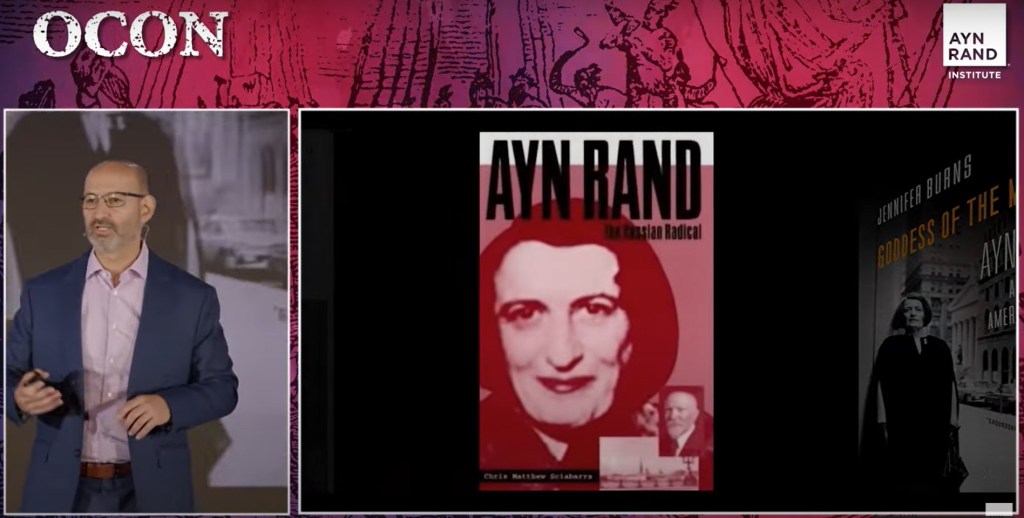
Ayn Rand: The Russian Radical, on-screen behind Tal Tsfany during the time frame: 29:39–30:11
Rand Scholarship: Central Planning versus Spontaneous Order
Which brings me to another significant issue concerning the nature of scholarship in general and Rand scholarship in particular.
In 1998, I had reported on a virtual renaissance in Rand scholarship in Reason Papers. That was followed up by a similar article in Philosophical Books, discussing “Recent Work” on Ayn Rand (2003). The number of scholarly publications on Rand’s life and thought have expanded exponentially since then, as I discussed in my 2024 encyclopedia entry on Rand for Twentieth-Century Literary Criticism. While many of the works cited in those essays were written by ARI-affiliated scholars, most published works on Rand — pro or con — have been generated by writers across the globe coming from vastly different philosophical and ideological perspectives.
For example, Feminist Interpretations of Ayn Rand (1999), coedited by Mimi Gladstein and me, provided a lively discussion of Rand’s complex relationship to feminism. Though the anthology featured past and current feminist critiques of Rand, it also included essays that viewed Rand’s work as an inspiration for individualist feminism. Among the nineteen authors were Barbara Branden, Nathaniel Branden, and Joan Kennedy Taylor, each of whom had had a personal relationship with Rand. Not a single ARI-affiliated scholar is listed among the contributors. Mimi and I invited some of those scholars to contribute to the anthology. Each declined the invitation. One suggested that they might participate if the volume were renamed “Objectivism vs. Feminism,” a nonstarter since the Feminist Interpretations collection was part of the Pennsylvania State University Press “Re-reading the Canon” series. The Rand volume sits alongside more than thirty other volumes dedicated to feminist “re-readings” of the works of philosophers such as Plato, Aristotle, Spinoza, Locke, Kant, Wollstonecraft, Hegel, and Nietzsche, among others.
That anthology and my book created such a stir that academic periodicals, at long last, took notice of Rand scholarship. In 1999, The Chronicle of Higher Education published an article by Jeff Sharlet, “Ayn Rand Has Finally Caught the Attention of Scholars,” and Lingua Franca published an article by Scott McLemee: “The Heirs of Ayn Rand: Has Objectivism Gone Subjective?” These articles discussed not only my work—which provoked scathing denunciations from both Rand officialdom and Rand critics who refused to take her ideas seriously—but also the growing body of scholarly publications devoted to examining Rand’s philosophy.
In that same year, I became a founding coeditor of The Journal of Ayn Rand Studies (JARS). I am proud to have helmed the publication of over 400 articles by nearly 200 authors in the two-plus decades of the journal’s run. Those articles crossed virtually all disciplines, written by a remarkably diverse group of authors, from Slavoj Zizek, Bill Martin, and Gene Bell-Villada to George Reisman, Jerry Kirkpatrick, and David Kelley. No “party line” was safe, since the journal featured spirited dialogue and critical exchanges on countless contentious topics in Rand studies. In over two decades of JARS publishing, only one writer was a then-current ARI-affiliated scholar; he subsequently issued a public apology, repudiating his own contribution to the journal, and calling for a boycott of JARS and my work. Aspects of the adversarial relationship between JARS and ARI is a subject I’ll discuss in a future post.
I’ve often argued that scholarship proceeds by a kind of hermeneutic: as more people enter a dialogue, each brings to that dialogue a personal context of knowledge with which to interpret the texts under consideration. Our initial assumptions are challenged by the text we encounter. The text affects our evolving comprehension, and our evolving comprehension sheds greater light on the various levels of meaning contained within it. The tacking back and forth between the intentions of the author as expressed in the text and the perspective of the interpreter creates a tension that advances the dialogue further.
It is inevitable that competing schools of interpretation will emerge, and the debates will intensify regarding the original author’s meaning, and the implications and applications of the author’s ideas to changing contexts of time and place.
For example, Karl Marx left a vast corpus of published works for future scholars to contemplate. But Marx’s long-time collaborator, Friedrich Engels, published many of Marx’s works posthumously, including two additional volumes of Capital and four volumes on Theories of Surplus Value. Years later, significant correspondence between Marx, Engels, and others were published by various publishing houses. All these works have become part of the Marxian corpus. No institute could have predicted or directed the diverse interpretive turns taken by writers who have identified themselves as Marxists.
Other thinkers, such as Eduard Bernstein, provided “revisionist” critiques of some of Marx’s ideas, while adhering closely to the Marxian paradigm. In Russia, Georgi Plekhanov took Engels’s writings on the dialectics of nature and developed a more formal “dialectical materialism.” Vladimir Lenin applied Marx’s theories to the context of a “pre-capitalist” country (Russia) and developed Marxist-Leninist ideology. The ideas of Sigmund Freud and Wilhelm Reich were integrated with some of Marx’s earlier, more “humanistic” works, by the Frankfurt school of Theodor Adorno, Herbert Marcuse, Jürgen Habermas, and others. Now, in the twenty-first century, we can read and evaluate a wide array of perspectives on Marx and his worldview: the Aristotelian Marx (Scott Meikle, Carol Gould), the Hegelian Marx (Georg Lukacs), the dialectical Marx (Bertell Ollman), the analytic Marx (John Roemer, G. A. Cohen, Ben Burgis), and the Marx-influenced “market socialists” (James Lawler, David Schweickart). All these developments emerged from the writings of thinkers inspired by Marx’s framework. And as their work has multiplied, it has become a scholarly industry, permeating political economy and aesthetic criticism, cultural anthropology and the critique of “hegemony” (as pioneered by the Italian Marxist, Antonio Gramsci).
Of course, I suspect that Marx would not have approved of every iteration in his name. Ayn Rand once expressed a spiritual affinity with Marx on this issue:
If you wonder why I am so particular about protecting the integrity of the term “Objectivism,” my reason is that “Objectivism” is the name I have given to my philosophy — therefore, anyone using that name for some philosophical hodgepodge of his own, without my knowledge or consent, is guilty of the fraudulent presumption of trying to put thoughts into my brain (or of trying to pass his thinking off as mine — an attempt which fails, for obvious reasons). I chose the name “Objectivism” at a time when my philosophy was beginning to be known and some people were starting to call themselves “Randists.” I am much too conceited to allow such a use of my name. (This made me feel a little bit of sympathy for Karl Marx who, on being told about some outrageous comments made by some Marxists, answered: “But I am not a Marxist.”) (Rand 1980, 1–2).
Both Rand and Marx shared legitimate concerns about the integrity of their worldviews. But once an idea enters the world, nobody can direct its development. The creator of a system of thought can try to control that development throughout her lifetime. But once that theorist is dead, their ideas live on. And as more information is generated about their work through posthumous publications and archival discoveries, the ideas take flight. Not even ‘central planners’ could have charted the evolution of Marxist ideas. All ideas evolve and go in directions that nobody could have predicted. This development is often dictated by changing contexts of time and place and the interpretive interests of those who engage the ideas.
To be clear, I do not believe that Tal Tsfany is suggesting that the Ayn Rand Institute should ‘centrally plan’ the development of Rand scholarship. The Institute has developed extraordinary educational and outreach programs. Many of its scholars have done fine work to advance the cause of Rand studies within the Institute, and as contributors to several anthologies centered on Rand’s fiction, and as members of the Ayn Rand Society of the American Philosophical Association (Eastern Division), which has published exceptional volumes of selected conference papers on ethics, epistemology, and politics. But not even ARI’s writers constitute a monolith. Even they have disagreed with one another on select issues. They too are engaged in the “spontaneous order” of interpretive developments that have brought Rand studies to maturity.
Nevertheless, it is simply not the case that without the Institute, there would be only disjointed activities, distortion, dilution, and dismissal. Countless scholars outside the Institute have devoted their lives to understanding and grappling with Rand’s work — not diluting or dismissing it. Even ‘fellow travelers’ who have been critical of aspects of Rand’s worldview have engaged those critics who dismiss and distort her ideas with strawman attacks that are almost always accompanied by the all-mighty smirk. Rand herself understood that participants in intellectual discourse must be willing to “rock the boat.” As she put it: “It is obvious that a boat which cannot stand rocking is doomed already and that it had better be rocked hard, if it is to regain its course …” (Rand, “The New Fascism: Rule by Consensus,” in Rand 1967, 203).
Rand studies have benefitted from a lot of boat-rocking. I’m tempted to say that ‘boat-rocking’ comes with the territory. These studies have evolved over time among writers impacted by Ayn Rand for whom boat-rocking is a fact of reality, whether they call themselves Objectivists or not.
I am not an Objectivist. I am a Rand scholar. But Rand’s work influenced me in a profound, life-altering way. My own reconstruction of Rand’s work as a dialectical project is something that most likely would have abhorred her. But in viewing dialectics as “the art of context-keeping,” it is impossible not to see core dialectical insights in the structure of her thought, in her rejection of the mind-body dichotomy and all its resultant dualisms, in her repudiation of the false alternatives in modern philosophy, and in her grasp of social relations and problems as reciprocally related within a larger system, understood across time.
I do not believe that interpretive developments — be they “orthodox” or “heterodox” — are anything to fear. As different interpretations of Rand’s worldview emerge, they become part of the spontaneous growth of an ever-expanding scholarly community.
That community will benefit immeasurably from what Tal Tsfany has outlined in his OCON presentation on the fortieth anniversary of the Ayn Rand Institute. Rand scholars from across the interpretive landscape should welcome ARI’s planned expansion of its deeply cherished archives and its promises of greater accessibility. I dare say that the availability of these archival sources can only fuel an even greater renaissance in Rand scholarship — “the likes of which nobody has ever seen before,” to paraphrase a familiar public figure.
Postscript #1 (July 23, 2025). This essay has prompted much discussion on various forums. Here are some additional comments that I’ve made:
On Rand’s and Peikoff’s positions on relativity, quantum mechanics, and evolution, I wrote:
This points to an issue I raised in my essay as to whether every opinion voiced by Rand is part of Objectivism. I even cited the history of science and the meaning of scientific theories as issues we might question among Rand’s own pronouncements and whether these and other voiced opinions of hers are to be considered part of “Objectivism,” foundationally speaking.
Ironically, Tibor Machan made an excellent point in one of his essays on Rand, which I cite in my own Russian Radical. Rand rejected cosmology and the importation of whatever was current in scientific theory into the foundation of metaphysics. As I put it: “Philosophy, then, begins with the knowledge of everything-in-general. It begins with that which exists. Physics, by contrast, requires greater particularity. Like all theories, the hypotheses of physics may change with the growing context of knowledge. …. As Tibor Machan (1992) notes, Rand’s Objectivism is based on ‘an open-minded ontological pluralism, and an (almost) anything goes, (almost) Feyerabendian, laissez-faire attitude toward the methods of empirical investigation’” (Sciabarra [1995] 2013, 124).
That said, Rand, Peikoff, and others sometimes stepped outside the philosophical realm to voice their own opinions about certain scientific theories. In my view, their voiced opinions, on Objectivism’s own grounds, should not be imported into the philosophy’s ontology. FWIW, John McCaskey questioned Peikoff and David Harriman’s account of the history of science and their assumptions about induction—and was subsequently purged from the Ayn Rand Institute.
Whatever Rand said about basic philosophical issues might certainly be considered “closed” in Objectivism. And anyone who adds to her framework ought to take credit for what they added, even if it doesn’t alter the “closed” nature of the philosophy’s fundamental framework. However, Rand herself admitted that the elaboration of any philosophy was a task that no one individual could finish in a lifetime. So, the door was left open to further elaborations and explorations of the applications and implications of Objectivism. This is one of the issues that led to the Peikoff-David Kelley split (another being that David had the audacity to speak before a largely libertarian audience of the Laissez-Faire Supper Club).
If a philosophical tradition is so “closed” to further elaboration, then it is transformed into a sclerotic, religious dogma.
I should add that “Objectivism”, the name that Rand gave her philosophy, is everything she said it was, but if it is to be a living philosophical tradition, then it becomes a wide-open philosophical tradition. “Objectivism” viewed as a concept, as a “text developing over time,” is open-ended. In Russian Radical, this is one of the reasons that I incorporate so many thoughts and observations by those who have been associated with Objectivism—from Peikoff and Binswanger to Nathaniel Branden, Barbara Branden, George Walsh, and David Kelley—into my exposition of the philosophy’s evolved meaning. As I put it, Objectivism “contains its history and its future. It must be understood in terms of both its historical origins and its post-Randian evolution. The existential conditions from which it emerged and to which it speaks are in large part what give it its very significance. So, too, its meaning continues to unfold through a clash of interpretations offered by followers and critics alike.” By clarifying these conditions and factors, the book attempts to provide an enriched appreciation of Rand’s contributions.
On Nathaniel Branden, Barbara Branden, and Robert Hessen:
I met Nathaniel Branden and Barbara Branden in the 1990s and they became very dear friends of mine. Long before we met, they provided extensive commentary and constructive criticism of an earlier draft of my book, Ayn Rand: The Russian Radical. Given the stories I’ve heard about the culture surrounding “The Collective”, especially during the days of the Nathaniel Branden Institute (NBI), I suspect I would not have had such a deep and enduring friendship with them. I think Nathaniel progressed dramatically from the NBI culture in the years after his break from Rand. He became a much more empathetic and caring human being. Barbara was a sweetheart as well.
As for Robert Hessen, we also became very good friends. He was one of the earliest Advisory Board members for The Journal of Ayn Rand Studies and always provided great advice and fine insights. I know that he was not thrilled with Nathaniel in the NBI days. And yes, indeed, what got Bob Hessen into hot water with Peikoff and company was his praise of Barbara Branden’s biography, The Passion of Ayn Rand. That said, he was very close with Barbara; they even participated in an auction of Rand memorabilia for Butterfield & Butterfield in 1998. Nathaniel met them there and it’s my understanding that they had all reconciled. There is some discussion of that auction here, which includes a group photo of all of them.
In response to a reader who was once attracted to Objectivism for its claims of “rationality”, but now finds it “unserious”, I wrote the following:
In my essay, I listed a whole slew of opinions that Rand held, which, for me, were cringe-worthy—everything from her positions on a woman president and homosexuality to her take on various philosophers, artists, and composers, and even the history of capitalism. But even if I reject all those opinions, I still take her philosophic worldview seriously. (I also question if these opinions can or should be separated from the philosophy proper, which opens up a whole debate on what is ‘open’ and what is ‘closed’ in “Objectivism”.)
The cultic aspects of Rand’s philosophy—or her “movement” to be more precise—were there as far back as the 1960s. It’s nothing new; it’s been ridiculed, laughed at, and criticized for nearly 70 years. Breaks, schisms, purges were all part of the furniture in the room.
In no way, shape, or form was I ever a part of “organized” Objectivism—too young for NBI and old enough to know the difference for ARI. My contact with Rand’s work was entirely first-hand. It was never filtered through the cultic personalities of the movement or any of the organizations, “official” or not.
There are those who were part of the official movement who found its atmosphere to have been “airtight” (to use a Randian phrase). Some of them have attested to being damaged by the experience, almost to the point of having PTSD. It is infuriating that those who claimed rationality as a mantle attempted to inspire loyalty through the manipulation of fear. I count myself fortunate that I was never a part of any group and hence had no worries about getting kicked out. And if I had been an adult back in the days when all this was going on, my Brooklyn attitude probably would have landed me on the street outside any number of Rand’s Manhattan apartments.
It was only after I wrote the outlines of my book that I got to know folks like Nathaniel Branden, Barbara Branden, and David Kelley. When I met them in the 1990s, they were all far removed from the slavish, cult-like behavior of Rand’s most orthodox followers.
In fact, those who were most “orthodox” were, perhaps, the most virulently opposed to my scholarly work on Rand. One critic went so far as to characterize Ayn Rand: The Russian Radical as a “truly grotesque example” of academia, “a book that is preposterous in its thesis, destructive in its purpose, and tortuously numbing in its content.” Given that my book was on display at the ARI 40 celebration (see the image above) as an example of the heretical, I wear that badge with honor.
So, I haven’t had a problem referring to Rand on any number of issues. But I approach Rand and Objectivism the way I approach every thinker and tradition. As I’ve said before: “Take what gems you can find in each writer and/or school of thought you are exposed to; give credit where credit is due; criticize that which you reject (but … understand what you’re accepting and what you’re rejecting), and Move the F&*k On!”
I have done this with Rand and all those influenced by her, and with all the variants within Austrian economics, anarchism, libertarianism, Marxism, critical theory, and dialectical methodology. The ideological rigidity prevalent in each of these traditions is something that I have always rejected. But I have learned quite a bit by being intellectually engaged, rather than a card-carrying member of any of the movements they inspired.
That approach has enabled me to live a much more intellectually enriched life.
Postscript #2 (July 25, 2025)
On the issue of “essentials” in Objectivism
I certainly agree that the fundamentals of the philosophy are in Atlas Shrugged. It is for that reason that I think folks should focus far more attention on ‘core essentials’ than on every opinion ever uttered by Rand, including any errors she may have made in her readings of other philosophers—none of which impugns the essence of her own philosophy. I also agree that one doesn’t need “mentoring” to grasp Rand’s thought. Certainly give-and-take among like-minded or even critical readers can be helpful to understanding any aspect of Objectivism. However, folks who are competent to read Rand for themselves have no need for any institute or organization to “show them the way.” I came to Rand first-hand, without any such help, and I believe I was all the better for it (though some might disagree with that!).
David Kelley has argued: “Like any other philosophy … Objectivism has an essential core: a set of basic doctrines that distinguishes it from other viewpoints and … that anyone in substantial agreement with those doctrines is an Objectivist.” But he also acknowledges that Rand’s explication of the system had nowhere near the comprehensiveness of other thinkers in the history of philosophy. As I’ve said, Rand herself acknowledged that the elaboration of any philosophy was a task that no one individual could finish in a lifetime. That opens up the whole project of a larger philosophical undertaking, one that far exceeds Rand’s—and our—lifetimes.
Ever since, folks have debated who is and who is not an Objectivist. It’s a tiring debate. Yes, there are aspects of philosophical psychology that are embedded in many of Rand’s works, even prior to her interactions with Nathaniel Branden. And yes, Rand’s nonfiction essays and lectures expand on the meaning of Objectivism’s essentials, as collected in such books as “Introduction to Objectivist Epistemology,” “The Virtue of Selfishness,” “Capitalism: The Unknown Ideal,” and, at the very least, her view of the role of art in human life as discussed in “The Romantic Manifesto.” All these writings are certainly helpful in understanding the implications and applications of the core ideas of Galt’s speech, as are those articles and lectures of others who learned much from Rand.
But as David suggests, to preserve every last statement in these books as part of the “purity and integrity of the system,” and “to pounce on thinkers who might have been … allies” along the way, has neither served to advance knowledge nor to encourage independent thinking. I can think of no better way to transform a philosophy into a dogma.
Postscript #3 (July 26, 2025)
On systematization in Rand’s thought
I do think believe that Rand’s work is systematic in two ways: First, in general, the core branches of her philosophy ‘fit together’. I can disagree with her opinions on plenty of topics, but there is a certain ‘logic’ to the ways in which her epistemology connects to her ethics and her politics, for example.
Second, I do believe that what I call Rand’s “dialectical sensibility” is reflected throughout her worldview in many ways: her rejection of ‘false alternatives’ across the board (most of them manifestations of the ‘mind-body dichotomy’, as she sees it), and her rejection of the ‘false alternatives’ in modern philosophy. This dialectical rejection of dualism redounds throughout her corpus.
Moreover, there is a systematic character to her critique of social problems. I don’t agree with all her opinions or prescriptions, but I do believe that my reconstruction of that critique as a tri-level model of social relations of power captures something inherently radical and systematic about her approach.
Now, Peikoff would argue, quoting Hegel, that “The True is the Whole.” The problem with that approach is that the orthodoxy has never made it clear just what constitutes that whole. If we include every opinion ever expressed by Rand, well, there are so many conflicting, mutually contradicting aspects to Rand’s views on so many issues that any “system” which includes these is marked by patchwork inconsistency. I enumerate quite a few of these views in my essay—from her stance on various thinkers, artists, and traditions to the history of capitalism to her personal views on sexuality.
I stand by my conviction, that with every thinker, systematic or not, take the gems of wisdom you find, give credit where credit is due, critique that which requires criticism, and move on. This “ecumenical” approach tends to transcend ideological rigidity of any kind.
Again, I do not consider myself an Objectivist. I will always give credit to Rand for the impact she made on my thought. Of course, I consider myself a Rand scholar. But I’m also a scholar of the work of other thinkers who have made a huge impact on my intellectual development—from Friedrich Hayek and Murray Rothbard in the Austrian tradition to Bertell Ollman in the Marxist tradition.
Selected References
Burns, Jennifer. 2009. Goddess of the Market: Ayn Rand and the American Right. Oxford: Oxford University Press.
Campbell, Robert L. 2017. “Six Years Outside the Archives: The Chronicle of a Misadventure, in Three Acts.” The Journal of Ayn Rand Studies 17, no. 1 (July): 68–83.
Ghate, Onkar and Harry Binswanger. 2022. “Of Schisms, Public and Private.” Introduction by Tal Tsfany. Ayn Rand Institute — New Ideal (5 March).
Gladstein, Mimi Reisel, and Chris Matthew Sciabarra, eds. 1999. Feminist Interpretations of Ayn Rand. University Park: Pennsylvania State University Press.
Gotthelf, Allan and Gregory Salmieri, eds. 2016. A Companion to Ayn Rand. Chichester: John Wiley and Sons.
Peikoff, Leonard. 1991. Objectivism: The Philosophy of Ayn Rand. New York: Dutton.
Rand, Ayn. 1967. Capitalism: The Unknown Ideal. New York: New American Library.
Rand, Ayn. 1968. “A Statement of Policy, Part I.” The Objectivist 7, no. 6 (June). In The Objectivist: Volume 5–10, 1966–1971. Palo Alto, California: Palo Alto Book Service, 471–73.
Rand, Ayn. 1980. “To the Readers of The Objectivist Forum.” The Objectivist Forum 1, no. 1 (February): 1–2.
Sciabarra, Chris Matthew. [1995] 2013. Ayn Rand: The Russian Radical. Second edition. University Park: Pennsylvania State University Press.
Tsfany, Tal. 2025. “Spreading Objectivism: A Vision for ARI’s Future.” OCON 2025. (3 July).

 Notablog