One of my Facebook pals put up this map yesterday of how the vote shifted in New York City between 2020 and 2024.
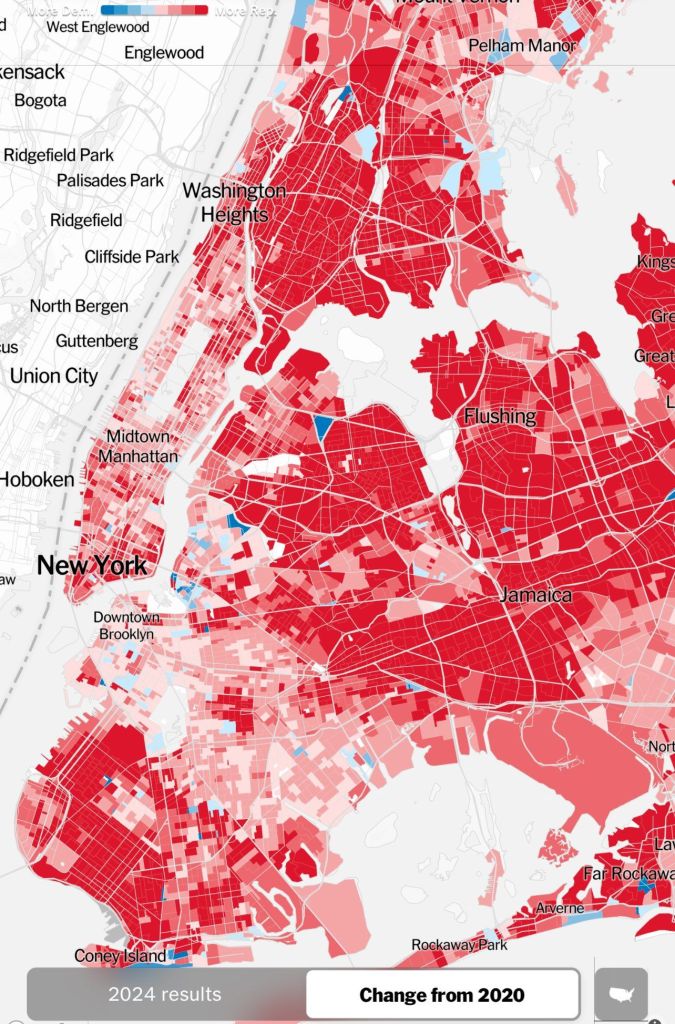
This is not to say that all those precincts went red. Indeed, the Democrats still won NYC (as shown by the vote tallies below). Rather, the above results show the change from four years ago. Here are two maps comparing the trends in voting (2020, 2024):
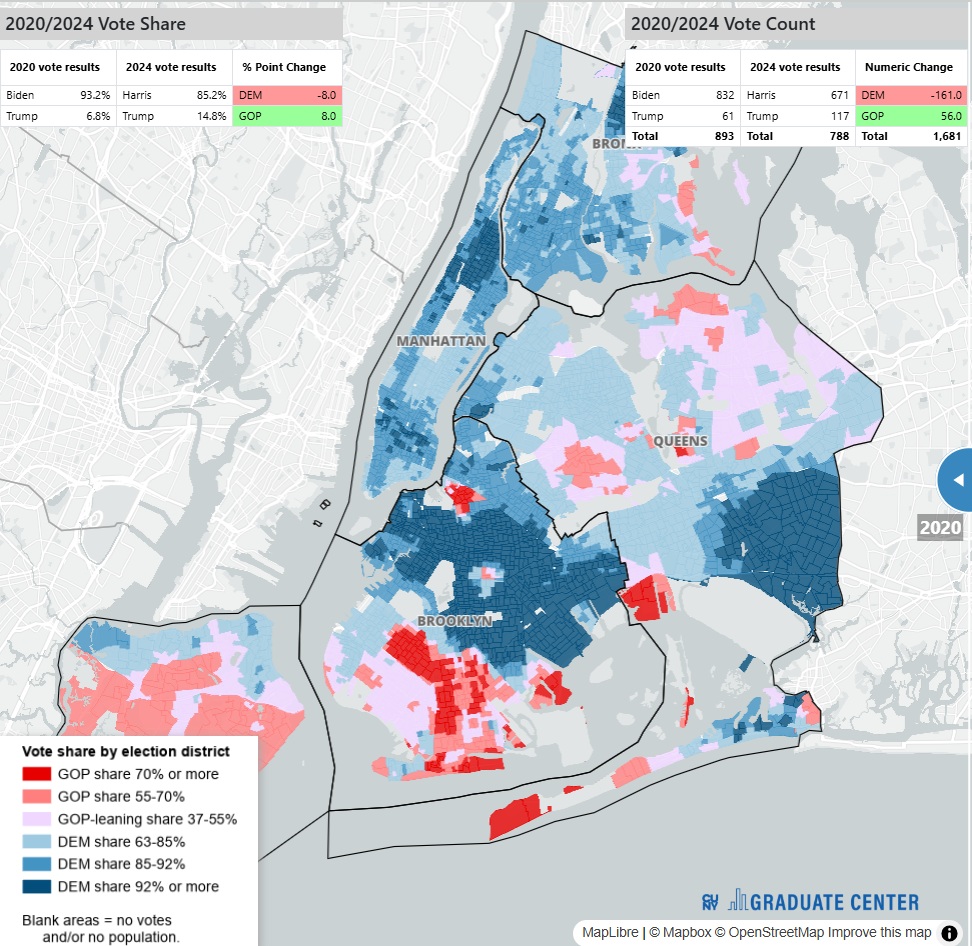
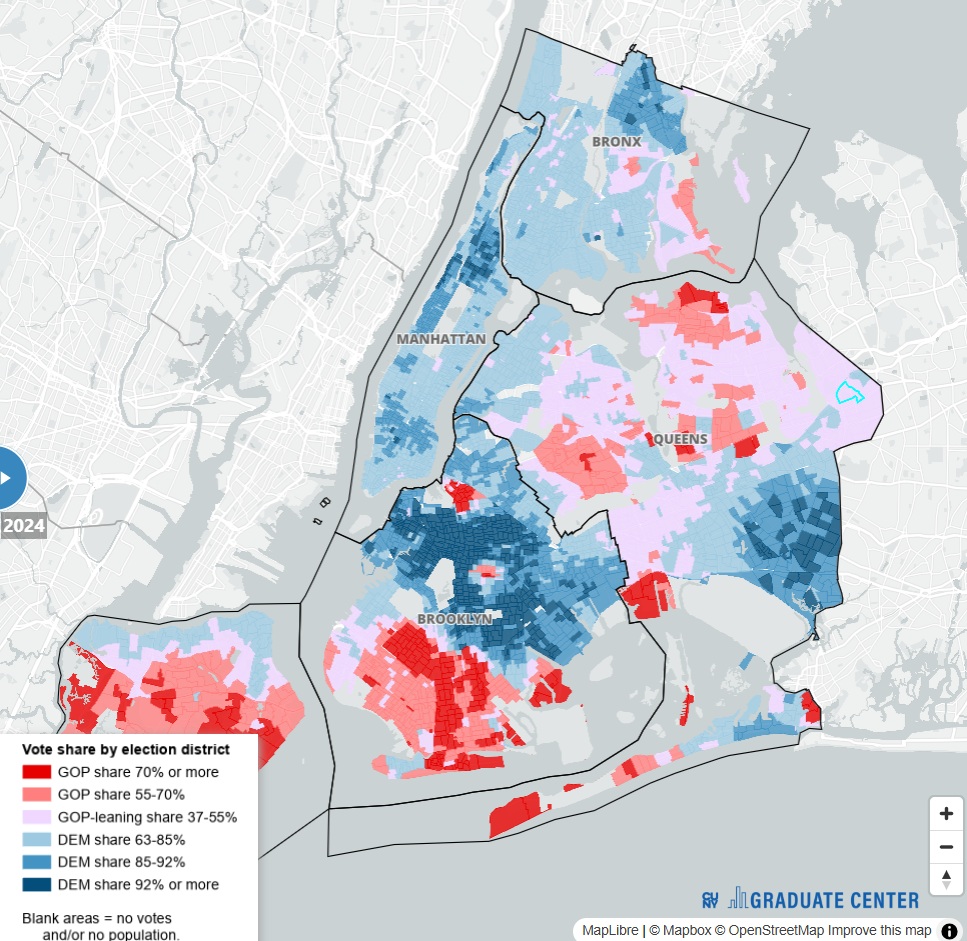
It doesn’t matter that the city ultimately voted Blue. The shift has been striking.
Back in July, I was shouting from the rooftops that this was the trend in “The Battle for New York.” “I Told You So” is not enough of a reply.
Note that the shift is mostly in the outer boroughs, in many working class neighborhoods, not in what is considered to be the wealthier sections of Manhattan. (And, of course, Staten Island was solidly red.)
Back in 2022, even as the Democrats performed better than expected in the midterm elections, Lee Zeldin performed better than expected against Governor Kathy Hochul.
There is no doubt that the “migrant” issue has played a big part in the shift, along with concerns about affordable housing, the cost of living, and a perceived uptick in high-profile crimes. (Overall, crime stats are actually down in the city, but even the uptick doesn’t remotely compare to the crime wave of the late 1980s-early 1990s).
While New York is proudly a city built on immigration, the politicized nature of recent waves of immigration has galvanized many communities. This is nothing new. Back in the 1990s, in the wake of the fall of the Berlin Wall, many New Yorkers were incensed by a wave of Russian immigrants who came to the city as political refugees. Having had a history of navigating through the labyrinth of government programs in the former Soviet Union, many of these immigrants put in the time and effort to get food stamps, Medicaid, and other social service benefits that were being offered to them. The anger and resentment of those New Yorkers who argued that their parents and grandparents came here and got nothing was understandable. At the time, I told my neighbors that if their parents and grandparents had been offered those benefits and didn’t take them, they’d only be put at a comparative disadvantage. But instead of aiming their discontent at the problems inherent in the system, their ire was directed at the new arrivals.
The same thing has happened over the last few years, but to a far greater degree of intensity as an estimated 200,000+ people were bused from Texas and Florida into the five boroughs. The resentment is palpable because, as a sanctuary city, New York (or, rather, New York taxpayers) provides billions of dollars to take care of the living needs of these new arrivals. This includes provisions for shelter, food, healthcare, education, legal assistance, and pre-paid debit cards for additional supplies.
And as new migrant and homeless shelters open, communities strike back. I can tell you that in my old Gravesend neighborhood, the Asians along 86th Street have been beating drums all day and night for months in opposition to a proposed migrant/homeless shelter. This is the kind of political football that the GOP used greatly to its advantage.
And if you add in the insanity of congestion pricing (and yes, I believe it is insane)—which might lessen congestion below 60th street (let’s check back on this in six months), even as it pushes congestion above 60th street and into the outer boroughs and New Jersey, not to mention spiking the costs for all those businesses operating in the congestion zone, who will merely pass on those costs to consumers with higher prices—this was a political time bomb waiting to be lit.
And mind you, it’s not the Democrats who first pushed this idea on NYC; it was Mayor Bloomberg, a Republican/Independent at the time, who proposed it in 2007. (Various other plans to slap tolls on Harlem River and East River crossings were proposed more than 50 years ago by Mayor Lindsay, also a Liberal Republican, but they never had a chance politically.) Folks dismissed Bloomberg’s congestion pricing plan and viewed him as a wealthy, disconnected elitist, who didn’t give a hoot about the economic impact on those outside (or even inside) the congestion zone who couldn’t afford to pay the price. That Governor Hochul paused congestion pricing until after the election—which every cynical New Yorker knew was going to happen—only heightens how disconnected these people are.
As an aside, I should add that many advocates of congestion pricing, including the libertarians at the Cato Institute, are clueless about its application in NYC. The problem in this city is that the plan is being floated as a panacea for both traffic congestion and for raising funds for the seriously mismanaged Metropolitan Transit Authority, responsible for the vast public transportation network of subways and buses. If revenue is the issue, it would have been easier to go back to the idea of putting tolls on all the bridges and tunnels in NYC, but even that would place an inequitable burden on those living in Queens and Brooklyn who travel across the East River. How about really raising the fares on subways and buses—not just 10 or 15 cents—so that the folks using public transportation bear the costs? Well, that would tick off straphangers and have an impact on working class riders! So, since a dramatic rise in the fares is politically untenable, let’s take it out on the motorists—including those who simply can’t take the subways to their Manhattan destinations.
The MTA has pushed the congestion pricing plan as a means of funding its pet projects and bloated bureaucracy, even as it can’t clamp down on fare beaters who cost the city nearly $800 million in lost revenue last year. Their representatives speak out of both sides of their mouths: With one breath, they say that congestion pricing will ease traffic below 60th street. With another breath, they don’t want traffic eased below 60th street, because if people find alternative ways to get around the congestion pricing zone, the MTA won’t get the revenue they hope to reap from the plan. Is it any wonder that so many dismiss this fiasco as a money grab?
If not the Democrats, then somebody, somewhere has to start addressing the real problems in this city, not just traffic congestion. How about addressing affordable housing, the cost of living, high taxes, problematic regulations? How about looking at creative alternatives to zoning restrictions and land use? If current trends continue, real solutions will not be in the offing. Because any politician or party that stokes the fears of those impacted by very real economic and sociological changes has a sure path to victory.

 Notablog