Review of Ayn Rand: Writing a Gospel of Success, by Alexandra Popoff. New Haven and London: Yale University Press, 2024, 264 pp, notes, index
Back in 2002, Jeff Walker, author of The Ayn Rand Cult (1999), sent me an unfinished manuscript tentatively titled The Jewish/Nietzschean Worldview of Ayn Rand. Sadly, it was never completed. Except for a few minor discussions of Rand’s Russian Jewish family background in various biographical studies, the only other work that comes to mind in this field is Orit Arfa’s 2018 book, Ayn Rand and Esther: How ‘The Fountainhead’ Can Illuminate Our Understanding of Esther, Israel, and the Jews.
Alexandra Popoff’s new biography, Ayn Rand: Writing a Gospel of Success, part of the Yale University Press book series, “Jewish Lives”, makes an important contribution to this field of inquiry. The book offers a stylized, crisp narrative that is unflinching in its portrait of Rand’s career and life. It pays specific attention to what the author sees as the Jewish subtext of Rand’s work. Popoff writes:
To succeed in America during the inter-war years, when anti-Semitism was rampant, many Jewish immigrants sought to bury their differences. Rand did not openly identify with Jewish issues, but when she spoke on behalf of American capitalists, defending ability, profit, and wealth, she was also fighting Jewish stereotypes. Her characters received gentile names but remain perceptibly Jewish in their otherness, defiance, and morality. (x)
Popoff tells us that she was “commissioned to write this biography” because of her own “ethnic background as a Russian secular Jew and immigrant to North America” (xi). One of her central themes is to trace “connections between Rand’s formative years in a traditional Jewish milieu and the stories she told in her books” (xi). Popoff observes correctly that Rand was “admired and attacked for her radical views,” but “that writers cannot hide themselves in a literary text, even when they go back to revise it, as Rand had done” (xi-xii). Though Rand “had claimed that being Jewish did not matter to her, … her Jewishness was about the text, crammed full of ideas, parables, paradoxes, questions, and arguments. Her fictional stories are moral and legal at the same time” (xii). This “new material and special focus” of Popoff’s book does, indeed, “make it different from previous biographies” (xii).
The book benefits from Popoff’s access to the Ayn Rand Archives, especially Rand’s correspondence with her relatives in Russia. She draws a compelling portrait of Rand’s early life in Russia and her journey to the United States. She threads this narrative with many important facts about Jewish life and thinking.
A Russian Jewish Life
For a woman who boldly declared her atheism, Rand gave no public acknowledgment during her lifetime of having been raised by a Jewish family. We surely would have discovered more about Rand’s early years had she not destroyed her diaries before she left the Soviet Union. Rand claimed that she decided to become an atheist at the age of 14. Given that this was in 1919, Popoff proposes that “it was probably the reality of the civil war that turned her into a nonbeliever” (27). Alas, we’ll never know.
What we do know is that the civil war had a devastating impact on Russia and on Rand’s family. But the reality of antisemitism in Russia long predated the revolution.
As Popoff explains, the young Alissa Rosenbaum grew up in Saint Petersburg, “a city where Jewish achievement in many spheres—from business to cultural life—was conspicuous” (4). She reminds us that during the civil war, when her family left Petrograd and traveled through Ukraine, they encountered the White Army “led by former tsarist commanders, many of them anti-Semitic,” prompting “anti-Jewish violence, which reached unprecedented levels during the civil war. Although the Bolsheviks had discouraged the violence, they could not control it. As many as 150,000 Jews were killed in the pogroms” (21-22).
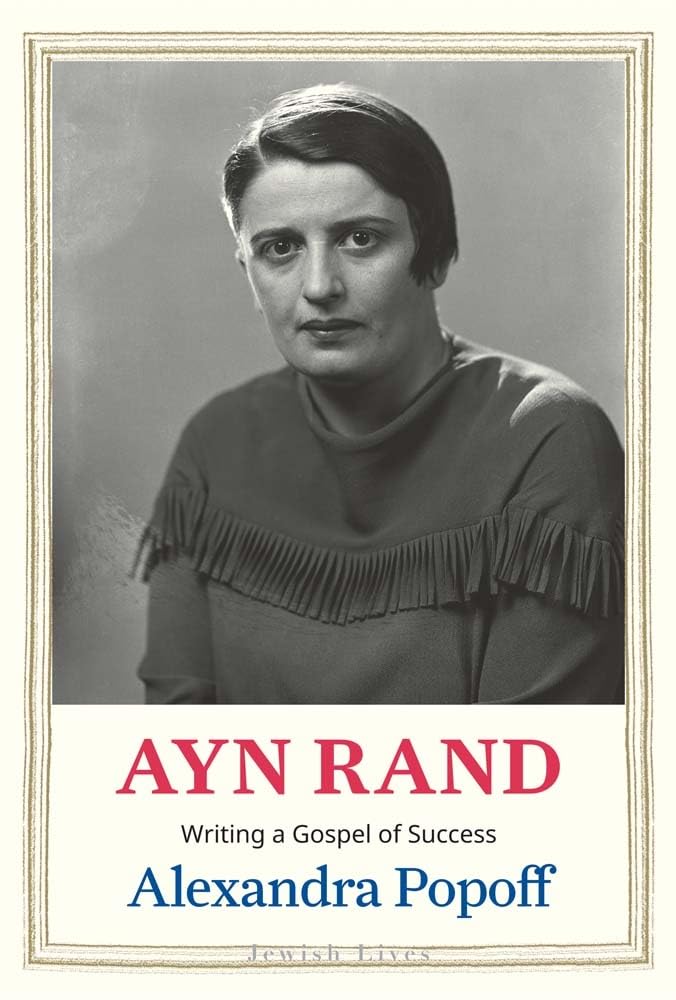
When the family returned to Petrograd, Rand entered the university and received a high-quality education. Popoff also tells us more about Rand’s enrollment at the Leningrad State Institute for Screen Arts, where Rand “studied acting, biomotion, and screenwriting for one full year.” She remarks that Rand’s “portrait in a turban, taken as a school assignment, was displayed in the window of the Alexander Borovikovsky photo studio on Nevsky Prospect” (41). (A photo of that portrait appears in Jeff Britting’s beautifully illustrated 2004 book, Ayn Rand. Sadly, except for its cover art, Popoff’s book lacks illustrations.)
Popoff highlights Rand’s relationship with Lev Bekkerman, her first love. Bekkerman’s rejection of her was fortuitous. Had she stayed with him, she most assuredly would have perished—like him—as a victim of the Soviet system.
The correspondence between Rand and her family from which Popoff draws extensively is both poignant and, at times, heartbreaking. En route to the United States in 1926, Rand received a letter from her mother: “You may consider yourself a second Columbus opening America, for none of us have ever been there.” And from her father, the plea: “Don’t forget us, hostages” (46). Upon her arrival, her mother congratulated Rand: “Having tackled the ocean, start wrestling with the ocean of life” (47).
Rand’s early fiction, from “Red Pawn” to her first novel, We the Living, was an attempt to grapple with her Russian past. Popoff believes that Rand never quite got “Russia out of her system. She never entirely succeeded because the revolution, civil war, and Bolshevik dictatorship determined her worldview, the black and white colors of her art. The world in her fiction is split between freedom and tyranny; the good and evil in her characters do not mix. But We the Living is an exception: her characters are not abstractions” (68). I will address this Manichaean view attributed to Rand a bit more below.
Personally, I’ve always found Rand’s We the Living to be the most realistic and tragic of Rand’s works. That’s largely because it’s semi-autobiographical. Its exploration of the theme that a totalitarian state creates an “airtight” environment that stifles human survival and personal flourishing is brutal partially because it draws from real-life events.
Ayn Rand and Evgeny Zamyatin
There were other themes that Rand also absorbed from her Russian past. One of Popoff’s most important revelations is that in 1922, at the age of 17, Rand applied to the Institute of the Living Word, which was “founded by a group of prominent writers and scholars in 1918.” It doesn’t appear that Popoff has uncovered Rand’s actual application to the Institute. Rather, she cites a letter to Rand from her sister Natasha, which apparently refers to this application. The letter is dated 26 February 1928 (212 n13).
Though Rand never mentioned attending this institute (36), Popoff argues that Rand most likely enrolled in the literary division, where she would have listened to phonographic recordings of readings by Andrei Bely, Aleksander Blok and others. As I point out in my book, Ayn Rand: The Russian Radical, Bely and Blok were among the Russian Symbolists, who “constituted one of the most important cultural movements of the age.” They “attempted to transcend the polarity in Russian culture between Westernizers and Slavophiles.” One can find in their work the paradoxical embrace of Christian messianism and the Dionysian aspects of Nietzsche’s philosophy. “They challenged both materialism and asceticism, positivism and rationalism, Marxists and czarist authoritarians” (30). Their beliefs were an extension of the broader impact of Nietzsche on the Russian Silver Age into which Rand was born. Indeed, Rand later praised Blok as “a magnificent poet,” even as she criticized his “ghastly” sense of life (407 n19).
But the real takeaway of Popoff’s revelation here is her discovery of what may very well be an explicit link between Rand and Evgeny Zamyatin, author of the classic dystopian work, We. Popoff explains that Zamyatin was a “highly influential writer, critic, and literary heretic, … among the few intellectuals who dared to openly resist the collectivism and conformity of the socialist state” (36). Many scholars have traced the similarities and differences between Zamyatin’s We and Rand’s Anthem. Among these studies are Z. Gimpelevich’s 1997 essay, “‘We’ and “I” in Zamyatin’s We and Rand’s Anthem (Germano-Slavica) and Peter Saint-Andre’s 2003 essay, “Zamyatin and Rand” (The Journal of Ayn Rand Studies).
In “Anthem in the Context of Related Literary Works,” which appears in the Robert Mayhew-edited collection, Essays on Ayn Rand’s ‘Anthem’, Shoshana Milgram—whose two-volume biographical work on Rand is forthcoming—discusses Zamyatin’s impact, and addresses Rand’s possible familiarity with his work. Quoting from Rand’s Biographical Interviews from 1960-1961, she writes:
More than thirty years after she came to the United States, [Rand] recalled her reading during her college years: ‘There were a couple of modern novels by Russian writers that were semi-anti-Soviet or thinly veiled anti-Soviet that I liked for that reason, but that was minor. I don’t even remember the authors’ names.’ Zamyatin’s We fits the general description, in that it was not openly or explicitly anti-Soviet, but merely susceptible to an anti-Soviet reading by those who wanted (or feared) such an approach. But this book, although read aloud before many audiences, was not available in published form, and it was clear that the book was considered ‘little short of treason’ by the Soviet officials, and it had ‘the distinction of being the first novel banned by the Glavlit (Chief Administration for Literary Affairs), established in 1922.’ If she had made the effort to find it or to attend a reading of it, it is likely that she would have also made note of the name of the author or the work. (137)
Milgram adds this important caveat:
Discovering relevant information about any contact between the writers would require historical study—of Zamyatin’s writing and teaching, of the Soviet literary milieu, and of the lives of both writers in Petersburg in the early 1920s. One might, for example, investigate the possibility that she might have attended Zamyatin’s speech in late October, 1921, at an evening meeting of the House of Writers dedicated to the memory of Blok, her favorite poet. … Such an inquiry would require Russian sources. (167 n50)
In her research, Popoff has discovered that Zamyatin was invited to lecture at the Institute of the Living Word and hypothesizes that Rand most likely met him at the institute (36). Popoff argues that Rand “probably attended Zamyatin’s courses in Petrograd on contemporary literature and the craft of writing” (87). She explains: “In his essays and lectures, which [Rand] probably audited, he called on the Russian intelligentsia to defend individual rights and values. Zamyatin’s theory of synthetic prose apparently influenced Rand. In his article ‘The New Russian Prose,’ he wrote that realistic depiction of daily life ‘no longer fits the concept of contemporary art’. Zamyatin advocated … a blend of romanticism and realism. … Rand … would define her literary method as romantic realism” (36-37).
In Chapter 5 of her book, “I versus We”, Popoff traces some similarities between Anthem and We. Though she reminds us that biblical references appear in an early draft of Anthem, and that allusions to Genesis and the book of Ruth remained in the final 1946 edition of Rand’s novella (90-91), I was hoping for more extended substantive comparisons between Rand and Zamyatin. There is only so much that could have been explored in the mere nine pages that she devotes to this fascinating subject. But clearly, she has advanced a provocative hypothesis that links the two writers much more explicitly than any previous studies.
The Fountainhead
The chapter on The Fountainhead (1943) contains some real gems. I enjoyed Popoff’s illustration of the ways in which Rand’s correspondence with her family in the 1930s inspired the development of that novel’s themes. Her father, Zinovy Rosenbaum, criticized those “masses of mediocrities” who undercut the talented. “They instinctively struggle against everyone who is exceptional and hold him back as not to let him rise above the crowd. … But despite this and much more, the talent will achieve recognition. … The talent will find a way!” (97-98). In these exchanges, Rand and her father express a love of the prime movers who exhibit an “inner integrity” (98)—an essential characteristic of the novel’s protagonist, Howard Roark. Barbara Branden quotes from her biographical interviews, in which Rand expressed deep affection for her father, which was rooted in their discussion of ideas. “It was when he and I began discussing ideas, … when we became political allies, that I felt a real love, a love that meant something” (The Passion of Ayn Rand, 4).
Popoff proposes several examples of the Jewish subtext in Rand’s novel. She claims that Howard Roark “resembles the type of the ‘new Jew’ imagined by Zionists, who replaced Jewish powerlessness in the Diaspora with traits necessary to succeed in Palestine” (100). Popoff also draws an interesting parallel between the destruction of the Stoddard Temple and “the destruction and desecration of the Holy Temple,” which “serves to amplify the vandalism of the collectivists” (104). In Roark’s buildings, “[c]reativity substitutes for the Christian promise of eternal life” (104). For Popoff, Rand’s celebration of the integrity of the creators who fight against all odds to actualize their ideals is an implicit acknowledgment of “centuries of Jewish discrimination in the Diaspora, Jews’ striving to succeed in an alien majority culture by the means available to them, their own intellect and perseverance. Through Roark, Rand tells the story of the marginalized beating the odds, and of her own trial and triumph as an immigrant” (106-7).
Later in her book, in her analysis of Atlas Shrugged, Popoff quotes Jordan Peterson from a 2018 conference, in which he argues that “‘stories lay out broad principles,’ and all major stories have a religious core.” Popoff recognizes that “Rand knew the value of biblical stories” (151). Indeed, in her 1968 introduction to The Fountainhead, Rand brought attention to the religious subtexts in the novel. She quotes from the book’s dialogue in which Hopton Stoddard observes: “You’re a profoundly religious man, Mr. Roark—in your own way. I can see that in your buildings.” Roark agrees: “That’s true” (The Fountainhead, x).
Rand understood why readers saw religious themes in her work. She argued that religion had dominated so much of what we understand as reverence, sacredness, exaltation:
Religion’s monopoly in the field of ethics has made it extremely difficult to communicate the emotional meaning and connotations of a rational view of life. Just as religion has pre-empted the field of ethics, turning morality against man, so it has usurped the highest moral concepts of our language, placing them outside this earth and beyond man’s reach. (xi)
Rand clearly grasped the context of what came before her; her attempts to alter that context fundamentally required her to use the language and symbolism bequeathed by another tradition entirely, in pursuit of her own ‘transvaluation of values’, so-to-speak. It is not without coincidence that she initially opened each section of The Fountainhead with an epigraph from Nietzsche. She restored one of Nietzsche’s quotations in her 1968 introduction: “The noble soul has reverence for itself” (xii). As I observe in Russian Radical:
Though Nietzsche’s writings are open to widely divergent interpretations, there is much evidence to suggest that his tribute to human greatness, to a ‘blessed selfishness, the wholesome, healthy selfishness, that springeth from the powerful soul’ was rooted in his exposure to the works of classical antiquity. Walter Kaufmann argues persuasively that Nietzsche’s projection of the reverence of the ‘noble soul,’ the very quotation that Rand placed in her introduction to the twenty-fifth anniversary edition of The Fountainhead, emerges from an Aristotelian base. Kaufmann cites sections of Aristotle’s Nicomachean Ethics dealing with the ‘great-souled man.’ As a lover of self, the ‘great-souled man’ rarely asks for the assistance of others. He is a being of self-esteem, caring ‘more for the truth than for what people think.’ Nietzsche appropriated these very themes in his own paean to individual excellence.” (218)
I’ll have more to say about the importance of Rand’s debt to both Aristotle and Nietzsche below.
Popoff makes yet another provocative observation in her chapter on The Fountainhead. She mentions Rand’s engagement with Old Right figures such as Albert Jay Nock, whose edition of Herbert Spencer’s The Man versus the State Rand owned and read. She argues that Rand was “obviously influenced by [Spencer’s] theories” (110), which is the first claim I’ve read of any explicit influence of Spencer on Rand—though I suspect it’s more of a Nockian influence than a Spencerian one. Indeed, Popoff sees parallels in Rand’s early distinction between the “Creative” and the “Political” spheres in human activity and Nock’s distinction between “economic man” and “political man”, so crucial to his book, Our Enemy the State.**
As an aside, I should note that Popoff makes a glaring error in her discussion of one plot point. In examining the controversial “rape” scene in The Fountainhead, Popoff writes: “But in the novel Dominique tells Wynand that Roark raped her, so the episode will continue to create confusion” (102). I have not read the novel in about 30 years, but I was certain that such a scene didn’t exist—that Wynand, in fact, knew nothing of the previous relationship between Dominique and Roark. I checked with my dear friend and colleague Mimi Reisel Gladstein, who assured me that my memory was intact.**
__
** Postscript: In a Facebook discussion of this review, my friend Roderick T. Long provides more on the connections between Herbert Spencer and Ayn Rand; see his essay, “Spencer: A Paterson-Rand Connection.” And given my own placement of Rand and Spencer in a dialectical-libertarian tradition, see also my essay: “The First Libertarian“. Roderick also corrects both Mimi and me on Wynand’s knowledge of the Dominique-Roark relationship: “Dominique tells Wynand that Roark raped her in part IV, section 17: ‘I met him when he was working in a granite quarry. Why not? You’ll put him in a chain gang or a jute mill. He was working in a quarry. He didn’t ask my consent. He raped me. That’s how it began. Want to use it? Want to run it in the Banner?’” (Thanks, Roderick, and apologies to Alexandra Popoff!)
Atlas Shrugged
After detailing Rand’s success with The Fountainhead, Popoff turns to Rand’s magnum opus, Atlas Shrugged (1957). Popoff sees in Rand’s novel “an essentially Jewish theme,” in which “successful industrialists [are viewed] through the prism of Jewish experience.” In her later essay on business as “America’s Persecuted Minority,” Rand claimed that American businessmen are
a small and productive minority who hold the economy on their shoulders … and are penalized for their achievements, not faults. … Further dramatizing the theme, she goes on to say that American businessmen, like racial and religious minorities, have to function under special restrictive laws. ‘In Soviet Russia, the scapegoat was the bourgeoisie; in Nazi Germany, it was the Jewish people; in America, it is the businessmen.’ This rare direct reference to the Jewish people is meant to draw attention to her cause of laissez-faire capitalism. (143-44)
Though the author offers no argument for her contention that Galt’s Gulch is “a patriarchal society of traders,” she stays on theme by drawing parallels between Rand’s “merit-based” values and “notions of Jewish intellectual prowess” (148). She sees in Galt’s Gulch “the archetypal story of Noah,” in which “the flood reaches a climax” and “the socialist world perishes because of corrupt morals and social structure” (149). Like others before her, Popoff recognizes religious iconography at work when Rand replaces “the cross, the symbol of sacrifice, with a dollar sign, which she associated with freedom of the mind and of trade.” At novel’s end, Galt raises his hand “over a desolate earth” and traces “the sign of the dollar” (151).
For Popoff, however, there is a downside to all this. In Atlas Shrugged, “Rand’s focus on production invokes an unfortunate parallel with the works of socialist realism” (144). Of course, I’d go further here; there are significant parallels between Marx’s focus on production and Rand’s—see especially the section on “Productive Work” in chapter 9 of Russian Radical (see also my comparisons of Rand’s romantic realist credo and socialist realism, 195ff). Popoff writes:
The Soviet industrial novel is populated with cardboard characters who are heroically dedicated to manufacturing steel, cement, and other necessities. In Atlas Shrugged morality is similarly fused with politics and economics. Everything that benefits laissez-faire capitalism is a virtue. The traits impeding economic progress are vices. Rand vindicates productive and talented businessmen and dehumanizes their enemies. (144-45)
She adds that Rand’s “angry novel … employs the violent and divisive language of Soviet politics,” echoing its “Manichaean view of the world … dividing characters into heroes and villains … [in which] the villains are physically annihilated” (146).
While a case can certainly be made that Rand employs a kind of dualism here, not enough attention is paid by Popoff to the ways in which Rand portrays the codependency of ‘masters’ and ‘slaves’ in conditions of structural decline, and how the ‘trader principle’ rises above the sacrifice of self to others and others to self. A similar problem arises with Popoff’s claim that “Rand’s absolute rejection of altruism” is somehow opposed to evolutionary psychology, which views “altruism [as] ingrained in human nature” (151). Aside from the contentious issue of ‘ingrained’ human characteristics, much of the debate centers on what we mean by altruism. Rand argues that human beings are nourished through their social relations and that they can achieve solidarity and share communitarian values, a clear outgrowth of their rational self-interest. But all this requires institutional and cultural structures that don’t undermine human sociality.
On Rand’s Relationships
In Chapter 9 of her book, Popoff turns to the crucially important relationship between Nathaniel Branden and Ayn Rand. It was through Nathaniel Branden and Barbara Branden that Rand developed a circle of admirers of The Fountainhead, ‘The Class of ‘43’ (the year in which the novel was published). Rand referred to this group as ‘The Collective’. Most of its members, except for art historian Mary Ann Sures (born Mary Ann Rukavina) “were children or grandchildren of eastern European Jewish immigrants, transitioning from the religion of their father to secularism. These young people looked up to Rand as their moral guide” (165). Popoff believes that Rand “felt most comfortable with ethnic Jews, provided, of course, that they shared her ideas.” But I think the emphasis is misplaced; there were plenty of eastern European Jewish intellectuals in New York City who decidedly did not share her ideas, and no amount of ‘ethnic’ comfortability could have bridged that gap. The key here is that the group surrounding her shared her ideas and wanted to learn more about their implications.
In this chapter, Popoff provides a fair assessment of the success of the Nathaniel Branden Institute and Rand’s embrace of the role of public intellectual. During this period, Rand published several nonfiction books on ethics, politics, aesthetics, and epistemology, which brought together essays first published in The Objectivist Newsletter and The Objectivist. Her discussion of the Rand-Branden affair and its damage to the Objectivist movement acknowledges “Rand’s many contradictions,” where “despite rejecting traditional morality, she remained old-fashioned, reluctant to reveal her affair” publicly (169).
I was, however, struck by Popoff’s repetition of the story of the origin of Nathaniel Branden’s chosen name. Born Nathan Blumenthal, his “new surname captured ‘Rand’ in both English and Hebrew, making him ‘son of Rand,’ ‘ben Rand.’ Like her other converts, Nathaniel became Rand’s spiritual son” (166). Having asked Nathaniel Branden about this directly and read many accounts of this, I’ve never been able to verify this story.
Of far greater significance is Popoff’s original research that brings to light some of philosopher John Hospers’s letters to Rand. Whereas Letters of Ayn Rand included many of Rand’s letters to Hospers, and Hospers would later publish a two-part memoir of his “Conversations with Ayn Rand” in Liberty magazine (1990), this is the first time I’ve seen any discussion of how Rand received news of Hospers’s sexual orientation. Popoff writes:
Challenging Rand’s conservative views, he brought up homosexuality. Hospers was made to resign his position at the University of Minnesota because of an accusation that he was homosexual. In his letter to Rand of September 26, 1961, he revealed his sexual orientation and told her about discrimination of sexual minorities, or students refused admission to graduate schools on mere suspicion of being homosexual. Importantly, this revelation did not affect his personal relationship with Rand. In 1968, during a question period at Ford Hall Forum in Boston, she said that she did not approve of homosexual practices or regard them as moral but believed that government laws prohibiting homosexuality should be repealed. (174-75)
Though Rand was libertarian on that score, her comments were deeply hurtful to her many LGBT+ fans. She said quite explicitly that homosexuality was “disgusting,” but that little bit never made it into the book, Ayn Rand Answers (2005), edited by Robert Mayhew, which Popoff cites. (My own monograph, Ayn Rand, Homosexuality, and Human Liberation, discusses these issues at length.)
Still, it’s an important revelation that Rand didn’t reject Hospers for his sexuality. She didn’t reject her own gay brother-in-law, Nick Carter, with whom she had a good relationship, or the many people she knew in Hollywood who were gay. The end of her relationship with Hospers came in the wake of an October 1962 conference on aesthetics that took place at Harvard University. Hospers engaged in a standard ‘academic’ critique of some of the views she presented in her paper on “Art and Sense of Life”—and Rand viewed it as a betrayal, storming out of the conference room. They never reconciled or saw each other again.
In examining Rand’s contentious personal relationships throughout her life, Popoff confronts the belief of some “that Rand’s stony facade concealed fear and insecurity” (153). She relates this to Rand’s Russian Jewish identity:
Living in her safe neighborhood, in a building with a doorman, Rand still bolted her door with steel locks, a habit of many Russian immigrants. … Although Rand had created herself in the image of her heroic characters, she harbored a typically Jewish—and immigrant—dichotomy between self-confidence and insecurity. Like other eastern European Jews who had witnessed lawlessness, war, and privation, she viewed America as a safe haven. For decades she was afraid of venturing abroad and of taking a plane, thinking it might be hijacked by Stalin’s agents. (154)
I couldn’t help but take pause reading this passage, when only 40 pages before, Popoff also mentions that in 1942 Rand had been prescribed Benzedrine, an amphetamine, to help her work long hours without sleep. Popoff emphasizes that the drug was addictive and “known to cause mood and mental disorders. Rand was burning her candle at both ends” (114). Other writers, such as “W. H. Auden, Graham Greene, Arthur Koestler, and Jean-Paul Sartre also took Benzedrine to sustain inspiration. Only Greene managed to break his dependency” (221 n51). Back in 1944, writer Isabel Paterson, who was a mentor to Rand, warned her friend repeatedly to “stop taking the ‘dope’ that her doctor said wouldn’t hurt her: ‘Stop taking the Benzedrine, you idiot. I don’t care what excuse you have—stop it’” (Stephen Cox, The Woman and the Dynamo: Isabel Paterson and the Idea of America, 2004, 304; 399 n19).
Alas, Rand didn’t stop. As Jennifer Burns acknowledges, Rand’s well-documented usage of Benzedrine and a similar prescription “continued … on a daily basis until the 1970s (Goddess of the Market: Ayn Rand and the American Right, 321 n40). The “boomerang” effects of this drug (89) and its possible contributions to Rand’s “emotional fragility” (178) cannot be ignored, especially since regular amphetamine use is known to have deleterious side effects on the central nervous system, causing irritability, anxiety, and paranoia.
Rand Contra Antisemitism and Racism
That said, no prescription drug could have prepared Rand for the firestorm that her work ignited. The hostility came from all quarters. Leftists were appalled by Rand’s moral defense of capitalism, while conservatives, such as Whittaker Chambers writing for National Review, saw Rand as “an enemy of Christianity,” something that Popoff dismisses as but another “old accusation to Jews” (157).
There were some pleasant surprises along the way. Alvin Toffler, who interviewed Rand for Playboy, projected the writer as “as an influential outsider.” For Popoff, this was “a role Jews have played for generations, living in majority cultures while questioning conventional values and beliefs” (192).
Popoff also documents the ways in which Rand, who never publicly identified as Jewish, stood up against antisemitism and racism. Popoff admits that not even in Rand’s journals or correspondence can one find any mention of “the Holocaust or anything that dealt with pain and suffering, experiences imprinted on the Jewish psyche” (112). But Rand did not stand by idly when she saw antisemitism rear its ugly head. As Popoff explains:
In May 1947 Rand resigned from MPA [the Motion Picture Alliance] over a conflict with [James K.] McGuinness, a known anti-Semite. She did not openly explain her decision but later similarly withdrew her support for another organization tainted with anti-Semitism. In the 1960s she resigned as a speaker from WBAI-FM radio station without explaining her reason. It is known, however, from her unsent letter to the radio station: “The specific reason is that WBAI permitted an obscene anti-Semitic ‘poem’ calling for the killing of Jews, and an obscene utterance, praising Hitler’s atrocities, to be broadcast over its facilities.” As is apparent from the agonized drafts of the letter, anti-Semitism concerned her deeply, even as she claimed that her ethnicity did not matter to her. (125-26)
In an endnote, Popoff states further: “In her notes Rand charges the radio station with promoting racist and anti-Semitic views and using free speech to justify racial hatred” (222 n27). Though “Rand was reluctant to reveal her background as a Russian Jew,” she would speak up when “faced with anti-Semitism” (140). This point is driven home by Harry Binswanger, whom Popoff interviewed for her book. Binswanger recalls an incident “involving a mutual female acquaintance, Jewish by birth, who failed to respond to anti-Semitic vitriol at a gathering. ‘Ayn held that it was morally obligatory to say you were Jewish, and that she had done so herself, even though she was an avowed atheist.’ Binswanger remembers Rand’s illuminating remark: ‘The only time I’m Jewish is when I hear anti-Semitism’” (203).
Popoff also notes that Rand was an ardent defender of Israel, even donating money to its cause (194). Popoff does not address Rand’s criticisms of the socialist, religious, and tribalist elements in Israel’s economy and culture (see Russian Radical, 318). Nor does she address Rand’s denigration of Arabs as primitive and nomadic.
Still, in principle, Rand repudiated racism as “the lowest most crudely primitive form of collectivism” (“Racism”, 1963). In the 1960s, she voiced her virulent opposition to the Jim Crow-enforced segregation of the South. Back in the 1940s, she sympathized with a Japanese American family, whose business had been confiscated after Pearl Harbor. She employed the couple and paid their unskilled daughter generously as the first typist of Atlas Shrugged, enabling her to go to college (128).
Minor Interpretive Issues
Some of Popoff’s interpretations of relatively minor issues are open to debate. Often these are interpretations that emerge from her framework, which focuses on the specifically Jewish subtext of Rand’s work and attitudes. For example, early in her book, Popoff observes that Rand’s dislike of beards may have been “a sign of psychological self-distancing from the [Jewish] religion and poverty of the Pale” (15). Well, that’s certainly possible. On the other hand, I suggest in Russian Radical that
the wearing of the beard had deep significance in Russian cultural history. Modeled after the icons of the saints, the wearing of the beard was a traditional practice of Orthodox religious ritual. When Peter the Great ushered in an era of Westernization, he introduced laws against such Orthodox beards. In 1705 Peter imposed taxes and license fees on those who chose to remain unshaven. The cultural battle between the ‘beards’ and the ‘non-beards’ was a battle between the Orthodox-Slavophiles and the Westernizers. … Rand’s preference for a clean-shaven appearance may have reflected her general esteem for the Westernizers. (404 n. 29)
Granted, neither of these hypotheses may be correct. My point here is that on most issues open to interpretation, Popoff tends to look for the Jewish connection as the reductive explanation.
There are also interpretive issues that emerge when Popoff drops the context of Rand’s intellectual evolution over time. For example, she claims that in We the Living, Rand portrayed the private traders under Lenin’s ‘New Economic Plan’ as “black marketeers and speculators.” She argues that Rand’s view of these private traders was a by-product of her having “detested … a mixed economy.” She states that “[i]n America Rand would forcefully argue against a mixed economy and government interference of any kind; to understand this, one has to know that she lived through the NEP” (34-35).
While it’s certainly true that such an experience would have made an impact on Rand’s later views, there’s no evidence that Rand rejected the mixed economy at the time she authored We the Living. Milgram has shown that Rand criticized capitalists in her earliest writings. In her 1926 Russian monograph, Hollywood: American Movie-City, Rand portrays film studio owners and executives as the enemy of “the new and unusual.” While it’s possible that some of this text may have been altered by the Soviets, Milgram argues persuasively that even if Rand never approved those changes, “there is at least a possibility that Ayn Rand herself had a similarly negative view” of business and capitalism. Even in her earliest extant journals, Rand lamented the “unprincipled and corrupt” world of capitalism, which was devoid of values. It wasn’t until the late 1930s and 1940s, as Rand learned more about American politics from the likes of Paterson that her views of the “unknown ideal” of free-market capitalism began to take shape.
Popoff does not discuss Rand’s aesthetics, but even her brief mention of it has a certain inaccuracy. “Rand maintained,” Popoff states, “that her judgments were objective, that beauty and goodness had little to do with the reactions of the observer: all aesthetic qualities were included in the object” (174). That statement converts Rand’s concept of the “objective” into an intrinsicist notion of aesthetic judgment—which was not Rand’s view. On this point, see especially the first four essays in Rand’s book, The Romantic Manifesto. (I discuss these themes as well in chapter 8 of Ayn Rand: The Russian Radical.)
Problematic Use of Primary Source Material
In the Acknowledgment section, Popoff tells us that she received permission to conduct research remotely during the pandemic at the Ayn Rand Archives. Of course, she notes that such access to the Archives, with the cooperation of the Ayn Rand Institute and Leonard Peikoff, executor of Rand’s estate, did not imply any endorsement or recommendation of her work (207).
By far, the most important original source material used by Popoff are the extensive quotations from family letters held by the Ayn Rand Archives, dating from 1926 through the 1930s and 1940s. Some additional correspondence dates from the 1960s and 1970s. Most other (non-family) letters are quoted from Michael Berliner’s edited collection, Letters of Ayn Rand (1995) or from essays by writers such as Richard Ralston, Scott McConnell and Jeff Britting, published in various Robert Mayhew-edited anthologies on Rand’s fiction. A few other primary sources from the Archives are also noted, including Rand’s 1950 “Perfection Desk Calendar,” marking the date and time of Nathaniel Branden’s first visit with Rand. Among the biographies and memoirs, there are citations to Anne Heller’s Ayn Rand and the World She Made and Jennifer Burns’s Goddess of the Market: Ayn Rand and the American Right. Popoff also cites Scott McConnell’s 100 Voices, which includes many (edited) interviews, Barbara Branden’s Passion of Ayn Rand, and Nathaniel Branden’s Judgment Day (the first, not the second edition, of his memoir). Jeff Britting’s Ayn Rand is also cited. There are also references to a Russian biography of Rand written by Lyudmila Nikiforova and Mikhail Kizilov (Ayn Rand, 2020).
Except for a single reference to the “Oral History with Ayn Rand, Conducted by Barbara Branden” (220 n28), communicated to the author by Jeff Britting, there are no references to the extremely important 1960-1961 Biographical Interviews.
Throughout her book, Popoff quotes liberally from the highly problematic Journals of Ayn Rand, edited by David Harriman (which is first cited in her endnotes, 213 n22). Given that Popoff admires Burns’s book on Rand (xii), I am perplexed how Popoff seems to have skipped over Burns’s crucial warnings regarding Harriman’s editing of the Journals:
Unfortunately, there are grave limitations to the accuracy and reliability of the putatively primary sources issued by Rand’s estate. Discrepancies between Rand’s published journals and archival material was first publicized by the Rand scholar Chris Sciabarra, who noticed differences between Journals of Ayn Rand (1999) and brief excerpts published earlier in The Intellectual Activist. After several years working in Rand’s personal papers I can confirm Sciabarra’s discovery: the published versions of Rand’s letters and diaries have been significantly edited in ways that drastically reduce their utility as historical sources. (Goddess, 291).
While Burns also confirms that the previous publication of Letters of Ayn Rand (1995) has no alterations, she observes that they are incomplete and that the “omissions are of high interest to the historian.” She was not as generous in her assessment of Harriman’s work on the journals:
The editing of the Journals of Ayn Rand (1997) is far more significant and problematic. On nearly every page of the published journals, an unacknowledged change has been made from Rand’s original writing. In the book’s foreword the editor, David Harriman, defends his practice of eliminating Rand’s words and inserting his own as necessary for greater clarity. In many cases, however, his editing serves to significantly alter Rand’s meaning. (291-92)
Burns observes that while some of the changes are stylistic, they obscure “evidence of [Rand’s] lingering difficulty with idiomatic and vernacular English.” Moreover, Harriman’s “editing also obscures important shifts and changes in Rand’s thought. … Even more alarming are the sentences and proper names present in Rand’s originals that have vanished entirely, without any ellipses or brackets to indicate a change.” Indeed, back in 1998, I noted that the name of Albert Jay Nock, present in passages published in The Intellectual Activist, was airbrushed from the Harriman book.
Burns continues:
Considered individually, many of the changes to Rand’s diaries are minor, but taken as a whole they add up to a different Rand. In her original notebooks she is more tentative, historically bounded, and contradictory. The edited diaries have transformed her private space, the hidden realm in which she did her thinking, reaching, and groping, replacing it with a slick manufactured world in which all of her ideas are definite, well formulated, and clear. Even her outlines for her major novels have been rewritten, with different drafts collapsed into one another. Given Rand’s titanic clashes with editors who sought to modify her work, it is not hard to guess what her reaction would be to these changes. (292)
Burns concludes: “The Journals of Ayn Rand are thus best understood as an interpretation of Rand rather than her own writing. Scholars must use these materials with extreme caution” (292). When Burns quotes “from the published diaries,” she reproduces only those sections that she “personally verified as accurate with the archival records,” noting “where important discrepancies exist” (292-93). No such assurances are given by Popoff. Moreover, as I’ve noted further, and as Burns confirms, similar problematic editing decisions “plague Ayn Rand Answers (2005), The Art of Fiction (2000), The Art of Non-Fiction (2001), and Objectively Speaking (2009). These books are derived from archival materials but have been significantly rewritten” (293).
Considering these limitations, it is regrettable that Popoff also provides citations to Ayn Rand Answers. One can only hope that any citations to published correspondence derived from Letters of Ayn Rand, rather than from her own rendering of the original source material, has been verified by reference to the originals. Admirably, Popoff’s citations for John Hospers’s letters to Rand are cross-referenced from both the Ayn Rand Archives and those held by the estate of John Hospers, from whom she received permission to quote.
I should also note that Popoff’s book most likely went to press before the author could refer to several additional biographical and archival studies of Rand and her family, which were published in The Journal of Ayn Rand Studies, including Mikhail Kravtsov and Mikhail Kizilov’s essay, “Archival Discoveries related to Ayn Rand’s Residences in Saint Petersburg” (2022); Pavel Solovyev’s “What She Left Behind” (2023); and Anastasiya Vasilevna Grigorovskaya’s “Ayn Rand’s Years in the Stoyunin Gymnasium” (2023). Popoff can’t be faulted for not having cited these important essays, but her book would have greatly profited from use of the primary source material therein.
Problematic Non-Use of the Secondary Literature
Popoff’s book is clearly a biography written for a series that has specific goals in mind. It is not a scholarly exegesis and cites very little of the secondary literature on Rand. It grapples with no alternative interpretations of the various issues that it addresses. A full scholarly presentation would have required a book of much greater length than the one Popoff has provided. I suspect that its narrow focus was dictated by the limited scope of the series.
Still, it is a shame that there aren’t even a few citations to the secondary literature, which would have provided the reader with a road map to other analyses of Rand’s corpus. Indeed, Rand scholarship has grown exponentially over the past three decades, with volumes published by trade and university presses alike. These include studies generated by the Ayn Rand Society, affiliated with the American Philosophical Association, as well as hundreds of essays published in countless scholarly journals, including The Journal of Ayn Rand Studies, whose interdisciplinary breadth was on display from 1999 through 2023. Given this growing literature, Popoff’s claim that Rand is “outside the literary and scholarly canons” (xi) is questionable. Indeed, her own book is published by Yale University Press—yet one more illustration of a growing canonical Randian presence.
In many instances, Popoff’s exposition would have been greatly enriched by at least mentioning the literature that preceded the publication of her book. For example, Popoff discusses Rand’s years at the Stoyunin gymnasium, without a single mention of Russian Radical, which offered the first published documentation of that early educational experience. It was at that gymnasium that Rand was most likely introduced to the great Russian philosopher, N. O. Lossky, whose in-laws founded the school. Lossky was the only professor named by Rand as among her university teachers—a recollection that Popoff views as “apocryphal” (32). While it may be “apocryphal,” this mysterious aspect of Rand’s biography is an issue I dealt with extensively in Russian Radical. Fortunately, though Popoff ignores my book, she includes three citations to a 2021 article I co-authored with Pavel Solovyev, which is, in my humble opinion, the most definitive discussion of Rand’s university education yet published.
As an aside, I should note that I discussed Popoff’s book with my friend and co-author Pavel Solovyev—who is not responsible for anything I’ve written in this review essay. He had this to say about Ayn Rand: Writing a Gospel of Success: “I would like to express my gratitude to the author of this book for kindly citing the JARS essay about Rand’s education in the Petrograd University (Sciabarra and Solovyev 2021) in the bibliography section.”It should be emphasized, however, that even when Popoff does not cite previous research relevant to her points, she uncovers some interesting historical information. For example, she tells us that the Stoyunin gymnasium “was nationalized in June 1918.” The gymnasium’s “liberal, individual approach to teaching” (15) was replaced by a revised co-ed curriculum and transformed into a “labor school.” Popoff reveals that when Rand left the school, “her vacated place was taken by Dmitry Shostakovich, the future composer” (21).
Regarding Rand’s intellectual debt to Friedrich Nietzsche, Popoff argues that “Rand’s interest in Nietzsche was not unusual for a secular European Jew. The message of cultural renewal and self-realization appealed to early twentieth-century European Zionists, who were aware of a crisis in Jewish tradition.” Nietzsche’s “radical antitraditionalism” inspired these thinkers. What Popoff doesn’t discuss is the larger renaissance of Nietzschean ideas that influenced the Russian Silver Age into which Rand was born. Nietzscheanism was so prolific during this period that its themes can be found among both idealists and Marxists. That’s one of the important issues explored in Russian Radical. But one can also find explorations of this issue in Derek Offord’s 2022 book, Ayn Rand and the Russian Intelligentsia: The Origins of an Icon of the American Right.
Popoff exhibits nuance in her discussion of some highly charged issues in Rand’s biography. Rand’s unfinished, controversial 1928 short story, “The Little Street”, included a protagonist loosely based on William Hickman, who kidnapped and murdered a schoolgirl in California. Some commentators, such as Lisa Duggan in her 2019 book, Mean Girl: Ayn Rand and the Culture of Greed, have viewed this as Rand’s idealization of a criminal, with “an erotic investment in death and destruction” (Mean Girl, 4). Popoff argues to the contrary that Rand’s story does not romanticize criminality. This early Rand celebrates a kind of “nihilist” heroism in which the “pariah” engages in a “radical rejection of established values” (58-59), a very Nietzschean theme. On this point, however, Popoff’s discussion could have been augmented by citations to Aaron Weinacht’s 2021 book, Nikolai Chernyshevskii and Ayn Rand: Russian Nihilism Travels to America.
There are additional lapses in Popoff’s presentation. She includes just a few minor mentions of Aristotle, to whom Rand claimed a major “philosophical debt” (169). There is no exploration of the connections between Aristotelian philosophy and Objectivism, and not a single citation to the vast secondary literature that has explored these connections extensively. Even a couple of citations here would have helped readers seeking further guidance on this topic—and many others.**
__
** Postscript: More kudos to my friend and colleague, Roderick Long, who makes the following point regarding Aristotle: “[A]nother reason a book about Rand’s Jewish side might benefit from discussing him is the long history of Aristotelean influence on Jewish thought, particularly among thinkers who were concerned to combat excessively literalist readings of scripture. Three of the biggest names here are Saadya Gaon, Moses Maimonides (ben Maimon), and Levi Gersonides (ben Gershom). Broadly speaking, they did for Judaism what Aquinas did for Christianity and what Ibn Sina, Ibn Rushd, et al did for Islam.”
Conclusion
Many of my criticisms of Popoff’s book fall under the category of what might have been. At the very least, we need to acknowledge what there is. Popoff has provided a significant addition to the biographical literature on Rand. She has opened the door to interpretive scholarship on the provocative parallels between Rand’s ideas and Jewish thought and identity. I highly recommend it!
A fruitful discussion of this post can be found on Facebook.

 Notablog