In yesterday’s post, “Decision 2024 (II): The Battle for New York,” I expressed my profound disenchantment with the current state of the presidential campaign. I highlighted a recent article by David Brooks in the New York Times, “The Deep Source of Trump’s Appeal.” In today’s post, I delve more deeply into Brooks’s article and the broader issues it raises about a key problem in American politics.
Brooks draws heavily from James Davison Hunter’s book Democracy and Solidarity: On the Cultural Roots of America’s Political Crisis, which I’ve yet to read. That work begins with the sound premise that “a nation’s political life rests upon cultural foundations.” My discussion here of Hunter’s perspective is filtered through Brooks’s interpretation.
The argument goes like this: American culture has rested upon an historical tension between the Enlightenment, which extolled the virtues of individual reason, liberty, deliberation, and democracy—and Religion, which places its faith in a moral order. Religion, of course, has many masks. It has been used to protest the injustices of slavery and discrimination, and it has also been a source of reaction, fueling Prohibition movements against alcohol, drugs, abortion, and sexuality. Each generation engages in a careful balancing act between Enlightenment virtues and religious faith. In the 1960s, as religion waned, moral authority disintegrated into a form of secular relativism and “emotivism.” Americans became increasingly disillusioned with both sides of the divide and in their search for meaning, they embraced identity politics. Brooks summarizes Hunter’s points:
People on the right and the left began to identify themselves within a particular kind of moral story. This is the story in which my political group is the victim of oppression and other groups are the oppressors. For people who feel they are floating in a moral and social vacuum, this story provides a moral landscape—there are those bad guys over there and us good guys over here. The story provides a sense of belonging. It provides social recognition. By expressing my rage, I will earn your attention and respect.
In public discourse, identity politics is more associated with the left. Progressivism used to be oriented around how to make capitalism just; but now in its upper-middle-class form, it’s oriented around proper esteem for and inclusion of different identity groups.
But as Hunter notes, Donald Trump practices identity politics just as much as any progressive. He tells the story of how small-town, less-educated Christians are being oppressed by elites. He alone is their retribution. That story resonates with a lot of people. In the 1950s, Billy Graham assumed that his faith was central to American life. By the 2020s his son Franklin considered himself a warrior under siege in an anti-Christian culture.
The problem with this form of all-explaining identity politics is that it undermines democracy. If others are evil and out to get us, then persuasion is for suckers. If our beliefs are defined by our identities and not individual reason and personal experience, then different Americans are living in different universes and there is no point in trying to engage in deliberative democracy. You just have to crush them. You have to grab power and control of the institutions and shove your answers down everybody else’s throats.
In this climate, Hunter argues, “the authoritarian impulse becomes impossible to restrain.” Authoritarianism imposes a social vision by force. If you can’t have social solidarity organically from the ground up, then you can impose it from top down using the power of the state.
Armed with the guns of identity politics, those on the illiberal right and those on the illiberal left understand the importance of fighting the culture war. They differ in their cultural values, but they share illiberal means of trying to secure them.
While I have important reservations about the source of identity politics as described in Brooks’s article, I think that there are many valid points therein. It should be noted, however, there are plenty of Christian nationalists who would argue that they abhor moral relativism. In the duality of Enlightenment virtues and religious faith, their embrace of the latter to the detriment of the former is deeply problematic—even if they are, indeed, wrapped up in the web of identity politics. More on that below.
American Political Thought 101
The central reservation I have with the Brooks/Hunter argument is that while contemporary identity politics sprouted from the 1960s and 1970s—in the wake of the civil rights movement, the women’s movement, and the movement for LGBT+ equality—intergroup conflict in various guises has been with us since this country’s inception. Indeed, it’s been an omnipresent fact throughout human history. James Madison, author of the classic “Federalist No. 10”—addressed, by the way, “to the people of the state of New York”—provides an insightful analysis of the corrosive “effects of the unsteadiness and injustice with which a factious spirit has tainted our public administrations.” He writes:
By a faction, I understand a number of citizens, whether amounting to a majority or a minority of the whole, who are united and actuated by some common impulse of passion, or of interest, adversed to the rights of other citizens, or to the permanent and aggregate interests of the community. There are two methods of curing the mischiefs of faction: the one, by removing its causes; the other, by controlling its effects. There are again two methods of removing the causes of faction: the one, by destroying the liberty which is essential to its existence; the other, by giving to every citizen the same opinions, the same passions, and the same interests.
It could never be more truly said than of the first remedy, that it was worse than the disease. Liberty is to faction what air is to fire, an aliment without which it instantly expires. But it could not be less folly to abolish liberty, which is essential to political life, because it nourishes faction, than it would be to wish the annihilation of air, which is essential to animal life, because it imparts to fire its destructive agency.
The second expedient is as impracticable as the first would be unwise. As long as the reason of man continues fallible, and he is at liberty to exercise it, different opinions will be formed.
Hence, for Madison, neither the destruction of liberty nor the imposition of conformity is desirable in any attempt to alleviate the “mutual animosity” of contentious interest groups and their negative impact on the polity. Madison saw the “latent causes of faction” as intrinsic to human nature, dividing a society “into different classes.” Though he placed special emphasis on the conflicts caused by inequitable property distributions among “a landed interest, a manufacturing interest, a mercantile interest, a moneyed interest,” and “many lesser interests,” he observed that the factious spirit was sewn into the very fabric of social existence. To the extent that people engage in different activities, hold different religious or political opinions or attach themselves “to different leaders ambitiously contending for pre-eminence and power,” there will be a “strong … propensity … to kindle their unfriendly passions and excite their most violent conflicts.”
He warned that no interest group could judge its own cause without bias. Such groups—especially the landed and manufacturing classes—will legislate on their own behalf and serve neither justice nor the public good. (I’m guessing that Madison would have appreciated Gabriel Kolko’s thesis on the growth of the regulatory state.) Not even “enlightened statesmen will be able to adjust these clashing interests.” Since “the CAUSES of faction cannot be removed,” Madison argued, the only alternative was to provide “the means of controlling its EFFECTS.”
The whole conception of federalism, separation of powers, and checks and balances was designed to frustrate the ability of any interest group to monopolize the tools of power. The founders could never have predicted the emergence and proliferation of the vast regulatory apparatus, of entrenched bureaucracies, and of a kind of interest group politics that would consolidate the power of some, while increasingly fragmenting the power of others along multiple lines of ethnic, racial, and gender differentiation. But they at least recognized that people gravitate toward group identification—factious “tribes”, if you will—and that a constitutional balancing act was required to prevent the monopolization of power by a majority or any group or coalition of groups.
I addressed the implications of this issue in last year’s essay, “Welcome to the Culture Wars: Pride Edition!” I wrote:
… why does it seem that we have reached a point in history where there is this vast proliferation of groups at war with one another? And why has this manifested with such virulence in identity politics?
On these questions, we can draw lessons from … Friedrich Hayek and Ayn Rand. It was Hayek who argued in ‘The Road to Serfdom‘ that as the state comes to dominate more and more of social life, state power becomes the only power worth having. This sets off a war of all against all, in which groups vie for political power at the expense of one another.
Rand saw further that this power struggle was endemic not only to political economy, but to the very genesis of the state, which was born from “prehistorical tribal warfare.” Political elites have historically perpetuated racial hatred, scapegoating and subjugating racial and ethnic groups to secure power. But “the relationship is reciprocal,” said Rand: Just as tribalism is a precondition of statism, so too is statism a reciprocally related cause of tribalism. “The political cause of tribalism’s rebirth is the mixed economy,” marked by “permanent tribal warfare.” In Rand’s view, statism and tribalism advance together, leading to a condition of “global balkanization.”
Since statism and tribalism are fraternal twins, as it were, and the “mixed economy” has always existed in some form, Rand argued that intensifying state domination of social life has an impact on every discernable group, not just every economic interest. Every differentiating characteristic among human beings becomes a tool for pressure-group jockeying: age, sex, sexual orientation, social status, religion, nationality, and race. Statism splinters society “into warring tribes.” The statist legal machinery pits “ethnic minorities against the majority, the young against the old, the old against the middle, women against men, welfare-recipient against the self-supporting.” … Given that these are the conditions that exist, given that “this is a society’s system, no power on earth can prevent men from ganging up on one another in self-defense—i.e., from forming pressure groups.” …
Identity politics, which has proliferated since the 1960s and 1970s, has been characterized as “a political approach wherein people of a particular race, nationality, religion, gender, sexual orientation, social background, social class, or other identifying factors develop political agendas that are based upon these identities.” Typically, “identity politics is deeply connected with the idea that some groups in society are oppressed and begins with analysis of that oppression.” But … an insidious form of “identity politics” has always been at work in this country. It began in this country as a tool of the oppressors, not the oppressed. It began with the “Western” conquest of indigenous peoples, the building of a slave economy, and, later, the tyranny of Jim Crow segregation. “Identity politics” was ensconced in this country’s constitution the moment it allowed states to count three-fifths of enslaved people toward their congressional representation. It was furthered even after slavery met its bloody end in the Civil War, when Southern states relied on Jim Crow laws and the KKK to subjugate, oppress, brutalize, and murder ‘uppity’ blacks who wanted to pursue their own rights to life, liberty, property, and the pursuit of happiness.
Indeed, it was James Madison who warned that the most toxic faction of all is one that emerges “by the superior force of an interested and overbearing majority. … When a majority is included in a faction,” it will “sacrifice to its ruling passion or interest both the public good and the rights of other citizens.” Madison’s observation helps us to understand that marginalized groups today are not engaged in some kind of ‘grand woke conspiracy’; they are reacting to 200+ years of the “identity politics” of an entrenched majority, using political and economic means to redress power imbalances. This historical reality also helps us to understand why today, right-wing traditionalists and Christian nationalists are reacting with such hostility against ‘progressives,’ even as they engage in the same practices of identity politics for which they condemn the ‘woke’ left. On this point, Hunter and Brooks are correct. But they don’t go far enough.
Nationalism and Right-Wing Identity Politics
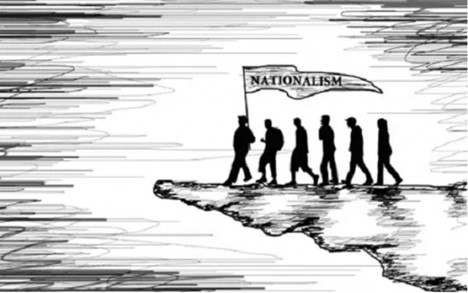
The current incarnation of right-wing identity politics is global in nature. While the peculiarly American context can’t be forgotten, even that context is not isolated from the larger global community in which it is embedded. The MAGA movement is made up of disparate populist and fundamentalist components and its emphasis on nationalism is an extension of a larger global tendency that utilizes fear-mongering xenophobia to consolidate political power. We have seen the rise of ultranationalist illiberal political parties and factions throughout the world, even in many Western European democracies. This tendency is especially prominent in countries like China, Russia, Hungary, and other Eastern European countries, many of whose former “communist regimes created a fertile ground for right-wing nationalism to prosper once they were gone,” as Martin Penov suggests. Hungary’s Prime Minister, Viktor Orban, whom Trump has praised, fully embraces the ideal of the “illiberal democracy.” Penov writes:
During the European Migrant Crisis, Orban styled himself as a defender of Christianity and opposed allowing asylum seekers into the EU. Similar rhetoric has been used to curtail LGBT+ rights in order to protect family values and hinder further European integration in favour of national sovereignty. … Orban has been able to utilise nationalist rhetoric within the (by now) largely Fidesz-controlled media to great effect in order to consolidate his power, framing himself as defending the conservative values of the countryside against the cosmopolitan aspirations of the large city elite. Much like its communist predecessors, the Hungarian government has used nationalism to justify many of its unsavoury practices. From dismantling the rule of law by attacking the independence of the judiciary to the crackdown on civil liberties of minorities, all of Viktor Orban’s authoritarian turns have been justified under the guise of protecting the interests of the nation, often from an alleged European interference. … Promoting nationalist policies has shown to be a prerequisite for increasingly authoritarian measures and the erosion of democratic institutions.
Alex Nowrasteh and Ilya Somin argue further that even as nationalism “has gained ground in many European countries over the last decade,” it is now the “dominant ideology on the American political right.” In the United States, the ethnocentric ideas of nationalist conservatives are manifested “in the form of industrial policy, protectionism, and immigration restrictionism. … To preserve their dominance and promote their interests, nationalists here and elsewhere advocate government control not only of the culture, but of the economy as well.” Just as troubling is the nationalist tendency to idolize the head of state as the embodiment of the nation. While this cult of personality is not unique to nationalism, it is one of its distinguishing characteristics. Those who feel disenfranchised look for leaders who are perceived as projecting “strength, charisma, and the will to succeed.” Sound familiar?
Nowrasteh and Somin understand that identity politics is at the core of nationalism:
Its foundational principle is that government exists to protect the national culture against potential dangers—including other domestic groups and the potential spread of their cultures. To promote the dominant group, government must have the power to act assertively on its behalf, which necessarily means constraining others. … Nationalism’s implication of identity-based discrimination has reemerged among some conservative nationalists today. The popularity of the “great replacement” theory (the notion that nefarious elites are using non-white immigrants to “replace” native-born Americans) on much of the right is the most blatant example. … One of the lessons of history is that it is difficult to constrain nationalist passions once they have been kindled. Conservatives rightly point out the danger of stoking group antagonisms when it comes to left-wing identity politics. But their own embrace of nationalism carries similar risks. In fact, stoking the nationalist passions of the majority group in a democratic society creates a more potent threat than minority-group identity politics. The majority generally has more political power than minorities, and therefore it can cause greater harm by abusing that power. If the conservative movement continues to embrace nationalism, we may well see far worse consequences than those that have already occurred.
Nowrasteh and Somin here recognize the greater threat posed by what James Madison called “the superior force of an interested and overbearing majority.” Nationalism as the tool of that majority is particularly corrosive in the context of a country as ethnically diverse as the United States.
It is the height of irony that for all their screaming about the “cultural Marxism” of the leftists marching through the institutions, it is the illiberal right that is weaponizing difference and grievance to consolidate power. It is even more hilarious (in a gallows sort of way) that when the right condemns the victimology prevalent on the left, it has embraced a popular political figure who, as an astute, prolific Master of Media, has played the Victim Card to the hilt—and it may very well return him to the Oval Office.
“National Conservatism” and Donald Trump
Back in 2018, Donald Trump proclaimed: “I’m a nationalist.” It cannot be said, however, that the MAGA movement he represents constitutes a fully coherent ideology. The GOP’s brand of “National Conservatism” is a mongrel by-product of nationalism, traditionalism, social conservatism, and cultural conservatism. It opposes moral relativism, globalism, and socialism. And despite its rhetoric of lower taxes and fewer regulations, it repudiates economic liberalism in favor of high tariff protectionism, while seizing on broad populist support for programs like Social Security and Medicare. It also has a growing “blue collar” working class pedigree. It is no coincidence that Trump himself invited Teamsters president Sean O’Brien to the first night of the Republican National Convention. While O’Brien did not formally endorse Trump, his attacks on big business and the corporate lobby for “waging a war against American workers” was clearly designed to appeal to that blue collar voting bloc.
Some commentators, such as Ross Douthat, suggest that Trump could be a moderating influence on the more doctrinaire right-wing elements in the GOP. Trump, says Douthat, is “not a movement conservative, not an ideologue, outside of core obsessions like trade and immigration.” He’s even distanced himself from the Heritage Foundation’s Project 2025 and from a federal abortion ban.
But this narrative, which suggests that the MAGA movement is “too incoherent to pose a threat,” inspires a form of complacency. Back in February, The Economist published an insightful critique of National Conservatism. Built by a “motley crew of Western politicians”, this ideological turn endorses
a statist, “anti-woke” conservatism that puts national sovereignty before the individual. These national conservatives are increasingly part of a global movement with its own networks of thinkers and leaders bound by a common ideology. … Rather than being sceptical of big government, national conservatives think ordinary people are beset by impersonal global forces and that the state is their saviour. … National conservatives are obsessed with dismantling institutions they think are tainted by wokeness and globalism. … They do not see the West as the shining city on the hill, but as Rome before the fall—decadent, depraved and about to collapse amid a barbarian invasion. Not content with resisting progress, they also want to destroy classical liberalism. … By setting out to capture state institutions, including courts, universities and the independent press, they cement their grip on power. … Once institutions have been weakened, it can be hard to restore them.
The editors argue that opposition to National Conservatism must begin by taking
people’s legitimate grievances seriously. The citizens of many Western countries see illegal migration as a source of disorder and a drain on the public purse. They worry that their children will grow up to be poorer than they are. They are anxious about losing their jobs to new technology. They believe that institutions such as universities and the press have been captured by hostile, illiberal, left-leaning elites. They see the globalists who have thrived in recent decades as members of a self-serving, arrogant caste who like to believe that they rose to the top in a meritocracy when, in reality, their success was inherited.
These complaints have their merits, and sneering at them only confirms how out of touch elites have become. … To have the truly open society they claim to want, liberals must press for elite intellectual institutions—the top businesses, newspapers and universities—to embody principles of liberalism instead of succumbing to censorship and groupthink. For all that the illiberal left and the illiberal right are mortal enemies, their high-octane rows over wokeness are mutually sustaining. … If liberals are too squeamish to defend principles such as free speech and individual rights against the excesses of the left, they will fatally undermine their ability to defend them against the right. … Liberalism’s great strength is that it is adaptable. The abolitionist and feminist movements broke apart the idea that some people counted more than others. Socialist arguments about fairness and human dignity helped create the welfare state. Libertarian arguments about liberty and efficiency led to freer markets and a limit on state power. Liberalism can adapt to national conservatism, too. Right now, it is falling behind.
We can have a spirited debate over how to oppose the National Conservative agenda. It is beyond debate, however, that the movement Trump inspired is bigger than him—and it will outlive him. This goes beyond Trump’s pick of Senator J. D. Vance as his running mate. For somebody who once wondered if Trump was “America’s Hitler,” Vance now embodies an aggressive ideological commitment to the reactionary populist nationalism of the MAGA movement. That movement will endure because the identity politics of grievance is real.
When those most adept at using the levers of political power rise to the top, the culture becomes an ugly race to the bottom. And yes, the relationship is reciprocal. A culture that embodies the perception of grievance will inspire political violence by those groups that feel threatened. As society is splintered and atomized, with each group cast as both victim and victimizer, the possibilities of building what David Brooks calls a “new cultural consensus that is democratic but also morally coherent” slips away. The “work of cultural repair,” says Brooks, “will take decades. Until then, we, as a democracy, are on thin ice.”
Alas, for decades now, I have argued that the fight for a free and open society requires the nourishment of a larger cultural context, which provides the preconditions necessary for its achievement. In future installments of this series, I will address problems that I believe are endemic to certain strains of libertarian political thought. Some of these strains endorse the illiberal values that bolster nationalism and conservatism, and undermine the possibility of constructing a viable alternative. These approaches ignore the wider context requisite to the achievement of a genuinely cosmopolitan liberal order.

 Notablog