Yesterday, I posted the first installment of my “Decision 2024” series: “From Bullets to Ballots.” As the Republican National Convention kicks off, I turn my attention today and tomorrow to issues explored in last week’s provocative and insightful New York Times article by David Brooks, “The Deep Source of Trump’s Appeal.”
Brooks begins by highlighting a piece published on July 10 in Politico. He writes:
There was an extraordinary story in ‘Politico’ this week. A group of Democratic officials and union leaders told journalists that Donald Trump was competitive in New York State. In 2020, Joe Biden won New York by 23 points. But now, Democratic Manhattan Borough President Mark Levine said, “I truly believe we’re a battleground state now.” If New York is anything remotely like a battleground, then Trump is going to win this election in a landslide. What is going on?
Nick Reisman of Politico reports that “Biden’s support is slipping in deep blue New York” and that the state is becoming “surprisingly competitive.” Could Donald Trump be the first GOP candidate to take New York since Ronald Reagan’s 1984 landslide victory? Indeed, Reagan won New York in both 1980 (narrowly) and 1984 (with nearly 54% of the vote).
Who could have possibly predicted that the Queens-born Trump would be competitive in what was once his home state? Yeah, yeah, if he could make it here, he could make it anywhere. But most folks know that the former president has never been well liked in New York City especially, given his long history here as a real estate “bribe broker” who was at the center of a “cesspool of corruption.” Those were the words used to characterize Trump by the U.S. Attorney for the Southern District of New York at the time, Rudy Giuliani.
Four years ago, not even I would have thought that Trump would have ever been in contention in New York. That perception started to change in 2022, when Republicans flipped several New York metropolitan area congressional districts in the midterm elections. Reisman writes: “Driven by the flood of migrants into New York City, high taxes and lingering perceptions of a crime wave, Republicans feel emboldened and believe they will be able to keep all five House seats they are contesting this year—and come within striking distance of Trump winning the state’s 28 electoral votes.”
In fairness, there has been a more general pushback against ‘progressive’ candidates in the city. Even ‘moderate’ Democratic Party candidates have had resounding victories over their ‘progressive’ rivals in some high-profile party primaries and in the general election against their Republican rivals.
Politico reports that Trump is leading Biden by 1 point in a key swing New York congressional district and that Biden’s statewide lead over Trump has narrowed to 8 points, even though registered Democrats outnumber Republicans 2 to 1. It’s getting to the point that Democrat congressional candidates have signaled their need to distance themselves from Biden.
Though I have my doubts that Trump could win the state, the fact that these issues are even being raised is a cause for concern among Democrats. Republican Nicole Maliotakis—who beat Democrat Max Rose to flip the House seat in 2022 right here in my own Congressional District 11 (which covers both Staten Island and southern Brooklyn)—observes that “even if [Trump] doesn’t win New York and New Jersey … if he comes close, what does that tell you about the rest of the country?”
What it tells me is that this is Trump’s election to lose. And I’ve been saying this for months in Facebook discussions and elsewhere. If Trump takes those swing states that he lost in 2020, he’ll have a large Electoral majority; if he takes a state like New York, Brooks is spot on to see a Trump landslide in the making. It’s hard to believe that Trump would get anything close to a ‘mandate’ with a popular vote majority. As Bret Stephens observes, Trump’s growing poll numbers owe “more to Biden’s weaknesses than to Trump’s strengths.” But it’s not looking good for Biden or anyone who potentially replaces him atop the Democratic ticket.
Still, I’d like to explore this issue of Trump’s rising popularity in New York by providing a few anecdotes about my own Gravesend neighborhood in Brooklyn and the changes I’ve seen in the last two years especially. Walking through the neighborhood last week, I came upon this display below and took a pic of it.
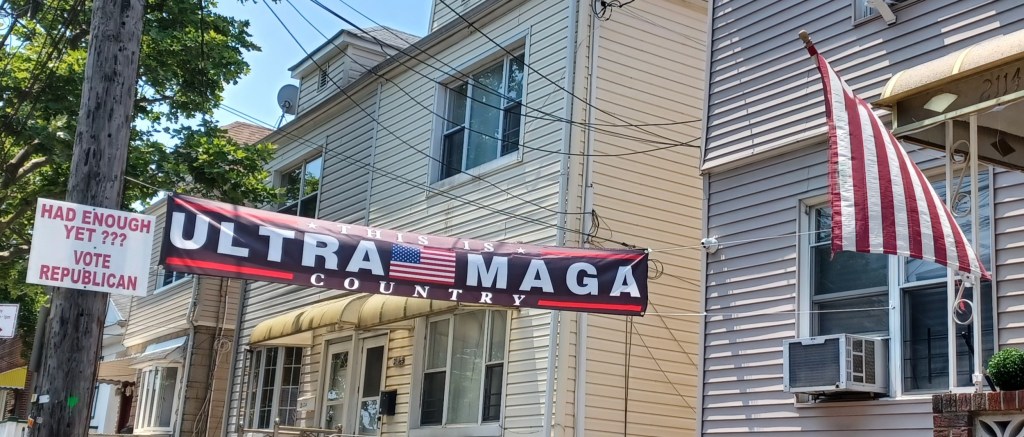
Such political displays were unimaginable in 2016 or even in 2020 in this ethnically diverse section of Brooklyn. I don’t know the ethnicity or race or religion of the person who raised these banners, but I do know that many people are hurting in this traditionally Democrat city. They feel disillusioned, disenfranshised and taken for granted. With the Democrats in full retreat among blue collar workers and losing ground among blacks and Latinos, there are some who believe that Trump is still an ‘outsider’, someone who projects strength in an uncertain and changing world.
The last time any Republican made major inroads in NYC was Giuliani, who became Mayor in the wake of a horrendous crime wave in the 1980s and early 1990s. (Michael Bloomberg ran as both a Republican and Independent, with much Democrat support, and was elected to three consecutive terms thereafter.) Nothing today can remotely compare with the violence of that era. This city registered over 2000+ murders per year between 1987 and 1994, reaching a peak of 2,262 murders in 1990. But even that Rudy would have been considered a RINO by today’s MAGA Republican standards.
Still, it’s worth reflecting on what this neighborhood was like 40 years ago. As I wrote back in April 2023:
In the early-to-mid-1980s, our Gravesend section of Brooklyn was far less integrated than it is now, populated predominantly by whites of Italian and Southern European descent.
As Wikipedia reports, back in 1982, African-American “transit worker Willie Turks was beaten to death in Gravesend by a group of white teenagers.” On Christmas Day 1987, “white youths beat two black men in the neighborhood in an apparent ‘unprovoked attack’,” which led to protests in January 1988 by the Reverend Al Sharpton, who “led 450 marchers between Marlboro Houses and a police station, and were met with chants of ‘go back to Africa’ and various racial epithets from a predominantly white crowd.” In 1989, in the wake of the murder of Yusef Hawkins, black protestors were welcomed to the neighborhood by whites who held up watermelons, while hurling obscenities and bricks at the demonstrators.
Displays of this kind of bigotry hit home. My sister, Elizabeth Sciabarra, was a gifted and beloved educator who also coached the cheering squad and dance team of Brooklyn Technical High School. She later became Principal at New Dorp High School on Staten Island; in fact, Nicole Maliotakis was a former student of my sister’s. Elizabeth would go on to become a Deputy Superintendent, and a Superintendent and founding CEO of the Office of Student Enrollment at the NYC Department of Education. After her retirement, she became Executive Director of the Brooklyn Tech Alumni Foundation.
In her capacity as a teacher and coach, she developed very close relationships with her students, whom she uplifted and inspired. On one Saturday afternoon, she invited a group of African American cheering squad members to our apartment. We could see that a few young Italian guys (“gavones” to those in-the-know) who lived on the block were visibly annoyed by the presence of black kids in our neighborhood.
On Sunday morning, when I went out to pick up the newspaper, I discovered that all the windows of my sister’s car had been splattered. We didn’t have surveillance video back then, but we both knew who did it. And when I walked up to our apartment and told my sister what had happened, she could not be contained. She looked out the window, saw the guy whom we knew was the culprit, and stormed down the stairs, barreling toward him. A crowd gathered as she screamed at him, accusing him of breaking her car windows. He told her to go away, or she’d get hurt. He said he “knew people” and that she should back off. “I know people too!” she shouted. “And they’re gonna break your f&cking legs if you touch my car again!” Yeah, this is Brooklyn.
The crowd fell silent as we marched back up the stairs. And those black kids returned to our home many times thereafter. And nobody ever touched our car again. But that’s the kind of illiberal environment we lived in for a period. Bigoted, exclusionary, and intolerant of difference.
An old neighbor, whom I saw recently after many years, told me that this is why he left Brooklyn three decades ago. He found the outer boroughs too ‘parochial’ for his tastes. He now lives comfortably in Manhattan and once again repeated the charge that Brooklyn is bigoted—as if Brooklyn has a monopoly on bigotry, as if this were the same neighborhood from the 1980s.
But this isn’t the same neighborhood. My block alone has become an integrated melting pot of Italians, Greeks, Jews, Irish, Russian, Georgian, Turkish, Ukrainian, Latino, African American, Middle Eastern, and Asian peoples, and we all look out for one another.
As a ‘progressive’ Democrat, my old neighbor wasn’t convinced. His diatribes reminded me of those disconnected members of the New York City Council, who decided unanimously that it was time to remove the nineteenth century statue of the slave-owning Thomas Jefferson from the council chamber. They’ve taken years to even begin addressing the city’s high taxes and its restrictive zoning regulations, which haven’t been updated since 1961, inhibiting the growth of urban businesses. They can’t even begin to address the labyrinth of zoning restrictions that inhibit the growth of affordable housing. But hey, at least that beast Thomas Jefferson is no longer peering out over our lawmakers! We get things done here!
My old neighbor told me that Trump is a symptom of a larger problem. “The problem,” he said, is that “Americans are stupid.”
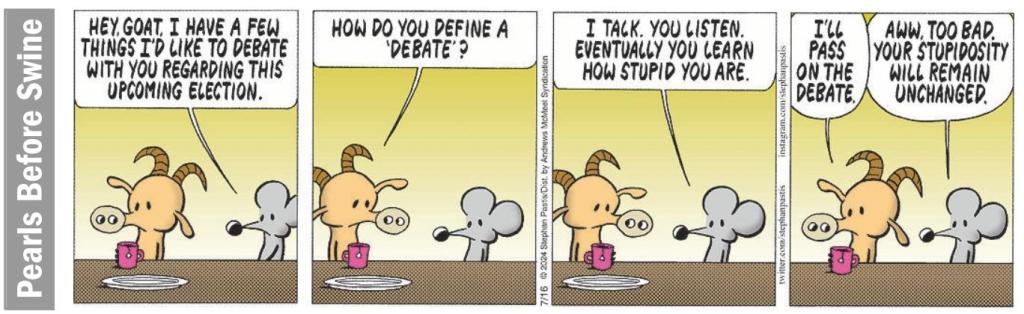
No doubt, there are many Americans who are not as enlightened as he is.
But “the problem” can’t be chalked up to mere “stupidity.” It can’t even be chalked up to a singular class of “deplorables” who constitute the MAGA movement—and I say this as someone who has been a long-time critic of Donald Trump. There is a reason why some people are disgusted with the Democratic complacency in this city and why banners like the one depicted above are showing up in various ethnically diverse neighborhoods, not just those in Republican-leaning Staten Island, with its nearly 56% non-Hispanic white population.
But with Trump as the GOP nominee and the Walking Dead Joe Biden as the presumptive nominee of the Democratic Party (barring his replacement at that party’s convention next month), I am appalled by the state of this race. It’s bad enough that we are in a rinse and repeat cycle that has disenchanted millions of voters across this country and that we continue to bracket out any fundamental alternatives to the status quo that challenge the two-party oligopoly and the system they represent.
The problem is indeed systemic, and it goes way beyond the battle for New York. Prompted by David Brooks’s article, I’ll discuss key aspects of the problem in tomorrow’s post.

 Notablog