On this date in 1930, psychotherapist and writer Nathaniel Branden was born. Back on December 3, 2014, upon his death, I wrote a heartfelt tribute to him: “Nathaniel Branden: Love and Friendship Eternal.” The generosity and support that he showed me and my family during some of our most difficult days is something I will never forget. He was a kind, humane and brilliant counselor, and a caring, loving friend.
I was first exposed to Nathaniel’s writings in my encounter with the nonfiction works of Ayn Rand. His pioneering exploration of the nature of self-esteem and its centrality to the project of human freedom and personal flourishing was both insightful and inspiring. And in the aftermath of his departure from the Objectivist movement, his eclectic therapeutic strategies were enormously helpful to countless numbers of individuals, who sought guidance for a life of authenticity and interpersonal visibility.
In later years, on the urging of Barbara Branden—another very dear friend—Nathaniel read a draft of my book, Ayn Rand: The Russian Radical, and made wonderful suggestions along the way. We spent countless hours on the phone and later met in New York City. Eventually, he made his way to Brooklyn with his then-wife Devers (who also became a cherished friend), and I took them for my celebrated tour of the borough. (And yes, they sampled everything from Nathan’s Hot Dogs to the Sicilian slices of L&B Spumoni Gardens!) In 1999, my sister and I joined them both at their Beverly Hills home for a delightful evening.
Long before Nathaniel died, I told him that The Journal of Ayn Rand Studies would publish a symposium dedicated to his work. Sadly, he never lived to see its publication in 2016. That 300-page double-issue, co-edited by Robert L. Campbell and me, was the first anthology to assess Branden’s contributions. “Nathaniel Branden: His Work and Legacy” (still available as a Kindle edition) featured sixteen contributors, including writers in academic and clinical psychology, who offered personal reflections and critical studies of Branden’s corpus.
I honor Nathaniel’s memory. I loved him and miss him very much.
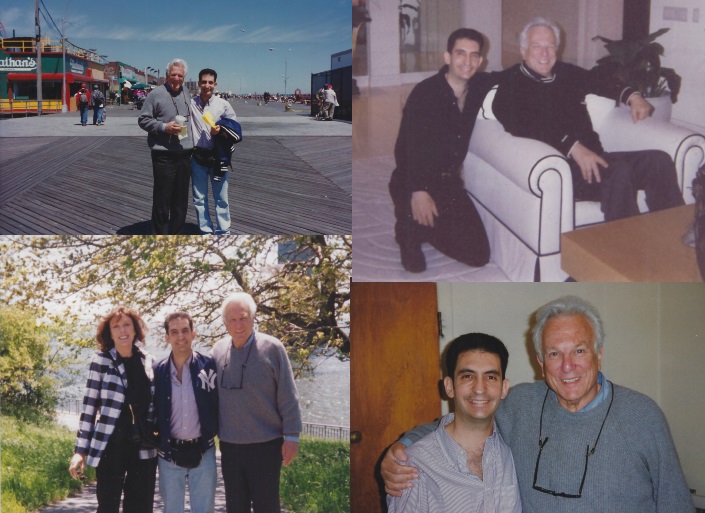
Below are a few photos to mark today’s anniversary. Clockwise from the top left: Nathaniel and I were on the Boardwalk in Coney Island; together in Beverly Hills; in my Brooklyn apartment; and with Devers, in the shadow of the Verrazzano-Narrows Bridge.
Postscript: In the Facebook discussion that followed this post, I added the following points:
Many folks remember his years with the Objectivist movement, when he was a stern gatekeeper. Others are still fighting over the schism of 1968. My exposure to him as a writer and dear friend was far removed from those years. And my experiences with him were far from unique. I discovered his work when I was 17. As a senior in high school, the first book of Rand’s that I read was Capitalism: The Unknown Ideal, and Branden’s essays were some of the most illuminating in the volume, including his discussion of “Alienation” (upon which he expanded in The Disowned Self).
I had the occasion to comment on several of his books in manuscript in the 1990s and 2000s, and I always told him that his approach had become even more profoundly dialectical over the years, insofar as it stressed the fuller context of process and system.
One could find this even in his attempts to redress the balance of reason and emotion from his earlier work. The Disowned Self emphasized the importance of never disowning one’s emotions. While Rand certainly recognized the integration of reason and emotion, Branden stressed that not only was it important to think in order to feel, but it was necessary to “feel deeply … to think clearly,” rejecting any “notion that thinking and feeling are opposed functions and that each entails the denial of the other.” His work is chock-full of important insights.
There’s a reason why Branden is considered “the father of the self-esteem movement”—except his own deeply philosophical and psychological exploration of self-esteem is far ahead of any of the fad-like books commonly associated with the topic. The Six Pillars of Self-Esteem is an outstanding example of his wider, evolving corpus.

 Notablog